

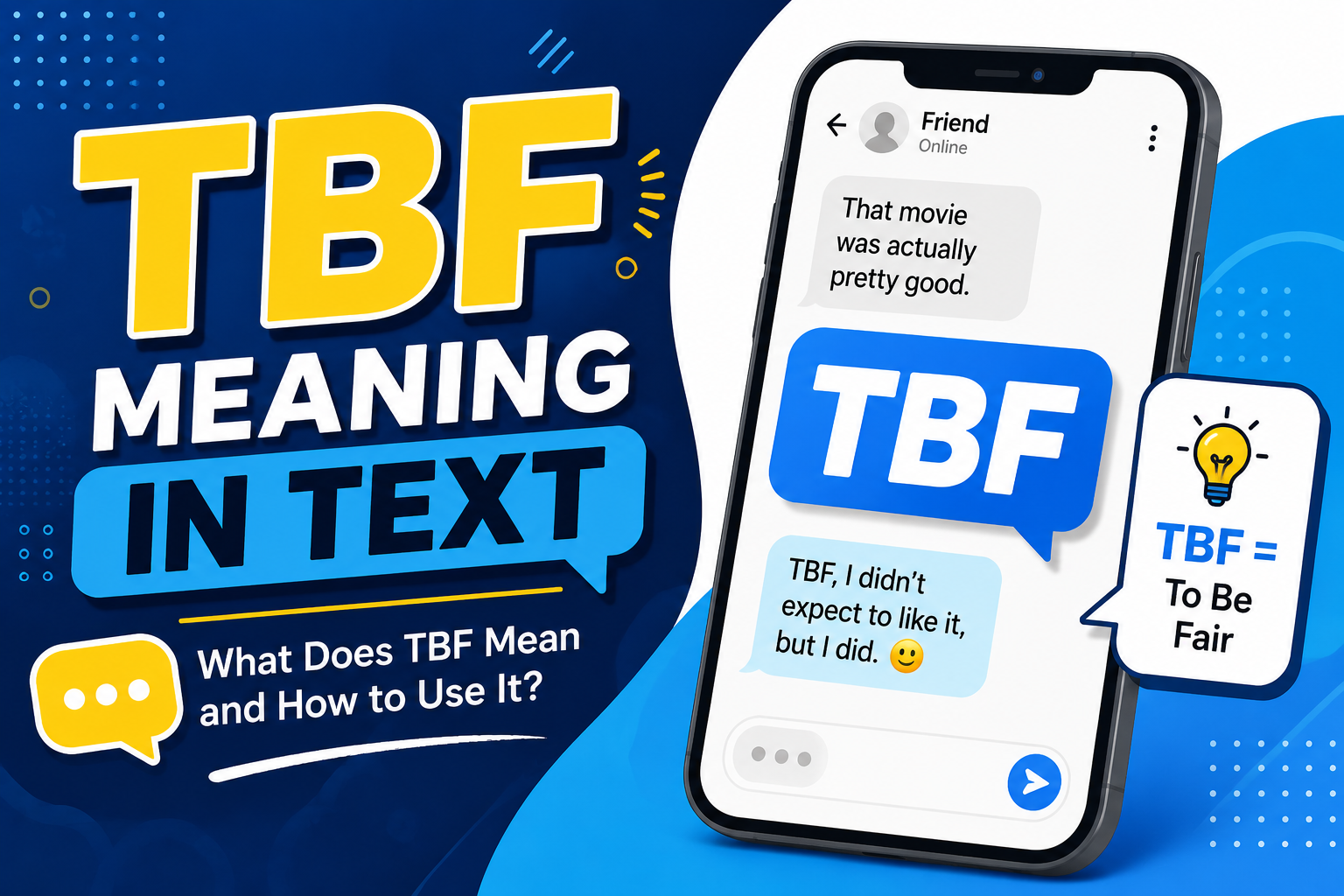
If you have ever received a message containing “TBF,” you may have wondered what these three letters mean. TBF is a common abbreviation used in text messages, social media, online chats, and casual conversations.
So, what does TBF mean in text?
TBF usually stands for “to be fair.” People use it when they want to acknowledge another person’s point, add balance to an argument, provide context, or make a statement more reasonable.
For example:
“TBF, she did warn us.”
This means:
“To be fair, she did warn us.”
TBF is often used when someone wants to recognize that a situation is not completely one-sided. It can soften criticism, introduce a different perspective, or acknowledge something positive about a person or situation.
In this complete guide, you’ll learn the TBF meaning in text, what TBF stands for, how it is used on Snapchat, Instagram, TikTok, and other platforms, what it means in relationships, how to respond to TBF, and plenty of examples.
What Does TBF Mean in Text?
TBF means “to be fair.”
It is commonly used to introduce a statement that adds fairness, balance, or another perspective to a conversation.
For example:
“TBF, he didn’t know about the change.”
The sender is saying:
“To be fair, he didn’t know about the change.”
TBF can be used when agreeing with someone while also pointing out another side of the situation.
Quick Reference Table
| Abbreviation | Full Form | Meaning | Example |
|---|---|---|---|
| TBF | To Be Fair | Acknowledging another perspective | “TBF, you had a point.” |
| TBF | To Be Fair | Adding context | “TBF, nobody told him.” |
| TBF | To Be Fair | Softening criticism | “TBF, she tried.” |
| TBF | To Be Fair | Giving credit | “TBF, he did a good job.” |
What Does TBF Stand For?
TBF stands for “To Be Fair.”
The phrase is used when someone wants to make a balanced or reasonable observation.
For example:
“I don’t like the movie, but TBF, the acting was good.”
The speaker still dislikes the movie, but they are acknowledging something positive.
This makes TBF particularly useful when discussing opinions, arguments, mistakes, or disagreements.
TBF Meaning in Everyday Texting
In everyday texting, TBF is usually a quick way to say:
- “To be fair”
- “That’s fair”
- “If we’re being fair”
- “To give them credit”
- “Looking at the other side”
For example:
“TBF, you did tell me beforehand.”
The sender acknowledges that the other person had already given a warning.
Another example:
“TBF, it wasn’t entirely his fault.”
Here, TBF introduces a more balanced interpretation.
Common TBF Text Examples
Example 1
“TBF, she was right.”
Meaning: “To be fair, she was right.”
Example 2
“TBF, you never asked.”
Meaning: “To be fair, you never asked.”
Example 3
“TBF, he did apologize.”
Meaning: “To be fair, he did apologize.”
Example 4
“TBF, the food wasn’t that bad.”
Meaning: “To be fair, the food wasn’t that bad.”
Example 5
“TBF, I would’ve done the same thing.”
Meaning: “To be fair, I probably would’ve done the same thing.”
TBF Meaning on Snapchat
On Snapchat, TBF usually means “to be fair.”
It can be used in chats, replies, captions, and group conversations.
For example:
“TBF, that was actually funny 😂.”
The sender is acknowledging that something they may have criticized was actually funny.
Another example:
“TBF you did warn me.”
This means:
“To be fair, you did warn me.”
Because Snapchat communication is usually casual, TBF is a convenient way to make a quick point.
TBF Meaning on Instagram
On Instagram, TBF is commonly used in:
- Direct messages
- Comments
- Reels
- Story replies
- Group chats
For example:
“TBF, this is actually a good idea.”
The person is giving credit to an idea they may not have initially supported.
Another example:
“TBF, everyone was confused.”
This provides context rather than simply blaming one person.
TBF Meaning on TikTok
On TikTok, TBF can appear in comments, captions, and conversations.
For example:
“TBF, the original video was better.”
This means:
“To be fair, the original video was better.”
Another example:
“TBF he had no idea what was happening 😂.”
The commenter is providing additional context for someone’s behavior.
TBF is especially useful when responding to debates or arguments in comment sections.
TBF Meaning on Facebook
On Facebook, TBF can be used in comments and Messenger conversations.
For example:
“TBF, they did explain the situation.”
The writer is acknowledging another side of the issue.
Another example:
“TBF, that was a pretty good deal.”
Here, the writer is giving credit where they believe it is deserved.
TBF Meaning on Twitter/X
TBF is frequently used on Twitter/X when people discuss:
- News
- Sports
- Entertainment
- Public debates
- Viral posts
- Opinions
- Arguments
For example:
“TBF, he made a good point.”
This means:
“To be fair, he made a good point.”
Another example:
“TBF, nobody expected that outcome.”
The writer is adding context to the situation.
TBF Meaning in Relationships
In relationships, TBF is often used when someone wants to acknowledge their partner’s perspective or make an argument more balanced.
For example:
“TBF, you did tell me you were busy.”
This could mean:
“To be fair, you did tell me you were busy.”
Another example:
“TBF, I was also being difficult.”
Here, the speaker is taking some responsibility instead of blaming the other person entirely.
TBF in Romantic Texting
TBF can actually be useful during disagreements because it allows someone to recognize the other person’s side.
For example:
“I was upset, but TBF, you had a lot going on.”
This means:
“I was upset, but to be fair, I understand that you were dealing with a lot.”
The abbreviation itself is not romantic, but it can help make a conversation sound more balanced.
TBF Meaning From a Girl
If a girl texts you “TBF,” it normally means “to be fair.”
For example:
“TBF, you did tell me.”
She may be acknowledging that you were right about something.
Another example:
“TBF, I overreacted.”
This means:
“To be fair, I realize that I overreacted.”
There is no special female-specific meaning for TBF.
TBF Meaning From a Guy
If a guy sends you “TBF,” it generally means the same thing:
“To be fair.”
For example:
“TBF, that wasn’t your fault.”
The person is trying to provide a fair assessment of the situation.
There is no special male-specific meaning associated with TBF.
TBF Meaning in a Group Chat
TBF is particularly useful in group chats when people are discussing different sides of an issue.
For example:
Alex: “Why did Sam leave early?”
Jordan: “He should’ve stayed.”
Taylor: “TBF, he had work in the morning.”
Taylor is providing another perspective.
Another example:
“TBF, everyone forgot about the deadline.”
Instead of blaming one person, the speaker acknowledges that multiple people were responsible.
Is TBF Rude?
No, TBF is not inherently rude.
In fact, it often makes a statement sound more balanced and reasonable.
However, the tone can depend on what comes after it.
For example:
“TBF, you weren’t listening.”
This could sound critical.
But:
“TBF, you had a good point.”
sounds supportive.
Therefore, TBF itself is neutral. The surrounding message determines whether it sounds friendly, critical, sarcastic, or dismissive.
Is TBF a Bad Word?
No. TBF is not a swear word or offensive expression.
It simply stands for “to be fair.”
It can be used in casual texting and, unlike many slang abbreviations, is generally understandable in workplace communication as well.
However, spelling out the phrase may be preferable in very formal writing.
Is TBF an Insult?
No. TBF is not an insult.
It is usually used to introduce a balanced observation.
For example:
“TBF, you did make a mistake.”
The statement may be critical, but TBF itself is not an insult.
Can TBF Be Used Sarcastically?
Yes.
Like many expressions, TBF can be used sarcastically.
For example:
“TBF, he only broke three things.”
Depending on the context, the speaker may actually be criticizing the person rather than genuinely defending them.
Another example:
“TBF, she was only two hours late 😂.”
The humor comes from exaggerating what is supposedly a “fair” defense.
TBF vs. TBH
TBF and TBH are sometimes confused because both are common texting abbreviations.
TBF = To Be Fair
TBH = To Be Honest
Compare:
“TBF, you did warn me.”
The speaker is acknowledging another perspective.
“TBH, I didn’t like it.”
The speaker is giving an honest opinion.
Quick Comparison
| Abbreviation | Meaning | Main Purpose |
| TBF | To Be Fair | Add balance or context |
| TBH | To Be Honest | Express honesty |
| IMO | In My Opinion | Give an opinion |
| IMHO | In My Humble Opinion | Give an opinion |
| FWIW | For What It’s Worth | Add a perspective |
| FYI | For Your Information | Provide information |
TBF vs. FWIW
TBF means “to be fair.”
FWIW means “for what it’s worth.”
They can sometimes appear in similar conversations, but their functions are different.
Example:
“TBF, he did try.”
The speaker is giving someone credit.
Example:
“FWIW, I think his idea could work.”
The speaker is offering an opinion.
What Does “TBF 😂” Mean?
“TBF 😂” usually means the person is making a fair or balanced observation in a humorous way.
For example:
“TBF 😂 that was actually pretty funny.”
The person may have initially disliked something but is admitting that it was funny.
The laughing emoji makes the statement feel more casual.
What Does “TBF You’re Right” Mean?
“TBF, you’re right.”
means:
“To be fair, you’re right.”
The person is acknowledging that the other person’s argument or opinion is valid.
This phrase is often used when someone changes their position slightly or recognizes another person’s point.
What Does “TBF I Agree” Mean?
“TBF, I agree.”
means:
“To be fair, I agree.”
It can be used when someone wants to acknowledge agreement after initially taking another position.
For example:
“I wasn’t convinced at first, but TBF, I agree with you.”
What Does “TBF Though” Mean?
“TBF though…”
means:
“To be fair, though…”
It usually introduces a counterpoint.
For example:
“The movie was too long. TBF though, the ending was really good.”
The speaker is acknowledging a positive aspect despite an overall criticism.
How to Respond to TBF
Your response depends on what the person is saying.
If You Agree
“Yeah, that’s fair.”
If They Defend You
“Exactly!”
If They Admit You’re Right
“I appreciate that 😂.”
If You Disagree
“I see your point, but I still disagree.”
If They’re Being Sarcastic
“Lol, that’s one way to put it 😂.”
When Should You Use TBF?
TBF is appropriate in many casual situations.
You can use it when:
- Discussing an argument
- Giving someone credit
- Acknowledging another perspective
- Admitting someone has a point
- Softening criticism
- Adding context
- Correcting an unfair assumption
For example:
“TBF, she wasn’t told about the change.”
This prevents the statement from unfairly blaming her.
Can You Use TBF at Work?
Yes, TBF can be understood in workplace communication, especially in informal chats.
For example:
“TBF, the team wasn’t given enough time.”
However, in a formal email or report, writing:
“To be fair, the team was not given enough time.”
may be more appropriate.
The level of formality should match your workplace and audience.
Common TBF Texting Examples
Example 1: Giving Credit
“TBF, he did a great job.”
Meaning: “To be fair, he did a great job.”
Example 2: Defending Someone
“TBF, nobody told her.”
Meaning: “To be fair, nobody gave her the information.”
Example 3: Admitting Someone Is Right
“TBF, you’re right.”
Meaning: “To be fair, you are right.”
Example 4: Relationship
“TBF, I was being unreasonable.”
Meaning: “To be fair, I recognize that I was being unreasonable.”
Example 5: Friends
“TBF, you did warn me.”
Meaning: “To be fair, you did warn me.”
Example 6: Social Media
“TBF, that comment was actually funny 😂.”
Meaning: “To be fair, that comment really was funny.”
Example 7: Debate
“TBF, both sides have a point.”
Meaning: “To be fair, both sides have reasonable arguments.”
Example 8: Self-Reflection
“TBF, I could’ve handled it better.”
Meaning: “To be fair, I admit that I could have handled the situation better.”
Common Mistakes When Using TBF
Mistake 1: Thinking TBF Means “To Be Frank”
TBF most commonly means “to be fair.”
“TBH” is the more common abbreviation for “to be honest.”
Mistake 2: Assuming TBF Means Agreement
TBF does not necessarily mean the sender agrees with everything being discussed.
It simply introduces a fair or balancing point.
Mistake 3: Assuming TBF Is Always Positive
TBF can introduce criticism as well.
For example:
“TBF, you should have checked first.”
Mistake 4: Using TBF Without Context
Because abbreviations can have multiple meanings, the surrounding conversation is important.
FAQs
What does TBF mean in text?
TBF usually means “to be fair.” It is used to acknowledge another perspective, provide context, give credit, or make a statement more balanced.
What does TBF stand for?
TBF stands for “to be fair.”
Is TBF a bad word?
No. TBF is not profanity or an offensive expression.
Is TBF rude?
No. TBF is generally neutral and often makes a statement sound more balanced. However, the rest of the message can make it sound critical or sarcastic.
What does TBF mean from a girl?
It normally means “to be fair.” There is no special romantic or female-specific meaning.
What does TBF mean from a guy?
It generally means “to be fair.” The context determines the specific message.
What does TBF mean on Snapchat?
On Snapchat, TBF usually means “to be fair” and is used to add context, acknowledge a point, or give someone credit.
What does TBF mean on Instagram?
On Instagram, TBF generally means “to be fair.” It can appear in comments, DMs, captions, and story replies.
What does TBF mean on TikTok?
On TikTok, TBF is commonly used in comments and discussions to introduce a counterpoint or acknowledge another side of an issue.
What does TBF mean in a relationship?
In relationships, TBF can be used to acknowledge your partner’s perspective or admit that they have a valid point.
What is the difference between TBF and TBH?
TBF means “to be fair,” while TBH means “to be honest.” TBF adds balance or context; TBH introduces an honest opinion or statement.
What is the difference between TBF and FYI?
TBF means “to be fair,” while FYI means “for your information.” TBF adds a balanced perspective, while FYI provides information.
Can TBF be sarcastic?
Yes. TBF can be used sarcastically depending on the situation and tone.
Can TBF be used professionally?
Yes, especially in informal workplace chats. For highly formal writing, spelling out “to be fair” may be more appropriate.
What should I reply to TBF?
You can respond with “That’s fair,” “I agree,” “Exactly,” or explain your own perspective if you disagree.
Final Thoughts
So, what does TBF mean in text?
TBF usually stands for “to be fair.” It is a popular texting and internet abbreviation used when someone wants to acknowledge another perspective, add context, give credit, soften criticism, or make an argument more balanced.
For example:
“TBF, you did warn me.”
means:
“To be fair, you did warn me.”
TBF is especially useful during disagreements because it allows someone to recognize that another person may have a valid point.
The abbreviation is common in text messages, group chats, Snapchat, Instagram, TikTok, Facebook, Twitter/X, and other online conversations.
It is not inherently rude, offensive, or romantic. However, the tone can change depending on the words that follow it.
Quick Summary
- TBF = To Be Fair
- It is used to add balance, context, or another perspective.
- TBF can be used to give someone credit.
- It can soften criticism or acknowledge that someone has a point.
- TBF 😂 often has a playful tone.
- TBF is different from TBH, which means “to be honest.”
- TBF is not a swear word.
- It does not have a special romantic meaning.
- It can be used in casual workplace chats, although formal writing may favor the full phrase.
- The meaning is usually clear from the surrounding context.
In short, when someone writes “TBF,” they are usually saying “to be fair” and introducing a point that makes the conversation more balanced or reasonable.