

If you are exploring undergraduate courses in computer science, information technology, or software development, you may have come across the term BCA. But what is the BCA full form, and what does this degree actually involve?
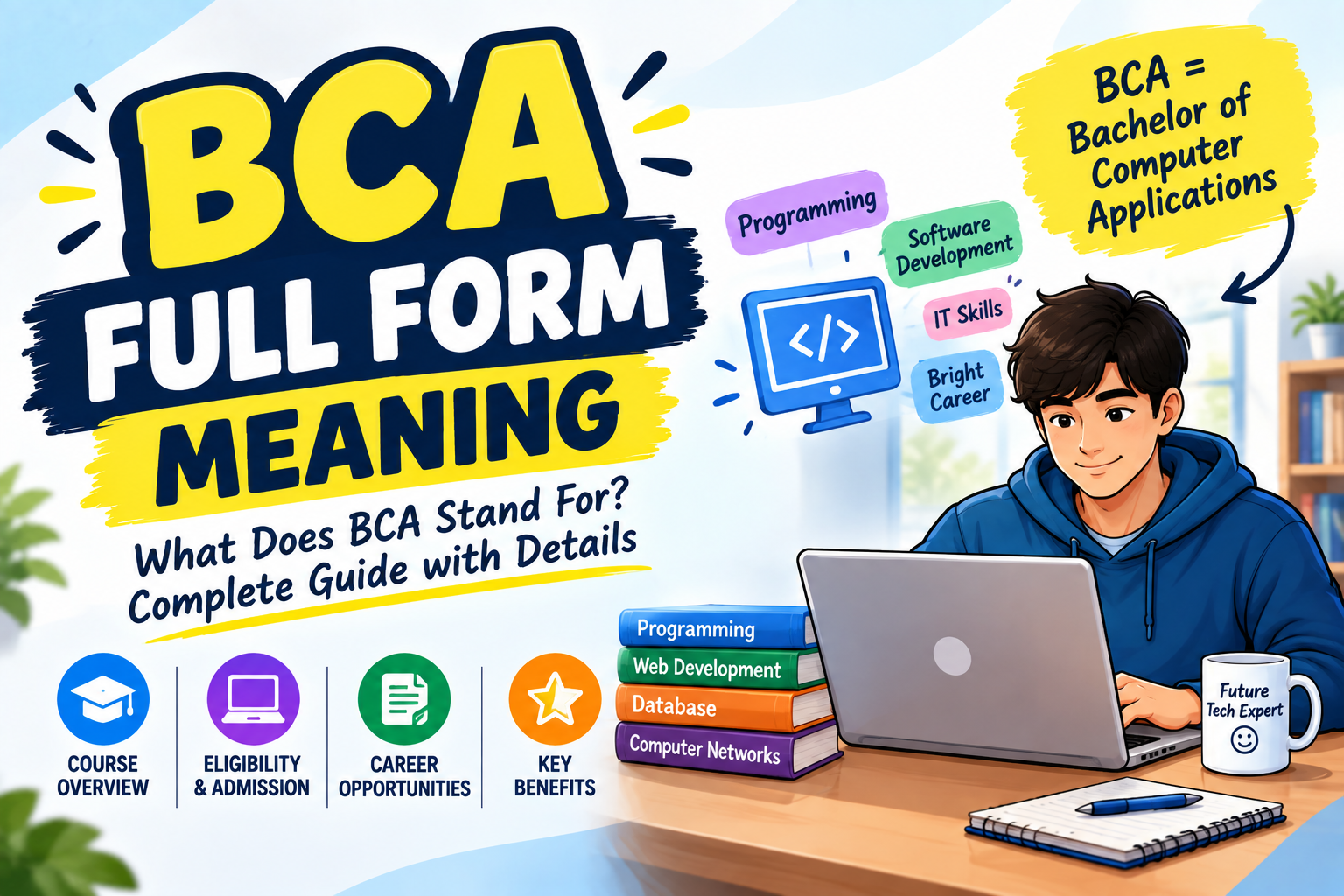
The full form of BCA is Bachelor of Computer Applications. It is an undergraduate degree program focused on computer applications, software development, programming, databases, networking, web development, and other areas of information technology.
BCA is a popular choice for students who want to build a career in the technology industry without necessarily pursuing an engineering degree such as B.Tech or BE.
Depending on the university and country, the course structure, duration, eligibility requirements, and subjects can vary. In many institutions, BCA is offered as a three-year undergraduate program, although some universities may follow different structures.
This guide explains the BCA full form and meaning, course duration, eligibility, subjects, admission process, specializations, career opportunities, salary expectations, advantages and disadvantages, and frequently asked questions.
What Is the Full Form of BCA?
BCA stands for Bachelor of Computer Applications.
It is an undergraduate academic degree designed to teach students about computer applications and information technology.
BCA Full Form at a Glance
| Term | Details |
|---|---|
| BCA Full Form | Bachelor of Computer Applications |
| Degree Type | Undergraduate |
| Main Field | Computer Applications & Information Technology |
| Typical Duration | 3 years |
| Study Mode | Full-time, part-time, or online depending on institution |
| Major Subjects | Programming, databases, networking, web development, software engineering |
| Eligibility | Usually completion of higher secondary education |
| Career Areas | Software, IT, web development, databases, support, cybersecurity, etc. |
The exact curriculum and admission requirements depend on the university offering the BCA program.
What Does BCA Mean?
BCA means Bachelor of Computer Applications, a degree focused on using computers and information technology to develop, manage, and maintain software applications and digital systems.
Unlike programs that focus heavily on hardware or advanced engineering concepts, BCA commonly emphasizes practical computer applications and software-related skills.
Students may learn programming languages, database management, operating systems, web technologies, networking, software development, and other IT concepts.
The degree can provide a foundation for entry-level technology jobs or further education.
BCA Course Duration
The duration of a BCA course depends on the institution and academic system.
A traditional BCA program is commonly structured as a three-year undergraduate degree, often divided into six semesters.
For example:
| Year | Typical Focus |
|---|---|
| First Year | Programming fundamentals, mathematics, computer basics |
| Second Year | Databases, data structures, operating systems, networking |
| Third Year | Software engineering, advanced programming, projects, specialization |
Some universities may use different semester structures or offer four-year versions of undergraduate programs.
Students should check the official curriculum of the institution they plan to attend.
BCA Eligibility Criteria
Eligibility requirements vary between universities.
Common requirements may include:
- Completion of higher secondary education or equivalent
- Meeting the minimum required percentage
- Meeting subject requirements specified by the institution
- Passing an entrance examination, where applicable
- Meeting the university’s age or admission requirements, if applicable
Some institutions may require students to have studied mathematics or computer science, while others may accept students from a wider range of academic backgrounds.
Is Mathematics Required for BCA?
It depends on the university.
Some colleges require mathematics or a related subject at the higher-secondary level, while others do not.
Therefore, students should check the specific eligibility rules of the university before applying.
BCA Admission Process
The BCA admission process varies by institution.
A typical process may include:
- Check eligibility requirements.
- Complete the application form.
- Submit academic documents.
- Take an entrance examination if required.
- Participate in a merit-based selection process or interview, if applicable.
- Receive an admission offer.
- Pay the required fees and complete enrollment.
Some institutions offer admission based primarily on previous academic performance, while others may conduct entrance tests.
BCA Subjects
The exact BCA syllabus varies from one university to another, but students commonly study a combination of programming, computer science, mathematics, databases, networking, and software development.
Common BCA Subjects
Some common subjects include:
- Computer Fundamentals
- Programming in C
- C++
- Java
- Python
- Data Structures
- Database Management Systems
- Operating Systems
- Computer Networks
- Web Development
- Software Engineering
- Computer Architecture
- Object-Oriented Programming
- Mathematics
- Data Communication
- Cybersecurity fundamentals
- Cloud computing
- Mobile application development
- Project management
Not every BCA program includes all of these subjects.
BCA First-Year Subjects
The first year generally introduces students to basic computer concepts and programming.
Typical subjects may include:
- Computer Fundamentals
- Programming Fundamentals
- C Programming
- Mathematics
- Digital Electronics
- Communication Skills
- Basic Web Technologies
- Computer Organization
The purpose of the first year is usually to establish a strong foundation before students move into more advanced topics.
BCA Second-Year Subjects
The second year often introduces more specialized computer science concepts.
Common subjects may include:
- Data Structures
- Database Management Systems
- Object-Oriented Programming
- Operating Systems
- Computer Networks
- Software Engineering
- Java or another programming language
- Web Development
Students may also begin working on practical programming projects.
BCA Third-Year Subjects
The final year often focuses on advanced concepts and practical application.
Depending on the university, subjects may include:
- Advanced Database Systems
- Software Engineering
- Mobile Application Development
- Cloud Computing
- Cybersecurity
- Artificial Intelligence fundamentals
- Data Analytics
- Advanced Web Development
- Project Work
Many programs also require students to complete a final-year project.
BCA Specializations
Some universities offer specialized BCA programs or allow students to choose electives in particular areas.
Possible areas include:
BCA in Data Science
This specialization may focus on:
- Statistics
- Data analysis
- Python
- Machine learning
- Data visualization
- Databases
BCA in Artificial Intelligence
Students may study:
- Machine learning
- Artificial intelligence
- Python
- Neural networks
- Data processing
- AI applications
BCA in Cybersecurity
This area may cover:
- Network security
- Information security
- Ethical security practices
- Cryptography
- Cybersecurity fundamentals
- Risk management
BCA in Web Development
Students may focus on:
- HTML
- CSS
- JavaScript
- Front-end development
- Back-end development
- Databases
- Web application development
BCA in Cloud Computing
This area may introduce:
- Cloud platforms
- Virtualization
- Cloud architecture
- Storage
- Networking
- Cloud-based applications
The availability of these specializations depends on the institution.
Skills You Can Develop During BCA
A BCA program can help students develop both technical and professional skills.
Technical Skills
Students may develop skills in:
- Programming
- Database management
- Web development
- Software development
- Networking
- Operating systems
- Data structures
- Application development
- Problem-solving
- Basic cybersecurity
Professional Skills
Students may also develop:
- Communication
- Teamwork
- Project management
- Logical thinking
- Presentation skills
- Research skills
- Time management
These skills can be useful when applying for internships and entry-level IT positions.
Career Opportunities After BCA
BCA graduates can pursue careers in several areas of information technology.
Some possible career paths include:
- Software Developer
- Web Developer
- Front-End Developer
- Back-End Developer
- Full-Stack Developer
- Database Administrator
- System Administrator
- IT Support Specialist
- Software Tester
- QA Analyst
- Network Support Specialist
- Junior Data Analyst
- Cybersecurity Analyst
- Application Support Analyst
- Technical Support Specialist
The actual job title and requirements depend on the employer, candidate’s skills, experience, and location.
BCA Jobs for Freshers
Fresh BCA graduates may qualify for entry-level technology positions.
Examples include:
Junior Software Developer
A junior developer assists with building, testing, debugging, and maintaining software.
Web Developer
Web developers create and maintain websites and web applications.
Software Tester
Software testers evaluate applications to identify bugs and quality problems.
Technical Support Specialist
Technical support professionals help users troubleshoot software, hardware, and technology issues.
Junior Database Professional
Graduates with strong database skills may pursue entry-level database-related positions.
IT Support Specialist
IT support roles involve troubleshooting systems, applications, networks, and user problems.
BCA Salary
There is no single salary associated with a BCA degree.
Income depends on factors such as:
- Country
- City
- Employer
- Job role
- Technical skills
- Experience
- Industry
- Certifications
- Communication skills
- Academic background
A fresh graduate generally earns less than an experienced technology professional.
As graduates gain experience and develop in-demand skills, they may qualify for higher-paying positions.
For this reason, it is more useful to focus on developing valuable skills than relying solely on the degree title.
Is BCA a Good Career Option?
BCA can be a good option for students interested in computers, software, programming, and information technology.
It can be particularly useful for students who want an undergraduate degree that combines academic learning with practical computer applications.
However, the value of the degree depends heavily on what students do alongside their coursework.
Building practical skills through:
- Coding projects
- Internships
- Open-source contributions
- Certifications
- Freelance work
- Portfolio projects
- Technical competitions
can improve a graduate’s career prospects.
BCA vs B.Tech
BCA and B.Tech are different undergraduate programs.
| Feature | BCA | B.Tech |
|---|---|---|
| Full Form | Bachelor of Computer Applications | Bachelor of Technology |
| Level | Undergraduate | Undergraduate |
| Common Focus | Computer applications and IT | Engineering and technology |
| Typical Duration | Often 3 years | Often 4 years |
| Programming | Strong focus | Varies by specialization |
| Engineering Content | Generally limited | More extensive |
| Career Options | IT and software-related roles | Engineering and technology roles |
Neither degree is automatically better for every student.
A student interested primarily in software and computer applications may prefer BCA, while someone seeking a broader engineering-oriented education may consider B.Tech.
BCA vs BSc Computer Science
BCA and BSc Computer Science overlap in several areas but have different academic approaches.
| Feature | BCA | BSc Computer Science |
|---|---|---|
| Full Form | Bachelor of Computer Applications | Bachelor of Science in Computer Science |
| Main Focus | Applications and IT | Computer science theory and concepts |
| Programming | Yes | Yes |
| Mathematics | Depends on curriculum | Often more prominent |
| Practical IT | Often emphasized | Depends on institution |
| Higher Studies | MCA, MSc, MBA, etc. | MSc, MCA, specialized master’s programs |
The best choice depends on the student’s career goals and the curriculum of the specific university.
Higher Studies After BCA
A BCA degree can also be a foundation for postgraduate education.
Possible options include:
MCA
MCA stands for Master of Computer Applications.
It is a popular postgraduate option for students who want to continue specializing in computer applications and IT.
MSc Computer Science
Students may also consider a master’s degree in computer science where eligible.
MBA
Students interested in technology management, business, or entrepreneurship may consider an MBA.
Specialized Master’s Programs
Depending on eligibility, graduates may pursue advanced education in areas such as:
- Data Science
- Artificial Intelligence
- Cybersecurity
- Information Technology
- Software Engineering
- Cloud Computing
Admission requirements vary by institution.
BCA for Software Development
BCA can provide a foundation for students interested in software development.
However, simply completing the degree does not automatically make someone a professional software developer.
Students should also learn practical development tools and technologies.
For example, a student interested in web development could learn:
- HTML
- CSS
- JavaScript
- Git
- Databases
- APIs
- A modern front-end framework
- Back-end development
Building several real-world projects can also help demonstrate practical ability to employers.
BCA for Web Development
BCA students interested in web development can pursue front-end, back-end, or full-stack development.
Front-End Development
Front-end developers work on the parts of websites and applications users interact with.
Common technologies include:
- HTML
- CSS
- JavaScript
- Front-end frameworks
Back-End Development
Back-end developers work on server-side functionality, databases, APIs, and application logic.
Full-Stack Development
Full-stack developers work across both front-end and back-end technologies.
BCA coursework can provide a foundation, but students generally need additional practical learning to become job-ready.
BCA for Data Science
Students interested in data science can use a BCA background as a starting point, particularly if they develop strong skills in mathematics, statistics, programming, and data analysis.
Useful skills include:
- Python
- SQL
- Statistics
- Data visualization
- Machine learning
- Data cleaning
- Problem-solving
Additional education or specialized training may be beneficial for advanced data-science positions.
BCA for Cybersecurity
Cybersecurity is another possible career direction.
Students can build foundational knowledge in:
- Networking
- Operating systems
- Security principles
- Authentication
- Access control
- Cryptography
- Security monitoring
Professional cybersecurity roles often require additional practical experience and specialized certifications or education.
Advantages of Studying BCA
BCA can offer several advantages.
1. Technology-Focused Education
Students learn concepts directly related to computers and information technology.
2. Programming Experience
Many BCA programs include multiple programming courses.
3. Career Flexibility
Graduates can explore different IT-related career paths.
4. Foundation for Higher Studies
BCA can provide a foundation for postgraduate education in technology or business, subject to admission requirements.
5. Practical Projects
Many programs include assignments and projects that allow students to apply their knowledge.
Disadvantages of BCA
BCA may not be the ideal choice for everyone.
Possible challenges include:
- Strong competition in entry-level IT jobs
- The need for continuous learning
- Some employers may prefer engineering or specialized degrees for particular positions
- Course quality varies significantly between institutions
- A degree alone may not be enough for highly technical jobs
Students should research the curriculum, faculty, facilities, accreditation, internship opportunities, and career support before selecting a program.
Who Should Choose BCA?
BCA may be suitable for students who:
- Enjoy working with computers
- Are interested in programming
- Want to enter the IT industry
- Like solving logical problems
- Want to learn software development
- Are interested in technology
- Plan to pursue higher education in computing
You don’t necessarily need to be an expert programmer before starting BCA. Basic computer familiarity and a willingness to learn are more important.
Is BCA Difficult?
The difficulty of BCA depends on the student’s background, learning style, and the university’s curriculum.
Some students may find programming and mathematics challenging initially.
However, consistent practice can make technical subjects easier.
Programming is a skill that improves through repetition. Reading theory alone is usually not enough; students should write code, solve problems, build projects, and learn from errors.
Does BCA Have Mathematics?
Many BCA programs include mathematics, but the amount varies by university.
Some curricula may include mathematical foundations, discrete mathematics, statistics, or related subjects.
Students should check the specific syllabus of the university they are considering.
Can Arts Students Do BCA?
It depends on the institution’s eligibility requirements.
Some universities accept students from different academic streams, while others require specific subjects such as mathematics or computer science.
Therefore, students from an arts background should check the admission criteria of individual universities.
Can Commerce Students Do BCA?
In many cases, commerce students may be eligible, but requirements vary.
Some institutions may require mathematics or another specific subject.
Always verify the eligibility requirements before applying.
Can BCA Students Become Software Engineers?
BCA graduates can pursue software development careers and work in software-related positions.
However, the exact job title “Software Engineer” depends on the employer and its hiring requirements.
Students should focus on developing:
- Strong programming skills
- Data structures and algorithms
- Databases
- Software development practices
- Version control
- Testing
- Projects
- Problem-solving
Practical skills can make a significant difference when applying for software jobs.
BCA Full Form in Different Contexts
Although Bachelor of Computer Applications is the most common meaning in education, BCA can have other meanings in different fields.
| BCA Meaning | Context |
|---|---|
| Bachelor of Computer Applications | Education |
| Business Continuity Analysis | Business/management |
| Building and Construction Authority | Government/industry context |
| Other organization-specific abbreviations | Various fields |
Therefore, if you encounter BCA outside an educational discussion, check the surrounding context before assuming it means Bachelor of Computer Applications.
BCA Full Form in Education
In education, BCA means Bachelor of Computer Applications.
It is an undergraduate program associated with computer applications, information technology, and software-related studies.
Students may study programming, databases, web technologies, operating systems, networking, software engineering, and other computing subjects.
BCA Full Form in Computer
When discussing computers or education, BCA generally refers to Bachelor of Computer Applications.
It is a degree rather than a computer technology itself.
For example:
“I am studying BCA.”
means:
“I am studying Bachelor of Computer Applications.”
Frequently Asked Questions About BCA
What is the full form of BCA?
The full form of BCA is Bachelor of Computer Applications.
What is BCA?
BCA is an undergraduate degree focused on computer applications, software, programming, databases, networking, and information technology.
How many years is BCA?
A traditional BCA program is commonly three years, although the duration can vary depending on the institution and academic structure.
Is BCA a graduation degree?
Yes. BCA is an undergraduate bachelor’s degree.
Is BCA good for a career in IT?
Yes, BCA can provide a foundation for various IT careers, especially when combined with practical technical skills and experience.
Can I do MCA after BCA?
In many education systems, BCA graduates can pursue MCA, subject to the postgraduate program’s eligibility requirements.
Can I get a software job after BCA?
Yes. BCA graduates can apply for various software and IT roles, although job requirements differ between employers.
Is BCA better than B.Tech?
Neither is universally better. BCA and B.Tech have different curricula, structures, and career orientations.
Is BCA difficult?
BCA can be challenging, particularly for students new to programming, mathematics, and technical subjects. Regular practice can make the coursework manageable.
Is mathematics compulsory for BCA?
Not always. Mathematics requirements vary by university.
Can arts students study BCA?
Some institutions accept arts students, while others have specific subject requirements. Check the university’s eligibility criteria.
Can commerce students do BCA?
Many institutions may accept commerce students, but eligibility varies by university and program.
What jobs can I get after BCA?
Possible roles include software developer, web developer, IT support specialist, software tester, database professional, system administrator, and other technology-related positions.
What can I study after BCA?
Depending on eligibility, students may pursue MCA, MSc Computer Science, MBA, or specialized postgraduate programs in areas such as data science, cybersecurity, AI, or IT.
What does BCA stand for?
BCA stands for Bachelor of Computer Applications.
Final Thoughts
The BCA full form is Bachelor of Computer Applications. It is an undergraduate degree designed for students interested in computers, software, programming, information technology, and digital applications.
A BCA program can introduce students to programming, databases, networking, web development, operating systems, software engineering, and other technology concepts.
After completing the degree, graduates can explore careers in software development, web development, IT support, testing, databases, networking, cybersecurity, data-related roles, and other technology fields.
However, the degree itself is only one part of building a successful technology career. Students can improve their prospects by developing practical skills, creating projects, completing internships, learning current technologies, and continuing their education.
If you enjoy technology and want to build a career in IT, BCA can be a useful undergraduate starting point.