

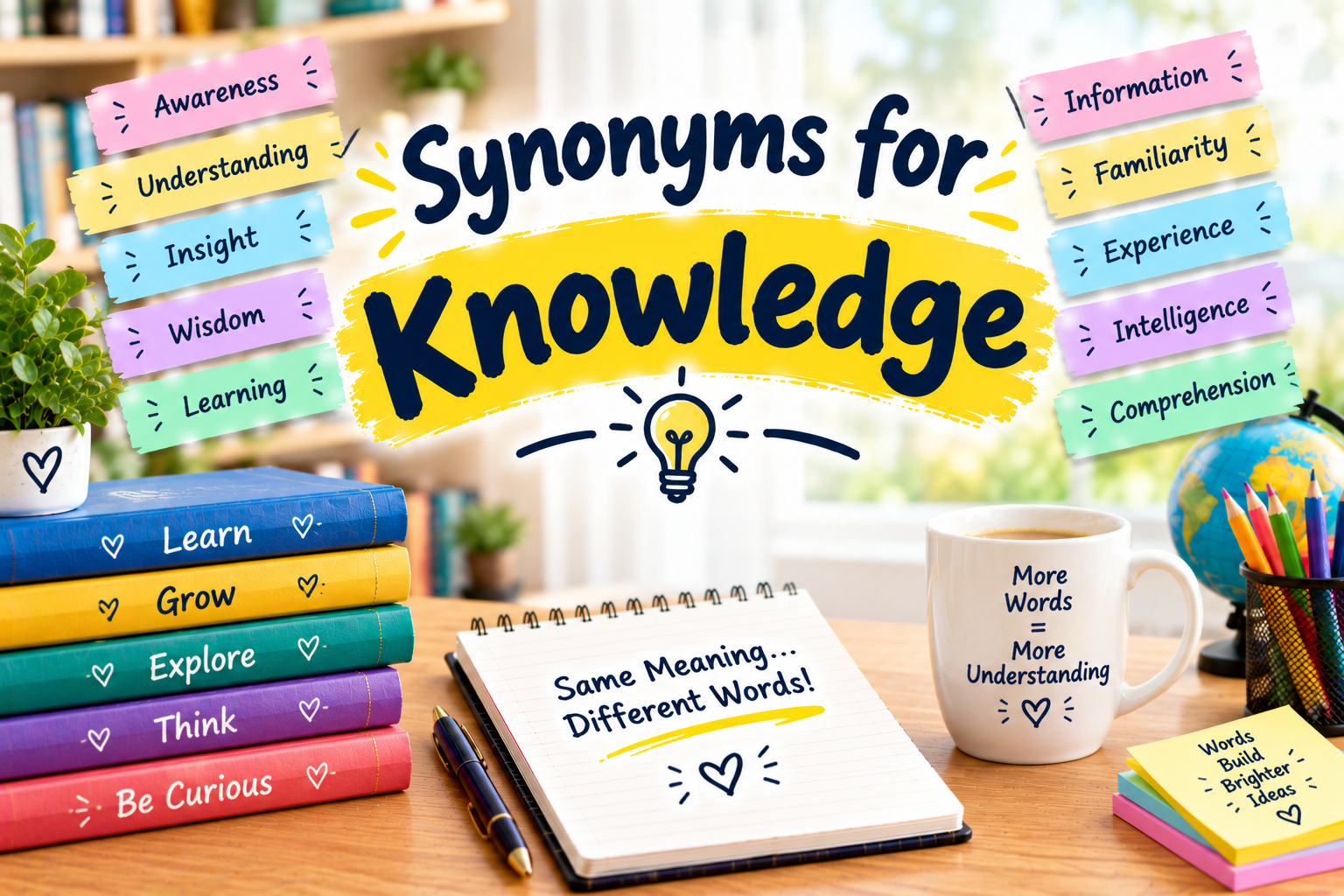
The word knowledge describes what you know or understand as a result of learning, study, observation, training, or experience. It can refer to facts about a subject, practical ability, familiarity with a topic, or a deeper understanding developed over time.
Because “knowledge” has such a broad meaning, there are many words that can be used in its place. However, not every related word means exactly the same thing. Expertise suggests advanced knowledge in a particular field, wisdom emphasizes experience and judgment, while awareness usually means knowing that something exists or is happening.
Choosing the right synonym depends on what you want to emphasize.
Whether you’re writing an essay, improving a professional resume, creating a business document, or simply looking for a more natural word, this guide provides 50+ synonyms and related alternatives for knowledge, with meanings and example sentences.
Quick List of Knowledge Synonyms
| Synonym | Meaning |
|---|---|
| Understanding | A clear grasp of an idea or subject |
| Expertise | Advanced knowledge or skill in a specific field |
| Wisdom | Knowledge combined with experience and good judgment |
| Awareness | Consciousness or recognition of something |
| Comprehension | Ability to understand something fully |
| Insight | Deep understanding of a situation |
| Learning | Knowledge gained through study or experience |
| Familiarity | Basic knowledge or acquaintance with something |
| Scholarship | Advanced academic study or learning |
| Proficiency | A good level of practical ability |
| Know-how | Practical knowledge of how to do something |
| Grasp | Understanding of a subject or concept |
| Mastery | Very high or complete command of a subject |
| Command | Strong knowledge or control of a subject |
| Education | Knowledge gained through formal or informal learning |
| Enlightenment | Deeper understanding or awareness |
| Discernment | Ability to recognize and judge differences |
| Perception | Way of understanding or interpreting something |
| Cognition | Mental process involved in knowing and understanding |
| Erudition | Extensive and advanced academic knowledge |
| Literacy | Knowledge or competence in a particular area |
| Experience | Knowledge gained by doing or encountering things |
| Background | Previous knowledge, education, and experience |
| Judgment | Ability to make sound decisions |
| Acumen | Sharp practical understanding |
| Capability | Ability supported by knowledge and skill |
| Competence | Ability to perform effectively |
| Fluency | Smooth and confident command of a subject or skill |
| Acquaintance | Limited or basic familiarity |
| Aptitude | Natural ability to learn or understand something |
| Attainment | Knowledge or achievement acquired through learning |
| Savvy | Practical understanding and good judgment |
| Faculty | Natural mental ability |
| Lore | Traditional or accumulated knowledge |
| Doctrine | Organized set of teachings or beliefs |
| Theory | Organized explanation or system of ideas |
| Skill | Learned ability to perform a task |
| Grounding | Solid basic knowledge of a subject |
| Cultivation | Development of knowledge or understanding over time |
| Breadth | Wide range of knowledge |
| Depth | Thoroughness of knowledge |
| Sophistication | Advanced or refined understanding |
| Information | Facts or details about something |
| Recall | Ability to remember information |
| Recognition | Ability to identify or know something |
| Judgment | Ability to evaluate and decide wisely |
| Know-how | Practical ability based on knowledge |
| Awareness | Conscious recognition of facts or conditions |
| Familiarity | Knowledge gained through exposure |
| Learning | Knowledge acquired through education or experience |
| Mastery | Exceptional command of a subject |
What Does Knowledge Mean?
Knowledge is the information, understanding, facts, skills, or awareness that a person acquires through learning or experience.
It can come from many sources, including:
- Education
- Reading
- Research
- Training
- Observation
- Practice
- Personal experience
- Conversation
- Professional work
For example:
She has extensive knowledge of American history.
Here, “knowledge” refers to what she has learned and understands about the subject.
Knowledge can also be practical:
He has excellent knowledge of computer repair.
Or more general:
Reading regularly can increase your knowledge.
The word is flexible enough for academic, professional, and everyday communication.
What Is Another Word for Knowledge?
There isn’t one perfect replacement for “knowledge” because the word can refer to several different things.
If you mean deep understanding, use:
- Understanding
- Comprehension
- Grasp
- Insight
If you mean professional knowledge, use:
- Expertise
- Proficiency
- Mastery
- Competence
- Command
If you mean knowledge gained through life experience, use:
- Wisdom
- Experience
- Judgment
- Discernment
If you mean basic recognition or consciousness, use:
- Awareness
- Familiarity
- Recognition
If you mean practical knowledge, use:
- Know-how
- Skill
- Savvy
- Acumen
The best choice depends on the exact meaning of your sentence.
50+ Synonyms for Knowledge
1. Understanding
Understanding is one of the closest alternatives to knowledge. It suggests that you have grasped the meaning or significance of something.
Example:
She has a strong understanding of financial management.
Best for: Academic writing, explanations, concepts, and professional communication.
2. Expertise
Expertise means advanced knowledge and skill in a particular field.
It is stronger and more specific than general knowledge.
Example:
His expertise in cybersecurity made him an important member of the team.
Best for: Careers, resumes, business, technical fields, and professional writing.
3. Wisdom
Wisdom refers to knowledge developed through experience, reflection, and good judgment.
It is not simply knowing facts.
Example:
Her wisdom helped the team make a difficult decision.
Best for: Life experience, personal development, leadership, and reflective writing.
4. Awareness
Awareness means knowing that something exists, is happening, or is important.
Example:
The campaign increased public awareness of the issue.
Best for: Social issues, risks, current events, and general recognition.
5. Comprehension
Comprehension means the ability to understand something, particularly information, language, or a concept.
Example:
The test measured students’ comprehension of the reading material.
Best for: Education, academic writing, reading, and learning.
6. Insight
Insight means a deep or clear understanding of something that may not be immediately obvious.
Example:
Her research provided valuable insight into consumer behavior.
Best for: Research, analysis, psychology, business, and personal reflection.
7. Learning
Learning can refer to knowledge acquired through study, teaching, or experience.
Example:
Continuous learning is important for professional development.
Best for: Education, training, career development, and personal growth.
8. Familiarity
Familiarity means having some knowledge of something because you have encountered or experienced it before.
Example:
She has a basic familiarity with accounting software.
Best for: Basic knowledge, introductions, and professional skills.
9. Scholarship
Scholarship can mean advanced academic study, knowledge, or intellectual achievement.
Example:
His scholarship in medieval history is widely respected.
Best for: Universities, research, academic writing, and intellectual work.
10. Proficiency
Proficiency means a good level of ability or competence in a particular subject or activity.
Example:
The position requires proficiency in Microsoft Excel.
Best for: Resumes, job descriptions, technical skills, and professional contexts.
11. Know-How
Know-how means practical knowledge of how to accomplish something.
Example:
She has the technical know-how to solve the problem.
Best for: Practical skills, business, technology, and conversational writing.
12. Grasp
Grasp refers to someone’s understanding of an idea, subject, or problem.
Example:
He has a good grasp of English grammar.
Best for: Everyday conversation, education, and professional communication.
13. Mastery
Mastery describes a very high or complete level of knowledge and skill.
Example:
Her mastery of the language impressed everyone.
Best for: Advanced abilities, education, arts, sports, and professional expertise.
14. Command
Command means strong knowledge or control of a subject or skill.
Example:
She has an excellent command of the English language.
Best for: Languages, academic subjects, professional skills, and formal writing.
15. Education
Education refers to knowledge and learning gained through teaching, study, or experience.
Example:
A strong education can provide a foundation for lifelong learning.
Best for: Schools, universities, career development, and formal learning.
16. Enlightenment
Enlightenment refers to a deeper level of understanding, awareness, or clarity.
Example:
The experience gave him a new sense of enlightenment.
Best for: Philosophy, spirituality, personal growth, and reflective writing.
17. Discernment
Discernment means the ability to understand differences and make careful judgments.
Example:
Good discernment is valuable when evaluating competing arguments.
Best for: Decision-making, leadership, judgment, and formal writing.
18. Perception
Perception refers to the way someone understands, interprets, or views something.
Example:
Her perception of the situation changed after learning the facts.
Best for: Psychology, analysis, opinions, and interpretation.
19. Cognition
Cognition refers to mental processes involved in acquiring and using knowledge, including thinking, remembering, and reasoning.
Example:
The study examined how sleep affects cognition.
Best for: Psychology, neuroscience, education, and scientific writing.
20. Erudition
Erudition means extensive and advanced academic knowledge.
It is a formal word and is not normally used in casual conversation.
Example:
His erudition was evident throughout the lecture.
Best for: Academic and highly formal writing.
21. Literacy
Literacy can mean competence or knowledge in a particular area, not just the ability to read and write.
Example:
Financial literacy helps people make informed decisions.
Best for: Finance, technology, education, health, and specialized knowledge.
22. Experience
Experience refers to knowledge gained through doing, practicing, observing, or living through something.
Example:
Years of experience gave her valuable knowledge of the industry.
Best for: Careers, practical learning, and life experience.
23. Background
Background refers to the education, training, experience, and knowledge someone already has.
Example:
His engineering background helped him understand the technical problem.
Best for: Resumes, careers, professional introductions, and personal profiles.
24. Judgment
Judgment is the ability to evaluate information and make sensible decisions.
Example:
Her experience and judgment made her a valuable advisor.
Best for: Leadership, decision-making, professional contexts, and life experience.
25. Acumen
Acumen means sharpness or skill in understanding and making decisions, especially in a particular area.
Example:
Her business acumen helped the company expand.
Best for: Business, finance, leadership, and professional writing.
26. Capability
Capability means the ability or capacity to perform something successfully.
Example:
The team’s technical capability has improved significantly.
It is related to knowledge but also includes ability and performance.
27. Competence
Competence means having the knowledge and ability needed to perform a task effectively.
Example:
Professional competence develops through training and experience.
Best for: Workplaces, education, technical skills, and performance.
28. Fluency
Fluency means the ability to use a subject, language, or skill smoothly and confidently.
Example:
She has impressive fluency in Spanish.
Best for: Languages, communication, technical subjects, and specialized skills.
29. Acquaintance
Acquaintance can mean a limited or basic knowledge of a subject.
Example:
I have some acquaintance with the principles of economics.
It suggests familiarity rather than expertise.
30. Aptitude
Aptitude means a natural ability or potential to learn or perform something.
Example:
She showed a strong aptitude for mathematics.
Aptitude is therefore related to the capacity to gain knowledge, rather than knowledge itself.
31. Attainment
Attainment refers to something achieved, particularly through learning or effort.
Example:
His academic attainment earned him a scholarship.
Best for: Education, qualifications, and formal achievements.
32. Savvy
Savvy means practical knowledge, understanding, and good judgment.
Example:
Her marketing savvy helped the business attract new customers.
Best for: Business, technology, marketing, and informal professional writing.
33. Faculty
Faculty can refer to a natural mental ability or capacity.
Example:
He has a remarkable faculty for remembering names.
It is more formal and less common in everyday usage.
34. Lore
Lore refers to traditional knowledge, stories, beliefs, or information passed through generations.
Example:
The village is rich in local folklore and traditional lore.
Best for: Culture, history, traditions, mythology, and storytelling.
35. Doctrine
Doctrine refers to an organized set of beliefs, principles, or teachings.
Example:
Students studied the doctrine in detail.
It is not a general synonym for knowledge, but it can refer to an organized body of teachings.
36. Theory
Theory refers to a structured explanation or system of ideas about a subject.
Example:
The theory provides a framework for understanding the results.
It is related to knowledge but should not replace “knowledge” in every sentence.
37. Skill
Skill means the ability to do something effectively, usually developed through learning and practice.
Example:
Communication is an important professional skill.
Best for: Practical abilities, work, hobbies, and training.
38. Grounding
Grounding means a solid foundation of knowledge or understanding in a particular subject.
Example:
The course gives students a strong grounding in mathematics.
Best for: Education, academic subjects, and professional training.
39. Cultivation
Cultivation refers to the gradual development of knowledge, ideas, abilities, or understanding.
Example:
The cultivation of knowledge requires curiosity and consistent study.
40. Breadth
Breadth describes the range or variety of someone’s knowledge.
Example:
The breadth of her knowledge impressed the interview panel.
41. Depth
Depth refers to how thorough or detailed someone’s knowledge is.
Example:
His depth of knowledge made him an excellent teacher.
42. Sophistication
Sophistication can describe advanced, refined, or complex understanding.
Example:
Her sophistication in financial analysis was impressive.
43. Information
Information means facts, details, or data about something.
Example:
We need more information before making a decision.
Information and knowledge are closely related, but they are not identical. Information can become knowledge when it is understood and applied.
44. Recall
Recall means the ability to remember information that has already been learned.
Example:
His recall of historical dates was remarkable.
Recall is therefore a memory-related ability rather than a direct synonym for knowledge.
45. Recognition
Recognition means identifying or acknowledging something because you know or understand it.
Example:
Recognition of the problem came too late.
46. Acquaintance
Acquaintance can describe a limited degree of knowledge or familiarity.
Example:
He has a basic acquaintance with the subject.
47. Judgment
Judgment combines knowledge, reasoning, and evaluation to reach a decision.
Example:
Good judgment often develops through experience.
48. Command
Command can describe strong knowledge and confident control of a subject.
Example:
The professor has a remarkable command of the topic.
49. Awareness
Awareness emphasizes consciousness or recognition rather than deep understanding.
Example:
The campaign raised awareness about workplace safety.
50. Familiarity
Familiarity indicates that you know something because you have encountered it before.
Example:
Her familiarity with the software made the transition easier.
Knowledge Synonyms by Context
The most useful synonym depends heavily on the context in which you’re using the word.
| Context | Useful Synonyms |
|---|---|
| Academic writing | Scholarship, comprehension, erudition, learning |
| Professional writing | Expertise, proficiency, competence, command |
| Resume | Expertise, proficiency, skill, competence |
| Casual conversation | Know-how, grasp, familiarity, savvy |
| Life experience | Wisdom, judgment, insight |
| General awareness | Awareness, familiarity, recognition |
| Technical subjects | Proficiency, expertise, command, mastery |
| Deep understanding | Comprehension, insight, mastery, grasp |
| Education | Learning, education, scholarship, understanding |
| Business | Acumen, expertise, savvy, experience |
| Language ability | Fluency, proficiency, command |
| Research | Scholarship, expertise, insight, understanding |
Professional Synonyms for Knowledge
When writing a resume, cover letter, business profile, or workplace email, some alternatives sound more specific and professional than simply saying “knowledge.”
Expertise
She has extensive expertise in digital marketing.
Proficiency
He has advanced proficiency in Excel.
Competence
The position requires technical competence.
Command
She has a strong command of written English.
Mastery
His mastery of the software makes him an excellent trainer.
Acumen
Her business acumen contributed to the company’s growth.
These terms are particularly useful because they communicate what kind of knowledge someone possesses and how effectively they can apply it.
Academic Synonyms for Knowledge
For essays, research papers, dissertations, and academic writing, consider:
- Understanding
- Comprehension
- Scholarship
- Learning
- Erudition
- Insight
- Cognition
- Education
- Literacy
- Grounding
Example:
Instead of:
The researcher has extensive knowledge of the subject.
You could write:
The researcher has extensive expertise in the subject.
Or:
The researcher demonstrates a deep understanding of the subject.
The second version emphasizes comprehension rather than simply accumulated facts.
Synonyms for Practical Knowledge
If you mean knowledge that allows someone to actually perform a task, use:
- Know-how
- Skill
- Proficiency
- Competence
- Experience
- Savvy
- Capability
- Expertise
Example:
She has the technical know-how required to repair the equipment.
This is more precise than:
She has knowledge of repairing equipment.
Synonyms for Deep Knowledge
When you want to emphasize a high or advanced level of knowledge, consider:
- Expertise
- Mastery
- Erudition
- Command
- Scholarship
- Comprehension
- Depth
- Sophistication
Example:
He has a deep understanding of constitutional law.
Or:
He has extensive expertise in constitutional law.
Synonyms for General Knowledge
If you mean broad or basic knowledge, use:
- Awareness
- Familiarity
- Understanding
- Background
- Acquaintance
- Information
- Learning
Example:
She has a general familiarity with the subject.
This is more precise than saying she has “expertise,” which would imply a much higher level of knowledge.
Knowledge Synonyms for a Resume
When writing a resume, replace vague phrases such as “knowledge of” with a more specific word whenever possible.
Instead of:
Knowledge of Microsoft Excel
Consider:
Proficiency in Microsoft Excel
Instead of:
Knowledge of marketing
Consider:
Expertise in digital marketing
Instead of:
Knowledge of customer service
Consider:
Strong customer-service skills
Instead of:
Knowledge of project management
Consider:
Project-management expertise
Specific wording makes it easier for readers to understand what you can actually do.
Knowledge vs. Understanding
Knowledge refers broadly to what you know.
Understanding emphasizes your ability to comprehend how or why something works.
For example:
She has extensive knowledge of climate science.
This tells us she knows a lot about the field.
She has a deep understanding of climate science.
This suggests that she can explain, interpret, and apply concepts within the field.
The two words overlap, but understanding often suggests greater conceptual depth.
Knowledge vs. Wisdom
Knowledge and wisdom are closely related but different.
Knowledge is information, facts, skills, or understanding that you acquire.
Wisdom involves applying knowledge with experience, judgment, and good sense.
For example:
A student can have extensive knowledge of history.
But:
A wise historian may use that knowledge to understand the consequences of historical decisions.
Knowledge answers “What do you know?”
Wisdom is closer to “How should that knowledge be used?”
Knowledge vs. Information
Information consists of facts, details, or data.
Knowledge generally involves understanding and being able to use what you have learned.
For example:
The report contains information about the company’s sales.
After studying and understanding that information:
The manager gained knowledge of the company’s sales trends.
The terms overlap, but they are not identical.
Knowledge vs. Intelligence
Intelligence refers to mental ability, including the capacity to reason, learn, understand, and solve problems.
Knowledge is what a person actually learns or knows.
Someone can be highly intelligent but have limited knowledge of a particular field simply because they have not studied it.
Similarly, someone can have extensive knowledge in an area through years of education and experience.
Knowledge vs. Expertise
Knowledge can be general or limited.
Expertise suggests advanced, specialized knowledge combined with skill.
For example:
I have some knowledge of graphic design.
This indicates familiarity.
She has expertise in graphic design.
This suggests a much higher level of professional ability.
Knowledge vs. Skill
A skill is an ability to perform an action effectively.
Knowledge is what you know.
Skill is what you can do.
For example:
Knowing the principles of photography is knowledge.
Being able to take and edit high-quality photographs is a skill.
The two often develop together, but they are not interchangeable.
Stronger and Weaker Knowledge Synonyms
Not every synonym communicates the same level of knowledge.
Basic or limited knowledge
- Awareness
- Familiarity
- Acquaintance
- Recognition
General knowledge
- Understanding
- Learning
- Background
- Education
Strong knowledge
- Expertise
- Proficiency
- Command
- Competence
Very advanced knowledge
- Mastery
- Erudition
- Scholarship
- Deep understanding
Choosing a word that matches the actual level of knowledge makes your writing more accurate.
Formal vs. Informal Knowledge Synonyms
Formal
- Erudition
- Scholarship
- Comprehension
- Expertise
- Proficiency
- Discernment
Professional
- Expertise
- Competence
- Proficiency
- Command
- Acumen
- Mastery
Informal
- Know-how
- Savvy
- Grasp
- Familiarity
- Background
For example:
Formal:
The researcher demonstrated considerable erudition.
Professional:
She demonstrated extensive expertise.
Informal:
He has the know-how to fix it.
All three communicate knowledge, but their tones are different.
Common Phrases With Knowledge
To the Best of My Knowledge
This means as far as I know, while leaving room for uncertainty.
Example:
To the best of my knowledge, the meeting starts at 10 a.m.
This phrase is common in professional communication.
Working Knowledge
A working knowledge is enough practical understanding to perform basic or useful tasks, without necessarily being an expert.
Example:
She has a working knowledge of Spanish.
In-Depth Knowledge
In-depth knowledge means detailed and thorough understanding.
Example:
The course provides in-depth knowledge of digital marketing.
Common Knowledge
Common knowledge refers to information widely known by people within a particular group or society.
Example:
It is common knowledge that the Earth revolves around the Sun.
Specialized Knowledge
Specialized knowledge refers to detailed knowledge in a particular field.
Example:
The position requires specialized knowledge of accounting regulations.
Knowledge Base
A knowledge base is an organized collection of information that can be used for reference.
Example:
The company created an online knowledge base for customers.
Thirst for Knowledge
A thirst for knowledge describes a strong desire to learn.
Example:
Her thirst for knowledge motivated her to study several subjects.
Knowledge Is Power
Knowledge is power is a common expression suggesting that information and understanding can provide people with greater ability to make decisions or act effectively.
Example:
He believes that knowledge is power, so he reads widely before making important decisions.
Antonyms of Knowledge
If you’re also looking for words that express the opposite or absence of knowledge, consider:
| Antonym | Meaning |
|---|---|
| Ignorance | Lack of knowledge |
| Unawareness | Lack of consciousness or recognition |
| Inexperience | Lack of practical experience |
| Unfamiliarity | Lack of knowledge of something |
| Naivety | Lack of worldly experience or judgment |
| Confusion | Lack of clear understanding |
| Misunderstanding | Incorrect understanding |
| Illiteracy | Lack of literacy in a particular area |
| Obliviousness | Lack of awareness |
| Incompetence | Lack of ability or competence |
Common Mistakes When Choosing a Knowledge Synonym
Using Wisdom When You Mean Facts
“Wisdom” implies experience and judgment.
If you simply mean factual information, use knowledge or information.
Using Expertise for Basic Familiarity
Expertise implies advanced knowledge.
If you only know the basics, familiarity is more accurate.
Using Intelligence for Knowledge
Intelligence and knowledge are different.
Intelligence is the ability to learn and reason, while knowledge is what has been learned.
Using Information and Knowledge Interchangeably
Information can be acquired without being understood.
Knowledge generally implies some degree of understanding or familiarity.
Using Erudition in Casual Conversation
“Erudition” is formal and academic.
In everyday speech, “knowledge,” “understanding,” or “know-how” will usually sound more natural.
How to Choose the Right Synonym for Knowledge
Before choosing an alternative, ask yourself what you’re actually trying to communicate.
Do you mean facts?
Use:
Information
Do you mean deep understanding?
Use:
Comprehension, understanding, insight
Do you mean professional ability?
Use:
Expertise, proficiency, competence
Do you mean practical ability?
Use:
Know-how, skill, savvy
Do you mean knowledge gained through life?
Use:
Wisdom, experience, judgment
Do you mean basic awareness?
Use:
Awareness, familiarity, recognition
Do you mean advanced academic knowledge?
Use:
Scholarship, erudition
This simple distinction can help you avoid using a synonym that changes the meaning of your sentence.
Example Sentences With Knowledge Synonyms
Here are examples showing how different alternatives work naturally:
- Knowledge: She has extensive knowledge of biology.
- Understanding: He has a strong understanding of economics.
- Expertise: She has expertise in software development.
- Wisdom: His wisdom comes from decades of experience.
- Awareness: The campaign raised awareness of the issue.
- Insight: Her research provided valuable insight into the problem.
- Proficiency: He demonstrated proficiency in data analysis.
- Know-how: She has the know-how to manage the project.
- Mastery: His mastery of the language is impressive.
- Familiarity: I have some familiarity with the software.
- Comprehension: Her comprehension of the text was excellent.
- Acumen: His business acumen helped the company grow.
- Fluency: She has fluency in several languages.
- Erudition: His erudition was evident throughout the lecture.
- Competence: The training improved employee competence.
- Grounding: The course provides a strong grounding in mathematics.
FAQs
What is the best synonym for knowledge?
The best synonym depends on the context. Understanding is useful for general comprehension, expertise for advanced professional knowledge, wisdom for experience-based judgment, and awareness for basic recognition.
What is a professional synonym for knowledge?
Common professional alternatives include expertise, proficiency, competence, command, mastery, and acumen. Choose one based on whether you mean specialized knowledge, practical ability, or advanced skill.
What is another word for deep knowledge?
Useful alternatives include expertise, mastery, erudition, deep understanding, scholarship, and command.
What is another word for basic knowledge?
Consider awareness, familiarity, acquaintance, grounding, or general understanding.
What is the difference between knowledge and wisdom?
Knowledge refers to information and understanding that you acquire. Wisdom involves using knowledge with experience, judgment, and good sense.
What is the difference between knowledge and expertise?
Knowledge can be general or limited. Expertise means advanced and specialized knowledge, usually accompanied by substantial skill or experience.
What is the difference between knowledge and information?
Information consists of facts or data. Knowledge generally involves understanding and being able to use that information.
What is a synonym for knowledge on a resume?
Depending on the context, use expertise, proficiency, competence, skill, command, or experience. These terms can communicate your abilities more precisely than the generic phrase “knowledge of.”
What is a casual word for knowledge?
Know-how, savvy, grasp, and familiarity can work in casual contexts. “Know-how” is especially useful when you mean practical knowledge.
What is a synonym for knowledge gained through experience?
Wisdom, experience, judgment, insight, and know-how can describe knowledge developed through doing and living through situations.
Final Thoughts
There are many synonyms for knowledge, but choosing the right one requires more than finding a similar-looking word. Each alternative highlights a different aspect of knowing.
Use understanding when you want to emphasize comprehension, expertise when describing advanced professional knowledge, and wisdom when experience and judgment are important. Choose awareness for basic recognition, know-how for practical ability, and mastery when someone has reached a very high level of command.
For academic writing, words such as scholarship, erudition, comprehension, and learning can be useful. In professional contexts, expertise, proficiency, competence, command, and acumen are often more precise.
The goal is not simply to replace “knowledge” with a more complicated word. The best synonym is the one that communicates exactly what you mean. When you match the word to the context, your writing becomes clearer, more natural, and more effective.