
Looking for synonyms for which can be confusing because which is not an ordinary vocabulary word with a long list of interchangeable synonyms. It is mainly used as a determiner, interrogative pronoun, and relative pronoun, so the correct alternative depends on how it functions in a sentence.
For example, you might replace which with that in certain restrictive relative clauses, use what when asking an open-ended question, or use whichever when any choice from a group is acceptable. If you are referring to a person, who or whom may be appropriate instead.
This guide explains more than 20 practical alternatives to which, including when each one works, what it means, and how to use it naturally in academic, professional, and everyday English.
What Does “Which” Mean?
Which is a wh-word that can function as a determiner or pronoun. It is commonly used to ask someone to identify or choose something from a known or limited group.
For example:
- Which book do you want?
- Which color do you prefer?
- Which route should we take?
Cambridge explains that which is used in questions when there is a fixed or limited set of possibilities.
Which also works as a relative pronoun to refer to things and animals or to add information about something already mentioned:
“The car, which I bought last year, is very reliable.”
In this use, which introduces a relative clause.
Is “Which” a Synonym Word?
Not exactly.
Unlike words such as happy, beautiful, or important, which is primarily a grammatical function word. Therefore, you cannot simply choose one synonym and replace which everywhere.
Instead, you need to identify the grammatical job which is performing.
For example:
- Question about limited choices → which
- Open-ended question → often what
- Restrictive relative clause → often that
- Any option from a group → whichever
- Person → who or whom
- Possession → whose
- Place → where
- Time → when
This is why the best “synonym” for which depends on context.
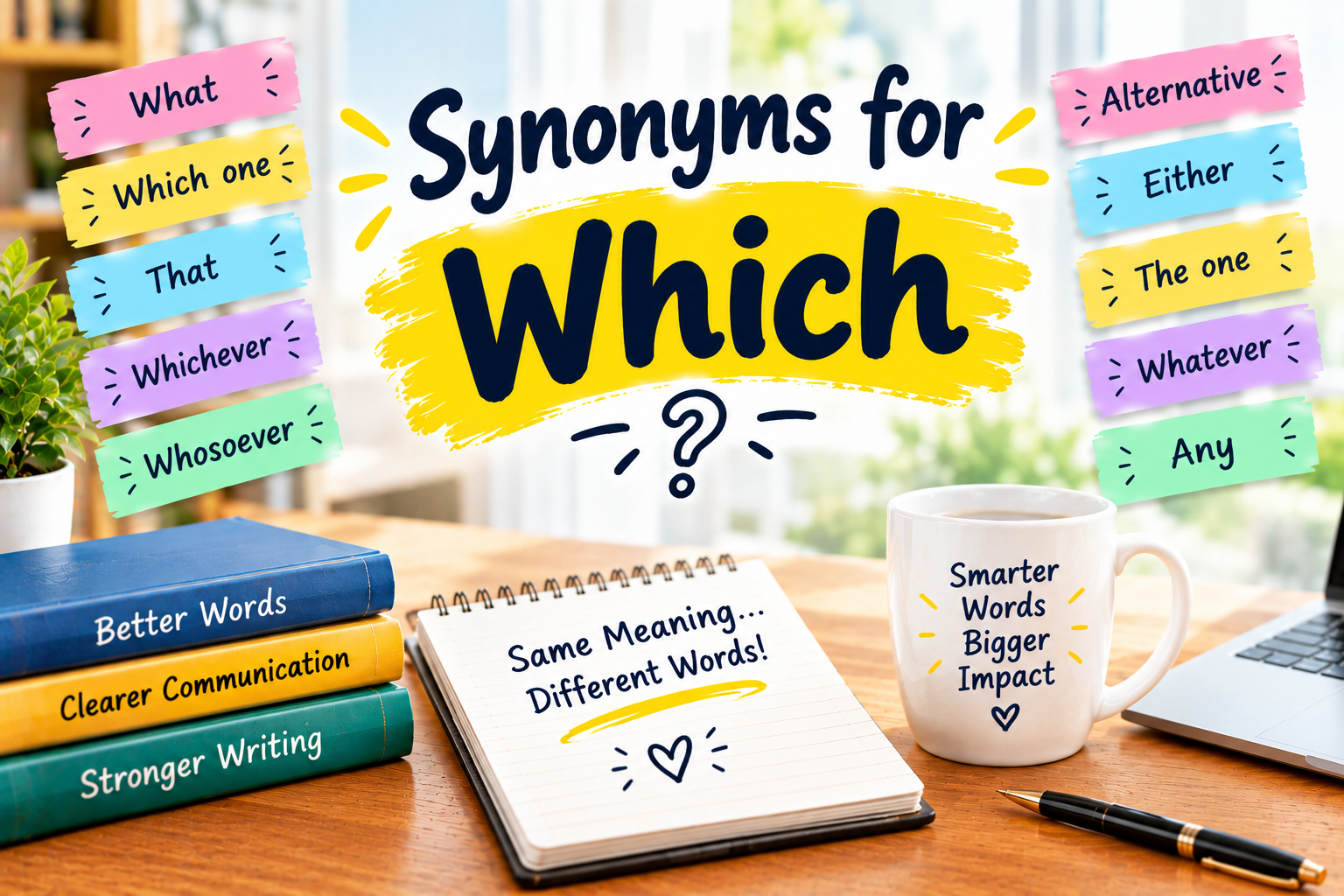
20+ Alternatives for “Which”
Here are practical alternatives and related structures that can sometimes replace which.
| Alternative | When to Use It | Example |
|---|---|---|
| That | Restrictive relative clauses | The book that I bought is new. |
| What | Open-ended questions | What do you want? |
| Whichever | Any option is acceptable | Choose whichever you prefer. |
| Whatever | Any thing or option | Take whatever you need. |
| Who | Refers to people | The teacher who called me is here. |
| Whom | Formal object form for people | The person whom we invited arrived. |
| Whose | Shows possession | The student whose bag was lost called. |
| Where | Refers to places | The house where I grew up is nearby. |
| When | Refers to time | I remember the year when we met. |
| Which one | Makes a specific choice clearer | Which one do you want? |
| The one that | Identifies a specific thing | Choose the one that fits. |
| What kind of | Asks about a category | What kind of car do you want? |
| What type of | Asks about a type | What type of book is it? |
| Any | No specific choice required | Any option will work. |
| Any of these | Any item in a known group | Any of these choices is acceptable. |
| One of these | Identifies one member of a group | One of these is mine. |
| Of these | Selection from a defined group | Of these options, choose one. |
| Among these | Selection within a group | Among these choices, this is practical. |
| No matter which | Choice does not affect the result | No matter which route we take, we’ll arrive. |
| Such as | Introduces examples rather than a direct selection | Topics such as grammar are useful. |
| Including | Introduces items within a larger group | Several options, including the first, are available. |
These are contextual alternatives, not universal replacements. Cambridge specifically explains that which and what differ according to whether the range of choices is restricted, while which and that differ in relative clauses.
“Which” vs. “That”
This is one of the most important grammar distinctions involving which.
Use “Which” for Non-Restrictive Clauses
A non-restrictive relative clause adds extra information that is not essential to identify the noun. It is usually separated by commas.
Example:
“My laptop, which I bought last year, still works perfectly.”
The phrase which I bought last year gives additional information.
Use “That” for Restrictive Clauses
A restrictive relative clause identifies which particular person or thing you mean.
Example:
“The laptop that I bought last year still works perfectly.”
Here, that I bought last year identifies the specific laptop.
Cambridge notes that which introduces both defining and non-defining relative clauses, while that is used for defining relative clauses.
Quick Comparison
| Sentence | Function |
|---|---|
| The phone that I bought is broken. | Identifies the phone |
| The phone, which I bought yesterday, is broken. | Adds extra information |
In formal writing, especially in American English, this distinction is often taught as that for restrictive clauses and which for non-restrictive clauses.
“Which” vs. “What”
These words are both used to ask questions, but they don’t normally mean exactly the same thing.
Use “Which” for a Limited Set
“Which dress do you prefer, the blue one or the black one?”
The choices are defined.
Use “What” for a More Open Question
“What dress do you want to buy?”
The possible answers are not limited to a clearly defined group.
Cambridge describes which as appropriate when the possible answers form a fixed or limited set, while what is more common when the range is not restricted.
More Examples
Which:
- Which restaurant should we visit, the Italian one or the Thai one?
- Which course are you taking?
- Which laptop do you want?
What:
- What do you want for dinner?
- What course would you like to take?
- What kind of laptop do you need?
“Which” vs. “Whichever”
These words are closely related but serve different purposes.
Which asks for or identifies a particular choice.
“Which color do you want?”
Whichever means that any choice from the available group is acceptable.
“Choose whichever color you like.”
Another example:
“Which route should we take?”
This asks for a specific route.
“Take whichever route is faster.”
This means the particular route does not matter as long as it satisfies the condition.
“Which” vs. “Whatever”
Whatever is broader than which.
Which generally points toward a specific selection.
“Which book do you want?”
Whatever means any option or thing without requiring a specific choice.
“Read whatever book you like.”
Therefore, whatever can sometimes replace a phrase involving which, but it changes the meaning from specific selection to open choice.
“Which” vs. “Who”
Use which primarily for things and who for people.
Correct:
“The teacher who helped me was very kind.”
Incorrect:
“The teacher which helped me was very kind.”
Cambridge identifies who as the relative pronoun used for people, while which is used for animals and things.
However, organizations, companies, and other entities can sometimes take which because they are treated grammatically as things:
“The company which hired her is expanding.”
“Which” vs. “Whom”
Whom is the formal object form of who.
For example:
“The manager whom I contacted responded quickly.”
In casual English, many speakers use who instead:
“The manager who I contacted responded quickly.”
The important point is that whom is associated with people, so it is not a direct synonym for which. It becomes relevant when a writer might otherwise incorrectly use which for a person.
“Which” vs. “Whose”
Whose indicates possession.
“The student whose laptop was stolen reported the incident.”
It should not be used simply because you want an alternative to which. It has a specific grammatical function.
Compare:
“The laptop, which was expensive, was stolen.”
with:
“The student whose laptop was stolen reported it.”
The first adds information about the laptop. The second shows possession.
“Which” vs. “Where”
Use where when the relative clause refers to a place.
“This is the restaurant where we had dinner.”
Compare:
“This is the restaurant which we visited.”
Both can be correct, but their grammatical structures differ:
- where we had dinner = location
- which we visited = object of the verb visited
“Which” vs. “When”
Use when to refer to a time.
“I remember the year when we moved.”
You could also say:
“I remember the year in which we moved.”
The second version is more formal.
Thus, when can sometimes replace a construction involving which when the antecedent is a time expression.
When Should You Use “Which”?
Use which when you need to identify a particular option from a limited group.
Examples:
- Which phone should I buy?
- Which answer is correct?
- Which route is shorter?
- Which candidate should we interview?
- Which of these files should I open?
It is also appropriate in relative clauses referring to things or animals.
Examples:
- The book, which was published last year, became popular.
- The dog, which had been rescued, found a new home.
- The report, which contains several errors, needs revision.
Cambridge confirms that which can introduce both defining and non-defining relative clauses and can refer to animals and things.
When Should You Not Use “Which”?
There are several situations where another word may be more appropriate.
Don’t Use “Which” for a Person
Instead of:
“The woman which called me…”
write:
“The woman who called me…”
Don’t Use “Which” for an Open-Ended Question When “What” Is More Natural
Instead of:
“Which do you want to eat?”
when there is no defined selection, you may say:
“What do you want to eat?”
If there are known choices, however, which can be appropriate.
Don’t Automatically Replace “That” With “Which”
A restrictive relative clause often requires that in standard formal American English:
“The book that I recommended is excellent.”
The meaning is different from a non-restrictive construction:
“The book, which I recommended yesterday, is excellent.”
Alternatives to “Which” in Academic Writing
Academic writing often requires precision rather than simply avoiding repetition.
Useful alternatives or structures include:
- That
- What
- Whichever
- Who
- Whom
- Whose
- Where
- When
- In which
- Among which
- Of which
- Through which
- By which
- From which
- The one that
- The one that was selected
Examples
Instead of:
“The method which produced the best results was selected.”
you can write:
“The method that produced the best results was selected.”
For a more formal construction:
“The method through which the results were obtained…”
The important point is that the replacement should preserve the intended grammatical relationship.
Alternatives to “Which” in Professional Writing
In business communication, you may use:
- That
- What
- Whichever
- Which one
- The one that
- Any of these
- Of these
- Among these
- The option that
- The approach that
Examples
Original:
“Please let me know which option you prefer.”
Alternative:
“Please let me know which one you prefer.”
Original:
“The proposal which we discussed has been approved.”
Alternative:
“The proposal that we discussed has been approved.”
Original:
“Choose whichever option works best for your team.”
Here, whichever is already the most natural choice because any suitable option is acceptable.
Alternatives to “Which” in Questions
Depending on the question, you can use:
- What
- Which one
- What kind of
- What type of
- Which of these
- Which of them
- What option
- What choice
- What sort of
Examples
Which:
“Which phone do you prefer?”
Which one:
“Which one do you prefer?”
What kind of:
“What kind of phone are you looking for?”
What type of:
“What type of phone would suit your needs?”
These alternatives can make a question more specific or more open depending on what information you need.
Alternatives to “Which” in Relative Clauses
When which introduces a relative clause, possible alternatives include:
- That
- Who
- Whom
- Whose
- Where
- When
- In which
- Of which
- Through which
- By which
- From which
The correct choice depends on the noun being described and the relationship between that noun and the relative clause.
For example:
“The company that hired me…”
“The manager who hired me…”
“The office where I work…”
“The year when I started…”
“The system through which payments are processed…”
Common Phrases With “Which”
Here are several common structures involving which.
Which One
Used when choosing one specific item.
“Which one would you like?”
Which of
Used before a determiner or pronoun.
“Which of these options is better?”
Cambridge specifically notes the use of which + of before words such as the, those, your, and pronouns.
In Which
A formal structure used when which follows a preposition.
“The room in which we met was small.”
Of Which
Used to indicate a relationship with something previously mentioned.
“She owns several businesses, one of which operates overseas.”
Through Which
Used to describe a method, system, or process.
“The platform through which customers place orders is being updated.”
By Which
Often used in formal writing to explain a method or process.
“The procedure by which the data was collected was carefully documented.”
Common Mistakes With “Which”
1. Using “Which” for People
Incorrect:
“The man which called me…”
Correct:
“The man who called me…”
2. Confusing “Which” and “What”
Incorrect in an open-ended context:
“Which do you want to do this weekend?”
More natural:
“What do you want to do this weekend?”
If the choices are defined, however, which is appropriate:
“Which activity do you want to do: hiking or swimming?”
3. Removing Necessary Commas
A non-restrictive clause normally requires commas:
“My car, which is five years old, still runs well.”
The commas show that the information is additional rather than essential.
4. Using “What” as a Relative Pronoun for a Noun
A common error is:
“The book what I bought…”
Standard English uses:
“The book that I bought…”
or:
“The book which I bought…”
Cambridge specifically notes that which or that, not what, is used in this type of relative clause.
Which Synonym Should You Choose?
Use this simple decision guide:
- Are you asking someone to choose from a known or limited group?
Use which. - Is the question open-ended?
Consider what. - Does any option work?
Use whichever. - Are you referring to a person?
Use who or whom. - Are you showing possession?
Use whose. - Are you referring to a place?
Use where. - Are you referring to a time?
Use when. - Does a relative clause identify a specific thing?
That may be appropriate. - Does a relative clause simply add extra information?
Keep which, usually with commas.
Real-Life Examples of “Which” Alternatives
In School
“Which chapter should we study first?”
“The chapter that we studied yesterday was difficult.”
“The teacher who assigned the project gave us another week.”
In the Workplace
“Which proposal should we present?”
“The proposal that the client approved will move forward.”
“The office where the meeting will take place is on the third floor.”
In Everyday Conversation
“Which restaurant do you want?”
“What would you like to eat?”
“Choose whichever restaurant you prefer.”
In Academic Writing
“The study, which examined several variables, produced interesting results.”
“The method that produced the strongest results was selected.”
“The researcher whose findings were cited published a follow-up study.”
Functional Opposites of “Which”
Technically, which does not have a true antonym because it is a grammatical function word rather than a descriptive word.
However, some expressions contrast with the idea of selecting a specific option.
| Expression | Contrasting Idea |
|---|---|
| Whatever | Any thing or option |
| Whoever | Any person |
| Wherever | Any place |
| Whenever | Any time |
| Any | No specific selection |
| Anything | No limited thing |
| Either way | Choice does not matter |
| No matter which | Specific choice is irrelevant |
| None | No available option |
| Any of them | No preference among the group |
For example:
“Which route should we take?”
asks for a specific choice.
“Either way, we’ll get there.”
means the specific choice does not matter.
Therefore, these are better described as functional contrasts rather than true antonyms.
FAQs
What is another word for “which”?
There is no single replacement that works everywhere. Depending on the sentence, alternatives can include that, what, whichever, who, whom, whose, where, and when.
What is the best synonym for “which”?
The best alternative depends on its grammatical function. That can work in some restrictive relative clauses, what can work for open-ended questions, and whichever works when any option is acceptable.
Can “that” replace “which”?
Sometimes. That can replace which in certain restrictive relative clauses, particularly when the clause identifies which specific thing is being discussed. It cannot simply replace which in every sentence.
Can “what” replace “which”?
Sometimes. Use what when asking about an open or unrestricted range of possibilities. Use which when the possible answers are limited or already defined.
Can “whichever” replace “which”?
In some sentences, yes. Whichever means any option from a group, while which normally asks for or identifies a particular option.
What is the difference between “which” and “that”?
In relative clauses, which is commonly used for non-restrictive clauses, while that is used for restrictive clauses. For example:
“The car, which I bought last year, is reliable.”
versus:
“The car that I bought last year is reliable.”
The second sentence identifies which car is being discussed.
What is the difference between “which” and “what”?
Which generally suggests a limited set of possibilities, while what is more open-ended.
“Which shirt do you want—the blue one or the white one?”
“What shirt do you want?”
Can “who” replace “which”?
When the reference is to a person, who is generally the appropriate relative pronoun.
“The woman who called me…”
not:
“The woman which called me…”
Cambridge identifies who for people and which for things and animals.
Is “which” formal or informal?
Which is neutral and works in casual conversation, professional communication, and formal writing. Its grammatical use in non-defining relative clauses is especially common in formal writing.
What is a formal alternative to “which”?
There is no universal formal replacement. Depending on the sentence, formal alternatives may include that, in which, through which, by which, of which, or another appropriate relative structure.
What is a simple alternative to “which”?
Depending on context, that, what, which one, or whichever may be simpler. The correct choice depends on the sentence.
Can I use “which” for a person?
Generally, no. Use who or whom for people. Which is normally used for things and animals.
What is “which of”?
Which of is used to select something from a defined group.
Examples:
- Which of these is yours?
- Which of the options do you prefer?
- Which of your friends is coming?
Cambridge specifically recognizes this structure.
Final Thoughts
The best synonyms for which are really context-dependent grammatical alternatives rather than traditional synonyms. That, what, whichever, who, whom, whose, where, and when can perform related functions, but each has its own grammatical purpose.
Use which when selecting from a limited or known set, what for more open-ended questions, whichever when any option is acceptable, that for appropriate restrictive relative clauses, and who/whom when referring to people. For places and times, where and when may be the correct alternatives.
Rather than replacing which simply to avoid repetition, focus on what the sentence is trying to express. Choosing the right grammatical structure will make your writing clearer, more natural, and more precise.