
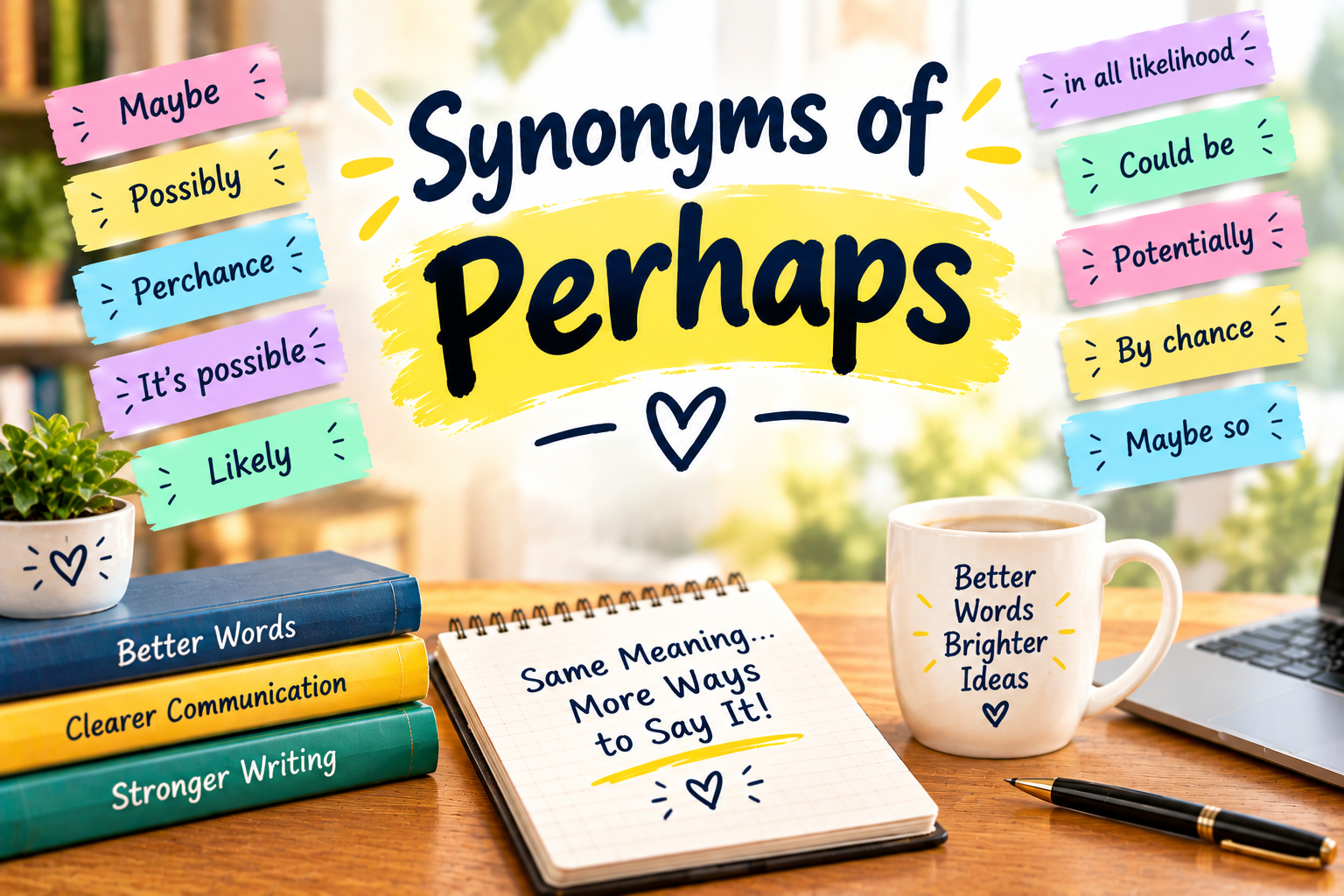
Looking for the right synonyms of perhaps can help you make your writing more varied, precise, and natural. Although perhaps is a simple word, it can express several related ideas, including possibility, uncertainty, approximation, and polite suggestion.
The closest everyday synonym is maybe. Other useful alternatives include possibly, potentially, conceivably, plausibly, perchance, feasibly, and mayhap. However, these words are not always interchangeable. Some suggest a particular degree of probability, while others sound more formal, literary, casual, or speculative.
Cambridge Dictionary defines perhaps as an adverb used to show that something is possible or that you are not certain about something. It can also be used when making a polite suggestion or expressing an approximate number or amount.
This guide explores 50+ synonyms and alternatives for perhaps, explains their subtle differences, and provides examples for everyday conversations, emails, essays, academic writing, and creative work.
What Does Perhaps Mean?
Perhaps means maybe, possibly, or it is possible that something is true or will happen.
For example:
“Perhaps she will call tomorrow.”
This means that she may call tomorrow, but the speaker is not certain.
Perhaps can also express an idea or suggestion politely:
“Perhaps we should leave earlier.”
Here, perhaps makes the suggestion sound less direct.
It can also indicate an approximate number:
“There were perhaps 500 people at the event.”
In this use, perhaps means approximately or around that amount.
Simple Definition
In simple English:
Perhaps means that something may be true or may happen, but you are not certain.
Is Perhaps a Synonym of Maybe?
Yes. Maybe is the closest and most common everyday synonym for perhaps.
Both words can express uncertainty:
- Perhaps we should wait.
- Maybe we should wait.
The meaning is essentially the same.
The main difference is style and position. Cambridge notes that maybe and perhaps both express possibility, but perhaps is slightly more formal. Maybe is especially common at the beginning or end of a sentence, whereas perhaps can occur at the beginning, middle, or end.
Examples
Maybe:
“Maybe I’ll call her later.”
Perhaps:
“Perhaps I’ll call her later.”
Both are natural, but perhaps can sound a little more polished or formal.
50+ Synonyms of Perhaps
Here are useful alternatives to perhaps, organized according to their usual meaning and tone.
| Synonym / Alternative | Meaning | Tone |
|---|---|---|
| Maybe | Possibly | Casual/neutral |
| Possibly | It may happen or be true | Neutral/formal |
| Potentially | Having the possibility of happening | Formal |
| Conceivably | Possible to imagine or consider | Formal |
| Plausibly | Reasonably possible or believable | Formal |
| Perchance | Perhaps; by chance | Literary |
| Mayhap | Perhaps | Archaic/literary |
| Peradventure | Perhaps; possibly | Archaic/formal |
| Feasibly | In a way that could realistically happen | Formal |
| It may be | Indicates possibility | Neutral |
| It might be | Indicates uncertainty | Neutral |
| Could be | Something is possible | Casual |
| Might be | Something may be true | Neutral |
| There is a chance | Possibility exists | Neutral |
| There’s a possibility | Something may happen | Neutral/formal |
| It is possible | States possibility directly | Neutral |
| It could happen | Indicates possible occurrence | Neutral |
| One never knows | Outcome is uncertain | Conversational |
| Who knows | Outcome is unknown | Casual |
| In theory | Possible according to an idea | Academic |
| Hypothetically | Assuming a possibility for discussion | Formal |
| Speculatively | Based on speculation | Formal |
| Tentatively | Not fully confirmed | Formal |
| Provisionally | Temporarily or subject to confirmation | Formal |
| Presumably | Based on what is reasonably assumed | Formal |
| Apparently | Based on what seems to be true | Neutral |
| Seemingly | Appears to be the case | Formal/neutral |
| Arguably | Can reasonably be argued | Academic |
| In all likelihood | Probably | Formal |
| Likely | Probable | Neutral |
| Probably | More likely than not | Neutral |
| It seems | Appears to be true | Neutral |
| It appears | Seems to be the case | Formal |
| Odds are | Likely | Informal |
| There’s a possibility | Possible outcome | Neutral |
| There’s a chance | Possible outcome | Neutral |
| By any chance | Used to ask about possibility | Conversational |
| If possible | Conditional possibility | Neutral |
| If all goes well | Conditional possibility | Neutral |
| If circumstances permit | Dependent on conditions | Formal |
| As it may be | Possible state | Formal |
| For all we know | Something remains possible | Conversational |
| For all I know | Speaker lacks certainty | Conversational |
| As far as I can tell | Limited certainty | Neutral |
| I suppose | Mild uncertainty | Conversational |
| I suspect | Tentative belief | Neutral |
| I imagine | Belief based on assumption | Neutral |
| I would think | Tentative opinion | Neutral |
| It could be that | Possible explanation | Neutral |
| It might be that | Possible explanation | Neutral |
| It is conceivable | Possible to imagine | Formal |
| It is plausible | Reasonably believable | Formal |
| It remains possible | Possibility has not been ruled out | Formal |
| It cannot be ruled out | Possibility remains | Formal |
Not every expression above is a strict dictionary synonym. Some are phrases that perform a similar communicative function, particularly when expressing uncertainty or possibility.
Common Synonyms for Perhaps
1. Maybe
Maybe is the closest everyday synonym for perhaps.
Example:
“Maybe we can meet tomorrow.”
It works naturally in casual conversation, text messages, emails, and general writing.
2. Possibly
Possibly means that something may happen or may be true.
Example:
“She could possibly arrive this evening.”
Cambridge lists possibly as a direct synonym related to perhaps when expressing uncertainty.
It is especially useful when you want a neutral or somewhat formal alternative.
3. Potentially
Potentially describes something that has the possibility of happening or developing.
Example:
“This could potentially solve the problem.”
It is common in professional, technical, and academic writing.
However, potentially can suggest capacity or possibility, rather than simply uncertainty.
4. Conceivably
Conceivably means that something is possible to imagine or consider.
Example:
“She could conceivably finish the project today.”
It often sounds more formal than maybe.
5. Plausibly
Plausibly means that something is reasonably possible or believable.
Example:
“He could plausibly have misunderstood the instructions.”
Unlike perhaps, plausibly often suggests that there is some reason to consider the possibility believable.
Formal Synonyms for Perhaps
When writing an essay, report, professional email, or academic paper, you may want an alternative that sounds more precise or formal.
Useful choices include:
- Possibly
- Potentially
- Conceivably
- Plausibly
- Feasibly
- Presumably
- Provisionally
- Tentatively
- Speculatively
- Arguably
- In all likelihood
- It is possible that
- It remains possible that
- It cannot be ruled out that
- If circumstances permit
Example
Casual:
“Maybe the results will change.”
More formal:
“It is possible that the results will change.”
Another option:
“The results could potentially change.”
The best choice depends on whether you want to communicate uncertainty, possibility, probability, or a conditional outcome.
Informal Alternatives to Perhaps
For casual conversations, texts, and friendly messages, these alternatives are natural:
- Maybe
- Could be
- Might be
- Who knows
- One never knows
- I suppose
- I guess
- I think
- There’s a chance
- It could happen
- For all I know
- Odds are
Examples
“Maybe I’ll come later.”
“Could be. I’m not sure.”
“Who knows? We might get lucky.”
“There’s a chance she’ll join us.”
These expressions generally sound more conversational than conceivably or perchance.
Academic Alternatives to Perhaps
Academic writing often benefits from precise expressions rather than repetitive use of perhaps.
Useful alternatives include:
- Possibly
- Potentially
- Conceivably
- Plausibly
- Arguably
- Hypothetically
- Theoretically
- Presumably
- Speculatively
- It is possible that
- It is plausible that
- It may be the case that
- It could be argued that
- It is conceivable that
Examples
Instead of:
“Perhaps this explains the difference.”
You could write:
“This could potentially explain the difference.”
Or:
“It is plausible that this explains the difference.”
Or:
“It could be argued that this explains the difference.”
These options communicate slightly different levels of certainty and reasoning.
Old-Fashioned and Literary Synonyms for Perhaps
Some alternatives to perhaps are uncommon in modern everyday English but can be useful in poetry, historical fiction, or deliberately old-fashioned writing.
Perchance
Perchance means perhaps or possibly.
Example:
“Perchance we shall meet again.”
It sounds poetic or old-fashioned.
Mayhap
Mayhap is an archaic or literary alternative to perhaps.
Example:
“Mayhap the answer will reveal itself.”
Peradventure
Peradventure is another old-fashioned expression meaning perhaps or possibly.
Example:
“Peradventure, the traveler will return.”
These words can add a historical or literary tone, but they would usually sound unnatural in an ordinary business email.
Synonyms for Perhaps in Different Contexts
Perhaps in Everyday Conversation
Use:
- Maybe
- Possibly
- Could be
- Might be
- I suppose
- Who knows
- There’s a chance
Example:
“Maybe we’ll go out tonight.”
Perhaps in Professional Emails
Use:
- Perhaps
- Possibly
- It may be
- It might be
- It may be worth considering
- We could consider
- There is a possibility
- If appropriate
Example:
“Perhaps we could discuss this option during tomorrow’s meeting.”
This is a polite way to make a suggestion without sounding overly forceful.
Perhaps in Academic Writing
Use:
- Possibly
- Potentially
- Conceivably
- Plausibly
- Arguably
- It is possible that
- It may be the case that
- It could be argued that
Example:
“It is possible that the difference results from the sample size.”
Perhaps in Creative Writing
Use:
- Maybe
- Perhaps
- Perchance
- Mayhap
- Conceivably
- It might be
- Who knows
Example:
“Perhaps the old house had been waiting for someone to return.”
Perhaps vs. Maybe
Perhaps and maybe are the closest synonyms.
Both express uncertainty or possibility.
| Perhaps | Maybe |
|---|---|
| Slightly more formal | More conversational |
| Common in formal writing | Very common in speech |
| Can appear in front, middle, or end position | Often appears at beginning or end |
| “Perhaps she forgot.” | “Maybe she forgot.” |
Cambridge explicitly states that the two words have the same basic meaning, while perhaps is slightly more formal.
Which Is Better?
Neither is universally better.
Use maybe when you want a relaxed, conversational tone.
Use perhaps when you want a slightly more polished or formal tone.
Perhaps vs. Possibly
Possibly is another close synonym, but it can sound more analytical or formal.
Compare:
“Perhaps he will come.”
and:
“He will possibly come.”
Both express uncertainty.
However, possibly is especially common when discussing whether something could happen.
Cambridge lists possibly directly among the words used to express uncertainty alongside perhaps and maybe.
Perhaps vs. Probably
These words are not exact synonyms because they communicate different levels of confidence.
Perhaps means something is possible but uncertain.
Probably means something is considered more likely than not.
Compare:
“Perhaps it will rain.”
This means rain is possible.
“It will probably rain.”
This suggests that rain is more likely.
Therefore, don’t automatically replace perhaps with probably.
Perhaps vs. Likely
Likely generally suggests a higher degree of probability.
For example:
“Perhaps she will accept the offer.”
This expresses uncertainty.
“She is likely to accept the offer.”
This suggests that acceptance is probable.
So while likely can be related to perhaps, it is not an exact replacement.
Perhaps vs. Conceivably
Conceivably means that something can reasonably be imagined as possible.
“Perhaps he made a mistake.”
“He could conceivably have made a mistake.”
The second version sounds more analytical and formal.
Cambridge includes conceivably among words used to express uncertainty and possibility.
Perhaps vs. Presumably
These words communicate different kinds of uncertainty.
Perhaps means something may be true.
Presumably means you believe something is true based on what you know or what seems reasonable.
Compare:
“Perhaps she is at home.”
The speaker isn’t certain.
“Presumably, she is at home.”
The speaker assumes she is at home based on available information.
Therefore, presumably is not a direct replacement in every sentence.
Perhaps vs. Apparently
Apparently means something seems to be true based on what has been seen, heard, or reported.
“Perhaps he left early.”
means his leaving early is one possibility.
“Apparently, he left early.”
means there is some indication or information suggesting that he did.
This distinction is important in formal writing because apparently can imply evidence.
Perhaps vs. Potentially
Potentially focuses on what could happen or what something could become.
“This could potentially save money.”
It often appears in professional, technical, and academic contexts.
Perhaps is broader:
“Perhaps this will save money.”
The first emphasizes potential; the second simply expresses uncertainty.
Perhaps vs. Arguably
Arguably does not simply mean perhaps.
It means that something can reasonably be argued or defended as true.
For example:
“She is arguably the most experienced person on the team.”
This means there is a reasonable argument supporting that statement.
It does not simply mean:
“Perhaps she is the most experienced person.”
The two words can both introduce uncertainty, but they do so differently.
Antonyms of Perhaps
Because perhaps expresses uncertainty or possibility, its contextual opposites are words that communicate certainty.
Common antonyms and contrasting expressions include:
- Definitely
- Certainly
- Surely
- Undoubtedly
- Clearly
- Absolutely
- Unquestionably
- Positively
- Assuredly
- Without doubt
- Beyond doubt
- Certainly so
- For certain
- Without question
Examples
Perhaps:
“Perhaps she will attend.”
Definitely:
“She will definitely attend.”
Perhaps:
“Perhaps this is correct.”
Certainly:
“This is certainly correct.”
The contrast is essentially uncertainty versus certainty.
Examples of “Perhaps” in Sentences
Here are natural examples showing different uses of perhaps.
- Possibility: “Perhaps it will rain tomorrow.”
- Uncertainty: “Perhaps he forgot the appointment.”
- Suggestion: “Perhaps we should leave earlier.”
- Polite suggestion: “Perhaps you could review the document again.”
- Approximation: “There were perhaps 200 people at the event.”
- Opinion: “Perhaps this is the best solution.”
- Future possibility: “Perhaps we’ll meet again someday.”
- Explanation: “Perhaps she misunderstood the instructions.”
- Reflection: “Perhaps I should have waited.”
- Qualification: “It was perhaps the most interesting part of the trip.”
Cambridge confirms that perhaps can express possibility, uncertainty, approximation, and polite suggestions.
Examples of Perhaps Synonyms in Sentences
Maybe
“Maybe we should try again tomorrow.”
Possibly
“She could possibly finish the project today.”
Potentially
“The new approach could potentially reduce costs.”
Conceivably
“He could conceivably solve the problem without assistance.”
Plausibly
“The explanation could plausibly account for the difference.”
Feasibly
“We could feasibly complete the work by Friday.”
Perchance
“Perchance we shall meet again.”
Presumably
“Presumably, they have already received the message.”
Tentatively
“The meeting is tentatively scheduled for Monday.”
Provisionally
“The application was provisionally approved.”
Arguably
“This is arguably the most effective approach.”
Polite Ways to Use Perhaps
One useful feature of perhaps is that it can soften a suggestion.
Compare:
“You should revise the report.”
with:
“Perhaps you could revise the report.”
The second sounds less direct and can be more appropriate in professional communication.
Other polite alternatives include:
- Maybe we could…
- Perhaps we might…
- It may be worth considering…
- It might be helpful to…
- We could possibly…
- It may be useful to…
- You might consider…
- One possibility would be to…
Examples
“Perhaps we could schedule another meeting.”
“It may be worth considering a different approach.”
“You might consider reviewing the figures again.”
These structures allow you to make suggestions without sounding unnecessarily forceful.
How to Choose the Right Synonym for Perhaps
The best alternative depends on certainty, tone, and context.
| If you mean… | Use… |
|---|---|
| Casual uncertainty | Maybe |
| General possibility | Possibly |
| Potential outcome | Potentially |
| Something imaginable | Conceivably |
| Something believable | Plausibly |
| Realistic possibility | Feasibly |
| Formal assumption | Presumably |
| Temporary or unconfirmed | Provisionally |
| Not yet confirmed | Tentatively |
| Reasonable argument | Arguably |
| Literary possibility | Perchance |
| Old-fashioned possibility | Mayhap |
| Higher probability | Probably |
| Strong probability | Likely |
| Any possible outcome | There’s a chance |
| Unknown outcome | Who knows |
| Conditional possibility | If all goes well |
This is more useful than treating all related words as interchangeable.
How to Avoid Repeating “Perhaps”
If you notice that your writing contains perhaps several times, don’t replace every occurrence with the same synonym. Instead, consider the specific meaning of each sentence.
For example:
“Perhaps the results are inaccurate. Perhaps the sample was too small. Perhaps the equipment malfunctioned.”
Could become:
“The results may be inaccurate. Possibly, the sample was too small. Another possibility is that the equipment malfunctioned.”
This creates more natural variation while preserving the intended uncertainty.
Use Different Structures
Instead of always using a single-word synonym, try:
- It is possible that…
- There is a chance that…
- It may be that…
- It might be that…
- It could be that…
- One possibility is…
- It remains possible that…
- There is reason to believe…
- It is conceivable that…
These structures are particularly useful in essays and professional writing.
FAQs
What is the best synonym for perhaps?
Maybe is the closest everyday synonym for perhaps. Other useful alternatives include possibly, potentially, conceivably, and plausibly, depending on the intended meaning and tone.
What is another word for perhaps?
Common alternatives include maybe, possibly, potentially, conceivably, plausibly, perchance, and mayhap.
Is maybe the same as perhaps?
Yes. Maybe and perhaps have essentially the same basic meaning: both express possibility or uncertainty. However, perhaps is slightly more formal than maybe.
What is a formal synonym for perhaps?
Formal alternatives include possibly, conceivably, plausibly, potentially, feasibly, and it is possible that. The best choice depends on the exact meaning.
What is an informal word for perhaps?
Maybe is the most common informal alternative. Other conversational options include could be, might be, who knows, and there’s a chance.
What is a literary synonym for perhaps?
Perchance and mayhap are literary or old-fashioned alternatives. They are more appropriate for poetry, historical writing, or deliberately archaic language than everyday communication.
Is possibly stronger than perhaps?
Not necessarily. Both express uncertainty. Possibly can sound more formal or analytical, but it does not automatically indicate a higher probability than perhaps.
Is probably a synonym for perhaps?
They are related but not exact synonyms. Perhaps indicates possibility, while probably suggests that something is more likely to happen or be true.
Is likely a synonym for perhaps?
Likely can sometimes appear in similar contexts, but it generally expresses a higher degree of probability. Therefore, it is not an exact substitute for perhaps.
What is the opposite of perhaps?
Contextual opposites include definitely, certainly, undoubtedly, absolutely, surely, and unquestionably. These words express certainty rather than possibility.
How do I use perhaps in a sentence?
You can use perhaps to express uncertainty:
“Perhaps she will come tomorrow.”
You can also use it for suggestions:
“Perhaps we should leave now.”
Or approximation:
“There were perhaps 100 guests.”
Can perhaps be used in formal writing?
Yes. Perhaps is suitable for formal, academic, professional, and everyday writing. It can also make suggestions sound less direct and more polite.
Is perhaps more formal than maybe?
Yes, slightly. Cambridge specifically notes that perhaps is somewhat more formal than maybe.
What is another way to say “perhaps we should”?
You can say:
- Maybe we should…
- We might consider…
- It may be worth…
- We could possibly…
- It might be helpful to…
- One option would be to…
- Perhaps it would be better to…
What is another way to say “perhaps not”?
Depending on context, you can use:
- Maybe not
- Possibly not
- It may not be
- It might not be
- Probably not
- There is a chance not
- I don’t think so
- It seems unlikely
Remember that probably not is stronger than perhaps not because it indicates that something is considered unlikely.
Quick Reference: Perhaps Synonyms by Tone
| Tone | Useful Alternatives |
|---|---|
| Casual | Maybe, could be, might be |
| Neutral | Perhaps, possibly, there may be |
| Professional | Possibly, potentially, it may be |
| Academic | Conceivably, plausibly, arguably |
| Formal | Presumably, feasibly, provisionally |
| Literary | Perchance, mayhap, peradventure |
| Conditional | If possible, if all goes well |
| Highly uncertain | Who knows, one never knows |
| More probable | Probably, likely, in all likelihood |
Final Thoughts
Learning the synonyms of perhaps gives you more ways to express uncertainty without making your writing repetitive. Maybe is the closest everyday alternative, while possibly provides a neutral and flexible option. Potentially, conceivably, and plausibly can add more specific shades of meaning, especially in professional or academic writing.
For formal contexts, phrases such as it is possible that, it may be, it could be argued that, and there is a possibility that can make your writing precise without sounding repetitive. If you’re writing creatively, perchance and mayhap can provide an intentionally old-fashioned or poetic tone.
The most important point is that these words are not all exact replacements. Perhaps expresses possibility or uncertainty, so choose an alternative based on the level of certainty, tone, and purpose of your sentence. This will make your English sound more natural, accurate, and effective.