

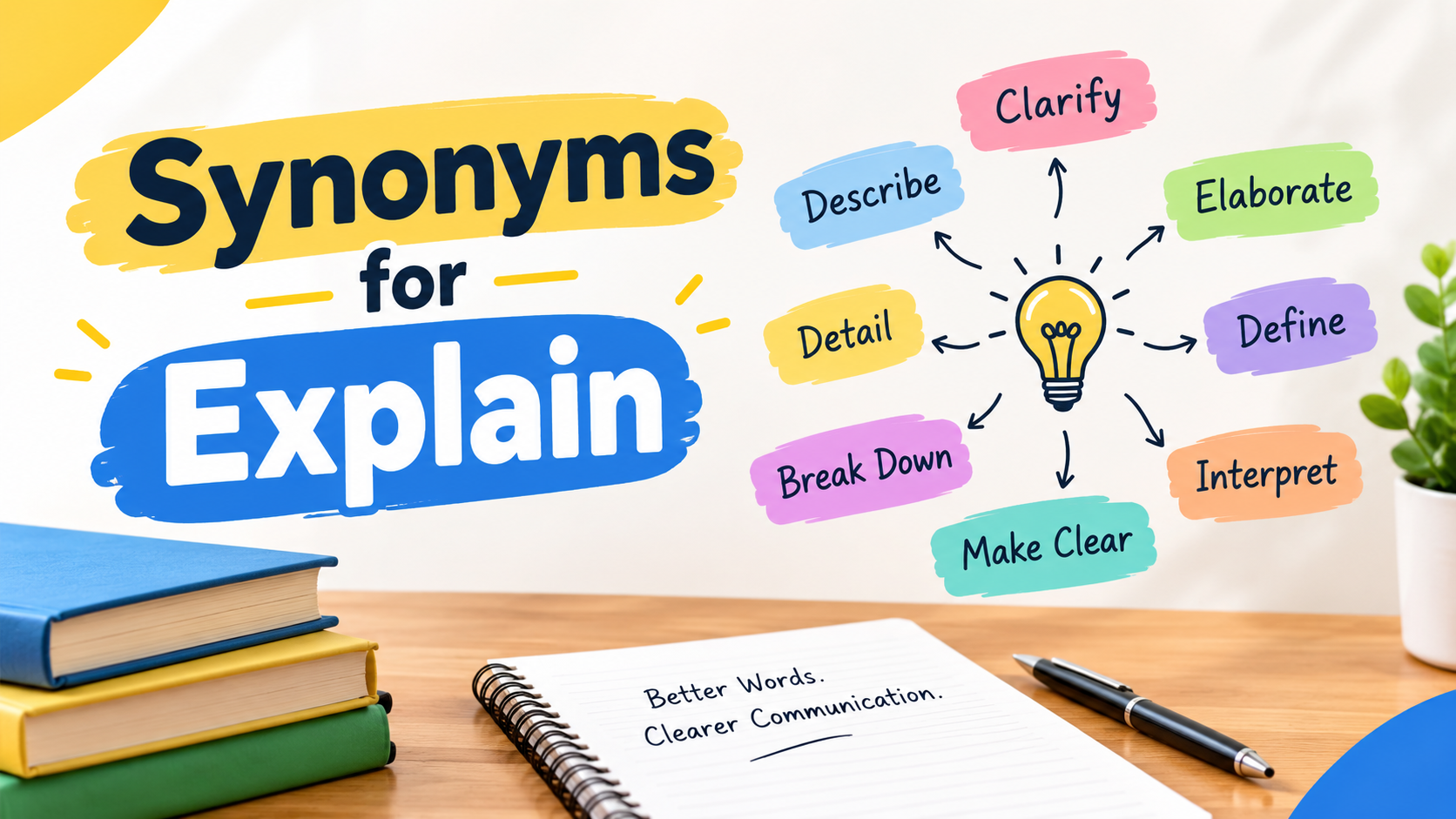
Looking for the right synonyms for explain can help make your writing more precise, natural, and engaging. The verb explain generally means to make something clear or easier to understand by providing information, describing it, or giving a reason.
However, “explain” can mean slightly different things depending on the situation. You might want to clarify a confusing idea, describe something in detail, define a term, illustrate an idea with an example, justify an action, or elucidate a complicated subject.
That is why there is no single replacement that works perfectly in every sentence.
In this guide, you’ll find more than 50 alternatives to explain, organized by meaning and context. You’ll also learn which words work best in formal writing, academic papers, professional emails, conversations, essays, and everyday English.
What Does “Explain” Mean?
Explain means to make something clear or easier to understand by describing it, providing information, or giving reasons.
For example:
“Can you explain how this machine works?”
Here, “explain” means to provide information that helps another person understand the machine’s operation.
The word can also mean to give a reason for something:
“Can you explain why you were late?”
So, depending on context, “explain” can involve:
- Making something understandable
- Giving information
- Describing how something works
- Defining an idea
- Giving a reason
- Clarifying confusion
- Providing details
- Interpreting meaning
- Showing how something happens
50+ Synonyms for Explain
Not every word in this table is a perfect replacement in every sentence. Some are close alternatives that emphasize a particular aspect of explaining.
| Synonym or Alternative | Meaning | Best Context |
|---|---|---|
| Clarify | Make something easier to understand | General |
| Describe | Give details about something | General |
| Define | State the exact meaning of something | Definitions |
| Illustrate | Make an idea clear with an example | Teaching |
| Elaborate | Add more information or detail | Formal |
| Expound | Explain an idea in detail | Formal/academic |
| Elucidate | Make something clear | Formal |
| Explicate | Explain something in detail | Academic |
| Interpret | Explain the meaning of something | Texts/data |
| Demonstrate | Show how or why something works | Teaching |
| Spell out | Explain something very clearly | Informal |
| Set out | Present information systematically | Formal |
| Set forth | Present or explain formally | Formal |
| Account for | Give a reason or explanation | Formal |
| Justify | Give reasons supporting an action or decision | Arguments |
| Rationalize | Provide a justification or explanation | Critical/formal |
| Detail | Give specific information | Reports |
| Outline | Give the main points | Academic/business |
| Summarize | Give the main ideas briefly | General |
| Paraphrase | Restate in different words | Writing |
| Translate | Express meaning in another form or language | Language |
| Decode | Make something difficult easier to understand | Informal |
| Unpack | Explain complex ideas step by step | Modern/informal |
| Break down | Divide a complex idea into simpler parts | Teaching |
| Go over | Review or explain something | Conversational |
| Walk through | Guide someone through a process | Instruction |
| Talk through | Explain step by step verbally | Conversational |
| Make clear | Remove confusion | General |
| Make plain | Express something clearly | Formal/literary |
| Clear up | Resolve confusion | Informal |
| Shed light on | Help make something understandable | Writing |
| Illuminate | Make an idea or issue clearer | Formal |
| Reveal | Make previously unknown information known | General |
| Disclose | Make information known | Formal |
| Present | Put information before an audience | General |
| Communicate | Convey information or meaning | Professional |
| Convey | Communicate an idea or meaning | Formal |
| Express | Put an idea into words | General |
| Relate | Tell or connect information | General |
| Recount | Tell what happened | Narrative |
| Narrate | Tell a story or sequence of events | Narrative |
| Account | Give a description or explanation | Formal |
| Reason | Think through or explain logically | Analytical |
| Analyze | Examine something to explain its parts | Academic |
| Examine | Study something closely | Academic |
| Clarify the meaning | Make meaning easier to understand | Language |
| Give an explanation | Provide information or reasons | General |
| Give an account | Describe what happened | Formal |
| Give details | Provide additional information | General |
| Provide context | Give background that makes something understandable | Academic |
| Elaborate on | Provide additional explanation | Formal |
| Expand on | Add more information | General |
| Specify | State something precisely | Formal |
| Characterize | Describe the nature of something | Academic |
Best Synonyms for Explain
Some alternatives are much more useful than others in everyday writing. These are among the most versatile choices.
1. Clarify
Clarify means to make something clearer or easier to understand by adding information or using a simpler explanation.
Example:
“Could you clarify what you mean by this statement?”
Use clarify when the person already has some information but is confused about a particular point.
2. Describe
Describe focuses on giving information about what something is like, what happened, or what something contains.
Example:
“Can you describe what happened?”
It is useful when explaining through details rather than reasons.
3. Define
Define means to state or explain the exact meaning of a word, concept, or term.
Example:
“The teacher asked students to define photosynthesis.”
Use it when explaining what something means, especially in academic writing.
4. Illustrate
Illustrate means to make an idea easier to understand by giving an example, comparison, image, or demonstration.
Example:
“This example illustrates how the process works.”
It is particularly useful in essays and educational writing.
5. Elaborate
Elaborate means to provide more information or additional details.
Example:
“Could you elaborate on your proposal?”
It is especially useful when someone has already introduced an idea and you want them to explain it further.
6. Elucidate
Elucidate is a formal word meaning to explain something or make it clear. Cambridge labels it as formal.
Example:
“The report attempts to elucidate the causes of the problem.”
Use it primarily in formal, academic, or sophisticated writing.
7. Explicate
Explicate means to explain something in detail, particularly a piece of writing, idea, or theory.
Example:
“The researcher explicates the theory in the second chapter.”
This is more specialized than ordinary “explain.”
8. Illustrate
When you explain something by showing an example, illustrate is often more precise than “explain.”
Example:
“The diagram illustrates the relationship between the two systems.”
9. Spell Out
Spell out means to explain something very clearly, often by providing all the details.
Example:
“The contract spells out the responsibilities of each party.”
Cambridge includes “spell out” among alternatives related to explaining something.
It is especially useful when you want to emphasize clarity and completeness.
10. Set Out
Set out means to present information, rules, terms, or ideas in an organized way.
Example:
“The report sets out the main reasons for the decision.”
This expression is common in formal and professional writing.
Formal Synonyms for Explain
When writing an academic paper, business report, professional document, or formal correspondence, consider:
- Clarify
- Elaborate
- Elucidate
- Explicate
- Expound
- Set out
- Set forth
- Account for
- Illustrate
- Define
- Interpret
- Demonstrate
- Detail
- Specify
- Provide an account of
- Provide clarification
- Give an explanation
- Shed light on
- Illuminate
- Outline
Example
Informal:
“Can you explain the issue?”
More formal:
“Could you clarify the issue?”
Very formal:
“Could you provide further clarification regarding the issue?”
Professional Ways to Say “Explain”
In workplace communication, replacing “explain” can make requests sound more specific.
Instead of:
“Can you explain this?”
Try:
- Could you clarify this point?
- Could you provide some additional context?
- Could you elaborate on this?
- Could you walk me through the process?
- Could you provide further details?
- Could you outline the main points?
- Could you clarify what you mean?
- Could you provide an explanation?
- Could you shed some light on this issue?
- Could you help me understand this?
Professional Example
Instead of:
“Please explain the delay.”
You could write:
“Could you please provide some context regarding the delay?”
This can sound less demanding and more professional.
Synonyms for Explain in Academic Writing
Academic writing often benefits from precise verbs.
Useful choices include:
- Analyze
- Clarify
- Define
- Demonstrate
- Describe
- Elaborate
- Elucidate
- Explicate
- Examine
- Illustrate
- Interpret
- Outline
- Account for
- Discuss
- Characterize
- Specify
Examples
“The study examines the factors contributing to the outcome.”
“The author elucidates the relationship between the variables.”
“The following example illustrates the underlying principle.”
“The paper outlines the main stages of the process.”
“The researcher interprets the findings in relation to previous studies.”
Using a precise verb can communicate exactly what the writer is doing rather than repeatedly relying on “explain.”
Synonyms for Explain in an Essay
When writing an essay, choose the alternative according to your purpose.
To make an idea clear
Use clarify.
“This example clarifies the author’s argument.”
To provide details
Use describe or detail.
“The researcher describes the experimental procedure.”
To give an example
Use illustrate.
“The case study illustrates the consequences of poor planning.”
To explain meaning
Use interpret.
“The final paragraph interprets the significance of the results.”
To give reasons
Use account for.
“Several factors account for the difference in results.”
To present the main points
Use outline.
“The introduction outlines the main arguments.”
Synonyms for Explain to Someone
When the meaning is specifically helping another person understand something, these expressions are useful:
- Clarify
- Teach
- Instruct
- Guide
- Walk through
- Talk through
- Show
- Demonstrate
- Break down
- Spell out
- Go over
- Make clear
- Illustrate
- Elaborate on
- Help someone understand
Examples
“Could you walk me through the process?”
“Let me break down the main idea.”
“She demonstrated how to use the software.”
“The instructor went over the procedure.”
Synonyms for Explain a Process
When explaining a procedure or process, these verbs are particularly useful:
- Describe
- Demonstrate
- Outline
- Detail
- Walk through
- Break down
- Illustrate
- Show
- Present
- Specify
- Set out
Example
Instead of:
“The manual explains how to install the device.”
You could write:
“The manual outlines the installation process.”
Or:
“The manual provides step-by-step instructions for installing the device.”
Synonyms for Explain a Problem
When discussing why something happened, consider:
- Clarify
- Account for
- Identify the cause of
- Give a reason for
- Explain the cause of
- Analyze
- Examine
- Investigate
- Account for
- Shed light on
- Provide an explanation for
Example
“The report investigates the cause of the system failure.”
This is more specific than simply saying:
“The report explains the system failure.”
Synonyms for Explain Why
When the goal is to give a reason, use:
- Account for
- Give a reason for
- Justify
- Explain the reason for
- Provide an explanation for
- Clarify why
- Establish the reason for
- Identify the cause of
- Give an account of
- Rationalize
Be careful with justify. It usually means giving reasons that defend or support an action or decision, rather than simply making something understandable.
Example
“The manager explained why the deadline changed.”
Possible alternatives:
“The manager clarified why the deadline changed.”
“The manager provided an explanation for the change in deadline.”
“The report accounts for the change in deadline.”
Synonyms for Explain Something Clearly
If your emphasis is on clarity, use:
- Clarify
- Make clear
- Make plain
- Spell out
- Elucidate
- Simplify
- Break down
- Illustrate
- Demonstrate
- Set out
- Clear up
- Shed light on
Example
“The teacher clarified the difficult concept.”
“The guide breaks down the process into simple steps.”
“The diagram makes the relationship clear.”
Synonyms for Explain in Simple Words
When communicating with beginners or general audiences, choose accessible expressions:
- Make clear
- Describe
- Show
- Tell
- Go over
- Break down
- Talk through
- Walk through
- Clear up
- Spell out
- Put simply
- Explain in simple terms
- Give an example
Example
Instead of:
“The professor explicated the theory.”
For a general audience:
“The professor explained the theory in simple terms.”
Not every synonym is an improvement. The best word is the one your audience can understand naturally.
“Explain” vs. “Clarify”
These two words are closely related but not identical.
Explain means to make something understandable by giving information or describing it.
Clarify means to make something clearer, often because it is confusing, ambiguous, or incomplete.
Compare:
“The teacher explained the new lesson.”
The teacher introduced and taught the subject.
“The teacher clarified the difficult part of the lesson.”
The teacher addressed a particular point of confusion.
“Explain” vs. “Describe”
Describe focuses on providing details about something.
Explain focuses more broadly on making something understandable.
For example:
“Describe the building.”
This asks what the building looks like.
“Explain how the building was constructed.”
This asks for information about the construction process.
“Explain” vs. “Define”
Define is more specific.
It means stating the meaning or nature of a word, term, or concept.
“Define inflation.”
But:
“Explain inflation.”
could ask for a broader discussion involving its causes, effects, examples, and meaning.
“Explain” vs. “Illustrate”
Illustrate means to make something clear by using an example, comparison, diagram, or demonstration.
“The teacher explained the concept.”
“The teacher illustrated the concept with a real-world example.”
The second sentence tells us how the concept was made easier to understand.
“Explain” vs. “Elaborate”
Elaborate means to add more information to something that has already been introduced.
“Could you elaborate on your idea?”
This suggests that an idea has already been presented but needs additional detail.
By contrast:
“Could you explain your idea?”
could mean that the idea itself has not yet been made understandable.
“Explain” vs. “Justify”
These words have different purposes.
Explain makes something understandable or gives a reason.
Justify gives reasons intended to defend or support an action, decision, or position.
Compare:
“She explained why she left.”
“She justified her decision to leave.”
The second sentence suggests that she was defending or supporting the decision.
“Explain” vs. “Interpret”
Interpret means to determine, express, or explain the meaning of something.
It is especially useful for:
- Literature
- Art
- Data
- Results
- Statements
- Symbols
- Historical evidence
Example
“The researcher interpreted the results.”
This is more specific than:
“The researcher explained the results.”
“Explain” vs. “Demonstrate”
Demonstrate can mean to show how something works or prove something through evidence.
“The instructor demonstrated how to operate the machine.”
This may involve actually showing the process rather than describing it verbally.
“Explain” vs. “Account For”
Account for is particularly useful when discussing causes or reasons.
“Several factors account for the difference.”
This means those factors help explain why the difference exists.
Cambridge lists account for among formal expressions related to explaining something.
Synonyms for Explain by Tone
| Tone | Useful Alternatives |
|---|---|
| Everyday | Explain, tell, describe, show |
| Simple | Make clear, break down, go over |
| Casual | Talk through, walk through, spell out |
| Professional | Clarify, elaborate, provide context |
| Formal | Elucidate, explicate, expound |
| Academic | Analyze, interpret, elucidate, explicate |
| Technical | Specify, demonstrate, detail |
| Persuasive | Justify, substantiate, demonstrate |
| Analytical | Examine, account for, interpret |
| Educational | Illustrate, demonstrate, clarify |
Examples of Explain Synonyms in Sentences
Clarify
“Could you clarify the final requirement?”
Describe
“The witness described what happened.”
Define
“The textbook defines the term clearly.”
Illustrate
“The chart illustrates the difference between the two methods.”
Elaborate
“The author elaborates on this argument in the next section.”
Elucidate
“The article elucidates the relationship between the two concepts.”
Explicate
“The researcher explicates the theory in considerable detail.”
Demonstrate
“The instructor demonstrated how the system works.”
Interpret
“The analyst interpreted the results.”
Outline
“The introduction outlines the main objectives.”
Spell out
“The agreement spells out the responsibilities of both parties.”
Break down
“The guide breaks down the complicated process into four steps.”
Antonyms of Explain
The opposite of explaining is not always one exact word, but several terms can express the idea of making something harder to understand or withholding information.
Common contrasts include:
- Confuse
- Obscure
- Conceal
- Withhold
- Complicate
- Mislead
- Obfuscate
- Muddle
- Distort
- Hide
- Leave unclear
Obfuscate is a particularly formal term meaning to make something difficult to understand rather than clear. Cambridge identifies it as an opposite of elucidate.
Example
“The technical language obscured the main point.”
This contrasts with:
“The teacher clarified the main point.”
How to Choose the Right Synonym for Explain
Ask yourself what you are trying to accomplish.
Are you removing confusion?
Use clarify.
Are you giving visual or descriptive details?
Use describe.
Are you giving the meaning of a term?
Use define.
Are you providing an example?
Use illustrate.
Are you adding more information?
Use elaborate.
Are you explaining something complex in detail?
Use elucidate or explicate.
Are you explaining meaning?
Use interpret.
Are you explaining a cause?
Use account for.
Are you defending a decision?
Use justify.
Are you presenting the main points?
Use outline.
Are you guiding someone through a process?
Use walk through or talk through.
This approach produces more precise writing than replacing “explain” with a random synonym.
FAQs
What is the best synonym for explain?
Clarify is one of the closest general alternatives, but the best choice depends on context. Other useful options include describe, define, illustrate, elaborate, interpret, and demonstrate.
What is a formal word for explain?
Formal alternatives include elucidate, explicate, expound, clarify, and set forth. “Elucidate” specifically means to explain or make something clear and is marked as formal by Cambridge.
What is a professional way to say explain?
In professional writing, try clarify, elaborate on, provide context, provide details, outline, walk through, or provide an explanation.
What is another word for explain clearly?
Useful alternatives include clarify, elucidate, spell out, make clear, make plain, illustrate, and break down.
What is another word for explain in detail?
You can use elaborate, explicate, elucidate, expound, detail, or provide a detailed account.
What is a synonym for explain in an essay?
Depending on the purpose, use clarify, analyze, describe, illustrate, interpret, examine, outline, or elucidate.
What is the difference between explain and clarify?
“Explain” broadly means to make something understandable. “Clarify” specifically emphasizes making something clearer, often because it was confusing or ambiguous.
What is the difference between explain and describe?
“Describe” focuses on details about something, while “explain” focuses on making something understandable, including how it works or why it happened.
What is the difference between explain and elaborate?
“Explain” can introduce an idea and make it understandable. “Elaborate” usually means adding more information or detail to something already mentioned.
What is the difference between explain and justify?
To explain is to make something understandable or give a reason. To justify is to give reasons intended to defend or support an action, decision, or position.
What is the opposite of explain?
Depending on the context, contrasting words include confuse, obscure, conceal, complicate, mislead, and obfuscate.
Quick Reference: Best Synonyms for Explain
- Closest general synonym: Clarify
- For details: Describe
- For definitions: Define
- For examples: Illustrate
- For additional information: Elaborate
- For complex subjects: Elucidate
- For detailed academic explanation: Explicate
- For meaning: Interpret
- For causes: Account for
- For defending a decision: Justify
- For main points: Outline
- For showing how something works: Demonstrate
- For very clear explanation: Spell out
- For step-by-step teaching: Walk through
- For simplifying complexity: Break down
- For formal presentation: Set out / set forth
Final Thoughts
There are many useful synonyms for explain, but they are not all interchangeable. The most accurate alternative depends on what kind of explanation you are providing.
Use clarify when removing confusion, describe when giving details, define when stating meaning, and illustrate when using examples. Choose elaborate when adding information, interpret when explaining meaning, and account for when discussing causes. For formal or academic writing, elucidate and explicate can be useful when the context calls for more specialized vocabulary.
The goal is not simply to replace the word “explain.” Instead, choose the word that tells readers how you are making something understandable. That small distinction can make essays, professional documents, emails, reports, and everyday communication much more precise.