

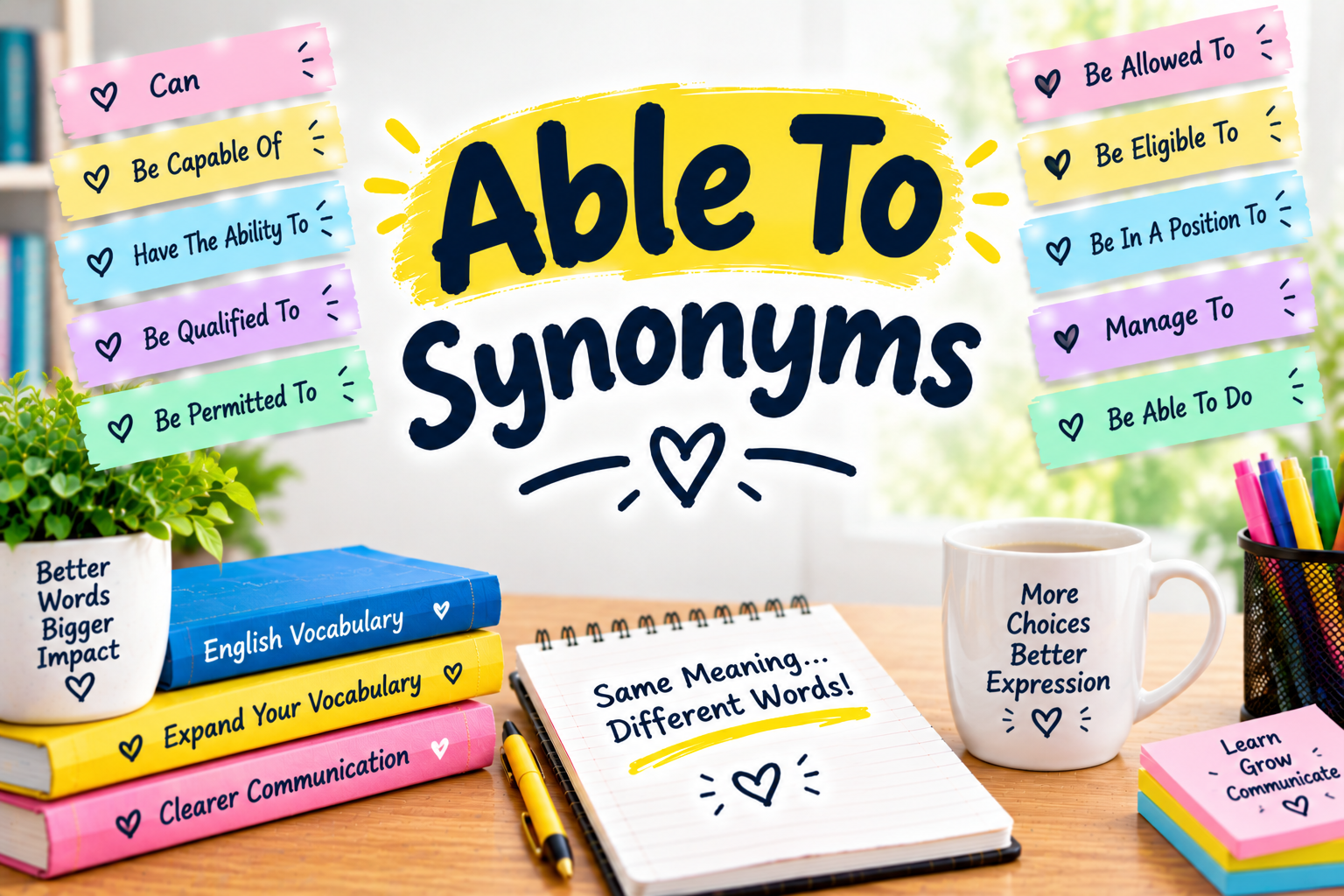
Looking for the best synonyms for “able to”? Whether you are writing an email, preparing an essay, updating your resume, or improving everyday English, choosing the right alternative can make your sentences clearer, more natural, and less repetitive.
The phrase “able to” describes having the skill, opportunity, resources, or capacity to do something. However, the best replacement depends on what you want to communicate. For example, “can” is a simple everyday alternative, “capable of” emphasizes ability, “qualified to” highlights credentials, and “manage to” suggests accomplishing something despite a challenge.
In this guide, you will discover more than 50 alternatives to “able to,” along with their meanings, example sentences, formal and informal options, grammar tips, and frequently asked questions. By the end, you will know how to choose the most accurate expression for any situation.
What Does “Able To” Mean?
“Able to” means having the ability, skill, strength, opportunity, permission, or resources needed to do something. It is commonly used when discussing what a person, organization, or object can accomplish.
Examples:
- I am able to complete the assignment before Friday.
- She is able to speak three languages.
- The new software is able to process large amounts of data.
- We will be able to attend the meeting tomorrow.
The phrase is neutral and works in professional communication, academic writing, and casual conversations. Depending on the sentence, it may describe physical ability, learned skills, available opportunities, or successful results.
Why Use Synonyms for “Able To”?
Using alternatives can improve your writing when you want to avoid repetition or communicate a more specific meaning.
Here are some benefits:
- Improve clarity: Choose words that explain the exact type of ability you mean.
- Avoid repetition: Make longer paragraphs sound more natural.
- Strengthen professional writing: Highlight skills, qualifications, and experience accurately.
- Improve sentence flow: Replace wordy constructions with simpler alternatives.
- Expand your vocabulary: Learn expressions suitable for different tones and situations.
Remember that a synonym should preserve your intended meaning. A person who is qualified to perform a task has the necessary credentials, while someone who is allowed to perform it has permission. These expressions are related to ability, but they are not identical.
50+ Synonyms for “Able To” With Meanings and Examples
The following table provides useful alternatives, their meanings, and examples showing how to use them naturally.
| Synonym or alternative | Meaning | Example sentence |
|---|---|---|
| 1. Can | Has the ability or opportunity | I can finish the report today. |
| 2. Capable of | Has the ability or potential | She is capable of solving complex problems. |
| 3. Have the ability to | Possesses the necessary ability | He has the ability to lead a team. |
| 4. Have the capacity to | Has room or capability for something | The system has the capacity to store more data. |
| 5. Competent to | Has sufficient skill or competence | She is competent to manage the project. |
| 6. Qualified to | Has the required qualifications | He is qualified to teach mathematics. |
| 7. Proficient in | Has a high level of skill | She is proficient in graphic design. |
| 8. Skilled at | Has developed practical expertise | He is skilled at repairing computers. |
| 9. Adept at | Is very good at a particular activity | She is adept at negotiating contracts. |
| 10. Equipped to | Has the necessary tools or preparation | Our team is equipped to handle the challenge. |
| 11. In a position to | Has the circumstances or opportunity | I am in a position to offer assistance. |
| 12. Have the means to | Has the necessary resources | They have the means to expand the business. |
| 13. Be in a position to do | Has the ability or opportunity | We are in a position to approve the request. |
| 14. Be prepared to | Is ready for an action | She is prepared to answer questions. |
| 15. Be ready to | Is ready to begin or act | I am ready to start the assignment. |
| 16. Be free to | Has freedom or permission | You are free to choose another option. |
| 17. Be allowed to | Has permission | Employees are allowed to work remotely. |
| 18. Be permitted to | Is officially allowed | Visitors are permitted to enter the building. |
| 19. Be authorized to | Has official authority | She is authorized to sign the documents. |
| 20. Be entitled to | Has a recognized right | You are entitled to request a refund. |
| 21. Manage to | Succeeds, often despite difficulty | We managed to finish before the deadline. |
| 22. Succeed in | Achieves a desired result | He succeeded in completing the course. |
| 23. Find a way to | Discovers a workable solution | They found a way to reduce costs. |
| 24. Be up to | Has the ability to handle something | She is up to the challenge. |
| 25. Be equal to | Is capable of meeting a demand | He is equal to the task. |
| 26. Be fit to | Is suitable or sufficiently capable | She is fit to lead the team. |
| 27. Be suited to | Is appropriate for a role or task | He is suited to manage this department. |
| 28. Be in control of | Has control over something | She is in control of the process. |
| 29. Be able to handle | Can manage a situation | I can handle the customer requests. |
| 30. Be capable of handling | Can manage a particular demand | Our staff is capable of handling urgent cases. |
| 31. Know how to | Has the knowledge or skill | Do you know how to use this software? |
| 32. Be experienced in | Has practical experience | She is experienced in project coordination. |
| 33. Have expertise in | Has specialized knowledge | He has expertise in cybersecurity. |
| 34. Be strong enough to | Has sufficient physical or figurative strength | She is strong enough to lift the box. |
| 35. Be smart enough to | Has sufficient understanding or judgment | He is smart enough to recognize the mistake. |
| 36. Be talented enough to | Has the necessary talent | She is talented enough to perform professionally. |
| 37. Be willing to | Is ready or prepared to do something | I am willing to help with the presentation. |
| 38. Be inclined to | Has a tendency or preference | She is inclined to try a different approach. |
| 39. Be in a position where | Is in circumstances that permit an action | We are in a position where we can offer support. |
| 40. Be empowered to | Has the authority or freedom to act | Staff members are empowered to make decisions. |
| 41. Be enabled to | Has been given the ability or means | The update enables users to access new features. |
| 42. Be set to | Is expected or ready to do something | The team is set to launch the product. |
| 43. Be likely to | Has a strong possibility of doing something | The team is likely to finish early. |
| 44. Be in range to | Is within the reach or range needed | The device is in range to connect to the network. |
| 45. Be in reach of | Is within practical reach | The goal is within reach of the team. |
| 46. Have what it takes to | Has the qualities needed | She has what it takes to become a manager. |
| 47. Be competent at | Performs a task adequately | He is competent at handling routine requests. |
| 48. Be effective at | Produces good results | She is effective at resolving conflicts. |
| 49. Be efficient at | Performs a task with little wasted effort | Our team is efficient at processing orders. |
| 50. Be successful in | Achieves positive results in an activity | He is successful in managing complex projects. |
| 51. Be able to carry out | Can perform or complete a task | The technician can carry out the inspection. |
| 52. Be able to perform | Can execute an action | The machine can perform several functions. |
Quick tip: The simplest and most natural replacement is often “can.” Use more specific expressions when you need to emphasize skill, permission, resources, readiness, or achievement.
Best Alternatives to “Able To” for Different Situations
Not every alternative fits every sentence. Use the following categories to select an expression that matches your purpose.
1. Formal Synonyms for “Able To”
Formal alternatives are useful in reports, official letters, academic documents, and business communication.
- Capable of: Emphasizes ability or potential.
- Competent to: Highlights sufficient skill or competence.
- Qualified to: Emphasizes credentials or formal qualifications.
- In a position to: Highlights circumstances, opportunity, or authority.
- Have the capacity to: Focuses on capability or available capacity.
- Authorized to: Indicates official permission or authority.
Examples:
- Original: We are able to provide the requested information.
- Alternative: We can provide the requested information.
- More formal: We are in a position to provide the requested information.
The simplest alternative is often the most professional. Choose a formal expression only when it adds useful meaning.
2. Professional Synonyms for “Able To”
In workplace communication, precise language helps explain responsibilities and capabilities.
| Original sentence | Improved alternative |
|---|---|
| I am able to manage multiple projects. | I have experience managing multiple projects. |
| She is able to solve technical problems. | She is skilled at solving technical problems. |
| We are able to support your team. | We can support your team. |
| He is able to lead the department. | He is qualified to lead the department. |
| I am able to meet the deadline. | I can meet the deadline. |
Use “experienced in,” “skilled at,” or “proficient in” when describing demonstrated abilities. Use “qualified to” when the sentence concerns credentials or eligibility.
3. Casual Synonyms for “Able To”
In everyday conversations, shorter phrases usually sound more natural.
- Can: I can come over later.
- Know how to: She knows how to fix a bicycle.
- Manage to: We managed to catch the bus.
- Be up to: Are you up to joining us?
- Find a way to: We will find a way to make it work.
For most informal situations, “can” is the easiest alternative to use.
4. Academic Synonyms for “Able To”
Academic writing often benefits from clear, specific descriptions of skills, methods, and results.
- Demonstrate the ability to: The students demonstrated the ability to analyze the results.
- Have the capacity to: The model has the capacity to process large datasets.
- Be capable of: The method is capable of identifying patterns.
- Be proficient in: The researcher is proficient in statistical analysis.
- Be equipped to: The laboratory is equipped to conduct advanced testing.
Avoid replacing “able to” with a complicated phrase simply to sound academic. Precision and readability matter more than elaborate vocabulary.
5. Resume and Cover Letter Alternatives
On a resume, it is usually stronger to describe what you have done rather than repeatedly write “able to.”
| Instead of writing | Consider writing |
|---|---|
| Able to manage teams | Experienced in team management |
| Able to solve problems | Skilled in problem-solving |
| Able to use Excel | Proficient in Microsoft Excel |
| Able to communicate clearly | Strong written and verbal communication skills |
| Able to meet deadlines | Consistently met project deadlines |
| Able to improve efficiency | Improved operational efficiency |
| Able to train employees | Experienced in employee training |
Use action verbs such as managed, developed, coordinated, implemented, and improved when they accurately describe your accomplishments.
How to Choose the Right Synonym for “Able To”
The best alternative depends on the specific meaning of your sentence.
| If you want to express… | Best alternatives | Example |
|---|---|---|
| General ability | Can, capable of | I can complete the task. |
| Professional skill | Proficient in, skilled at | She is proficient in data analysis. |
| Formal qualifications | Qualified to, certified to | He is qualified to teach. |
| Permission | Allowed to, permitted to | Visitors are allowed to enter. |
| Official authority | Authorized to, empowered to | She is authorized to approve payments. |
| Available resources | Have the means to, equipped to | We have the means to expand. |
| Readiness | Ready to, prepared to | I am prepared to begin. |
| Successful completion | Manage to, succeed in | They managed to solve the issue. |
| Suitability | Fit to, suited to | She is suited to the role. |
| Potential | Have the capacity to, capable of | The system is capable of scaling. |
Before replacing “able to,” ask yourself what you want to emphasize: ability, skill, permission, resources, readiness, or success. This simple step helps you avoid changing the meaning of your sentence.
“Able To” vs. Similar Words: What Is the Difference?
Some alternatives have closely related meanings but different grammatical patterns or implications.
Able To vs. Can
Both expressions can describe ability or possibility.
- Able to: She is able to swim.
- Can: She can swim.
“Can” is usually shorter and more natural in everyday English. “Be able to” is particularly useful in grammatical structures where “can” cannot be used directly.
For example:
- Correct: I will be able to attend tomorrow.
- Incorrect: I will can attend tomorrow.
Able To vs. Capable Of
“Capable of” emphasizes a person’s or thing’s ability or potential.
- Able to: The device is able to detect movement.
- Capable of: The device is capable of detecting movement.
Notice the grammar: “capable of” is followed by a noun or an -ing form, not directly by “to” plus the base verb.
Able To vs. Qualified To
“Qualified to” refers to having the necessary qualifications, credentials, or training.
- Able to: She is able to teach the course.
- Qualified to: She is qualified to teach the course.
The first sentence describes ability or possibility. The second emphasizes that she meets the relevant requirements.
Able To vs. Allowed To
“Allowed to” means having permission, rather than necessarily having the skill to perform an action.
- Able to: He is able to enter the building.
- Allowed to: He is allowed to enter the building.
Someone may be physically able to enter a building but not have permission to do so.
Able To vs. Manage To
“Manage to” usually suggests that someone succeeds despite difficulty, effort, or obstacles.
- Able to: We were able to finish the project.
- Manage to: We managed to finish the project despite the delays.
The second sentence highlights the challenge involved in completing the work.
Able To vs. Have the Ability To
“Have the ability to” is a more explicit, often more formal way of describing capability.
- Able to: She is able to analyze the data.
- Have the ability to: She has the ability to analyze the data.
Both are correct. The shorter option is often preferable when it communicates the same meaning.
Antonyms of “Able To”
Antonyms describe an inability, limitation, or lack of permission. The best opposite depends on the original sentence.
| Antonym | Meaning | Example |
|---|---|---|
| Unable to | Not capable of doing something | I am unable to attend the meeting. |
| Cannot | Does not have the ability or possibility | She cannot access the file. |
| Incapable of | Lacking the ability to do something | The device is incapable of processing that format. |
| Unqualified to | Lacking the necessary qualifications | He is unqualified to perform the procedure. |
| Not permitted to | Lacking permission | Visitors are not permitted to enter. |
| Unauthorized to | Lacking official authority | He is unauthorized to approve the request. |
| Unfit to | Not suitable or capable enough | The equipment is unfit for use. |
| Powerless to | Unable to influence or change a situation | They were powerless to stop the damage. |
| Unable to manage | Cannot handle a task or situation | She was unable to manage the workload alone. |
Remember that “unable to,” “unqualified to,” and “not permitted to” describe different limitations. Choose the one that accurately reflects the situation.
Example Sentences Using Alternatives to “Able To”
Here are additional examples that show how different alternatives work in everyday and professional writing.
- General ability: I can finish the presentation this afternoon.
- Professional competence: She is capable of leading a successful project.
- Technical skill: He is proficient in Python programming.
- Permission: Employees are permitted to work flexible hours.
- Preparation: We are ready to launch the new website.
- Resources: The organization has the means to support the program.
- Successful achievement: The team managed to complete the task on time.
- Formal qualification: She is qualified to teach English.
- Workplace authority: The manager is authorized to approve expenses.
- Problem-solving: We found a way to resolve the issue.
- Academic ability: The student demonstrated the ability to evaluate evidence.
- Personal potential: He has what it takes to become a successful entrepreneur.
These examples demonstrate why context matters more than simply choosing a word from a synonym list.
Common Mistakes When Using “Able To” Synonyms
Avoid these frequent errors to keep your writing grammatically correct and natural.
1. Using “Capable Of” With the Wrong Verb Form
Incorrect: She is capable of solve the problem.
Correct: She is capable of solving the problem.
Use a noun or an -ing verb after “capable of.”
2. Confusing Ability With Permission
“Can” may express ability or permission, depending on context. “Allowed to” and “permitted to” focus specifically on permission.
If you mean that someone has authorization, choose the more precise expression.
3. Using “Manage To” for Every Situation
“Manage to” often implies effort or difficulty. If you simply want to describe an ordinary ability, “can” or “is able to” may be more appropriate.
4. Making Simple Sentences Unnecessarily Formal
“I can help you” is already professional and clear. Replacing it with “I possess the capacity to provide assistance” can sound unnatural.
Choose a more elaborate phrase only when it improves precision or fits the context.
5. Using “Qualified To” Without Meaning Qualifications
“Qualified to” suggests that a person meets specific requirements. Do not use it as a direct replacement for “able to” when you only mean that someone can perform an action.
Frequently Asked Questions About “Able To” Synonyms
What is the best synonym for “able to”?
“Can” is usually the simplest and most natural alternative. “Capable of” is useful when emphasizing ability or potential. The best choice depends on your sentence.
What is another word for “able to” in professional writing?
Useful options include “capable of,” “qualified to,” “competent to,” and “in a position to.” However, “can” is also appropriate in professional writing when it expresses your meaning clearly.
What is a formal way to say “able to”?
You can use “capable of,” “have the capacity to,” “competent to,” or “in a position to.” Use “qualified to” when you specifically mean that someone has the required credentials.
What is another way to say “I am able to”?
In most situations, say “I can.” Depending on your meaning, you could also write “I am capable of,” “I am qualified to,” or “I am in a position to.”
For example, “I am able to assist with the project” can become “I can assist with the project.”
Can “able to” and “can” always be used interchangeably?
No. They often express similar meanings, but their grammar differs. For example, “I will be able to attend” is correct, while “I will can attend” is not standard English.
What is a synonym for “able to” on a resume?
Use specific wording such as “proficient in,” “experienced in,” “skilled at,” or “demonstrated the ability to.” Whenever possible, describe an actual accomplishment rather than making a general claim about what you can do.
What is the opposite of “able to”?
Common antonyms include “unable to,” “cannot,” and “incapable of.” If the issue is permission, use “not allowed to” or “not permitted to.” If it concerns qualifications, “unqualified to” may be more accurate.
Is “manage to” the same as “able to”?
Not exactly. “Manage to” often suggests succeeding despite a challenge, whereas “able to” can describe ability without implying difficulty.
How can I avoid repeating “able to” in an essay?
Use “can” for general ability, “capable of” for potential, “demonstrate the ability to” for evidence of skill, and specific action verbs when appropriate. Always check that your replacement preserves the original meaning.
Conclusion
Learning synonyms for “able to” can make your writing clearer, more varied, and more precise. Alternatives such as “can,” “capable of,” “qualified to,” “equipped to,” and “manage to” each communicate a slightly different idea.
The key is to choose an expression that fits your sentence rather than replacing words simply for variety. Use straightforward language in everyday communication, specific skill-related terms in resumes, and formal expressions when your context requires them. With practice, you can avoid repetition while keeping your English natural, professional, and easy to understand.