
If you’ve seen “PSA” in a text message, social media post, group chat, or online conversation, you may be wondering what it means. PSA is a common abbreviation that can have different meanings depending on the context.
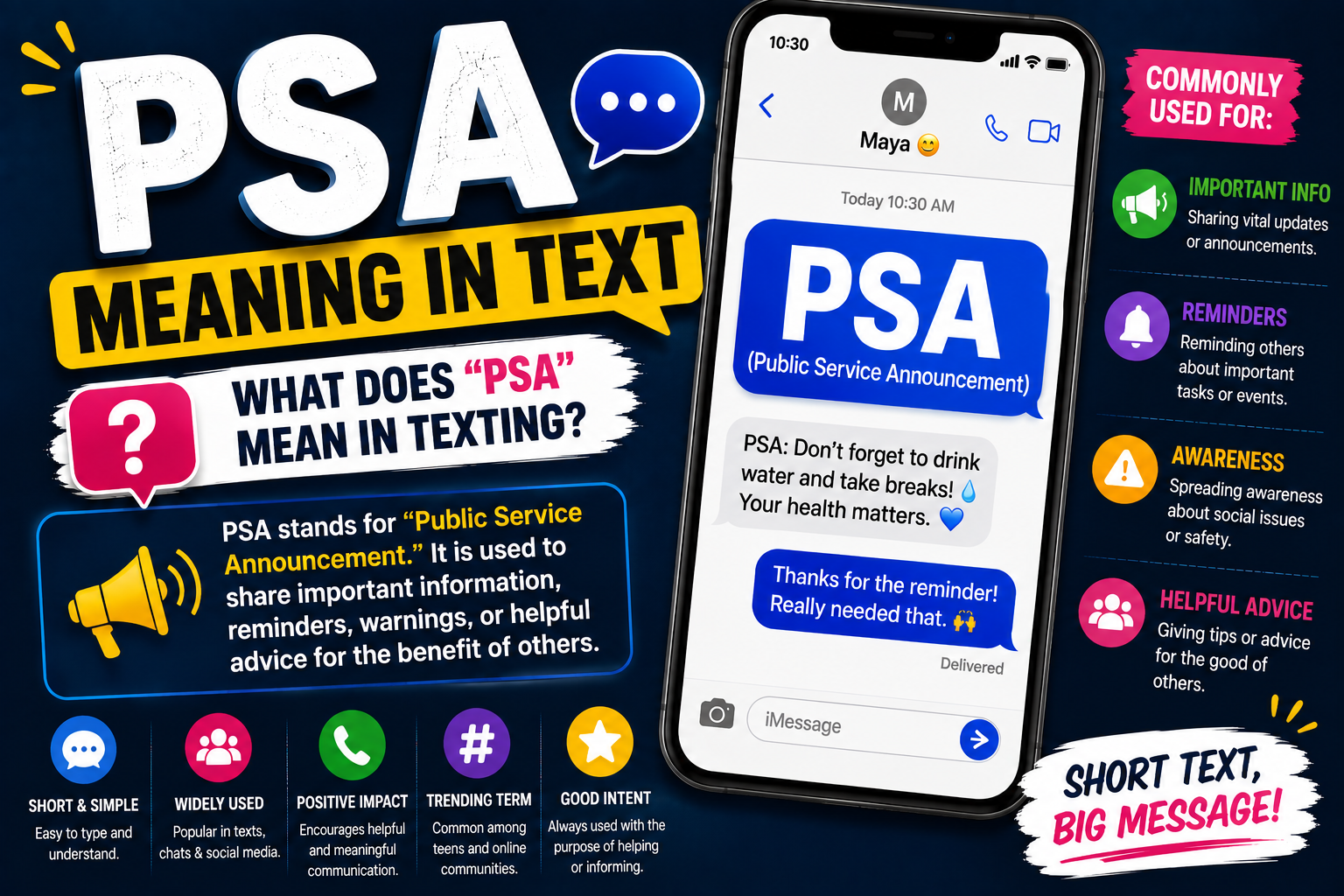
In everyday texting and social media, PSA most commonly means “Public Service Announcement.” People use it before sharing information, reminders, warnings, or advice that they want others to notice.
For example:
“PSA: Don’t forget your keys!”
Here, PSA means “Public Service Announcement.”
It can be serious, informative, helpful, or even humorous depending on how it is used.
What Does PSA Mean in Text?
Primary Meaning
PSA = Public Service Announcement
A PSA is a message intended to inform the public about something important, useful, or noteworthy.
In texting and social media, people often use PSA casually to introduce:
- An important reminder.
- Helpful information.
- A warning.
- Advice.
- An announcement.
- A funny observation.
Quick Reference Table
| Meaning | Platform | Context | Example |
|---|---|---|---|
| Public Service Announcement | Text Messages | Reminder | “PSA: Bring an umbrella.” |
| Public Service Announcement | Snapchat | Advice | “PSA: Charge your phone.” |
| Public Service Announcement | Information | “PSA: This sale ends today.” | |
| Public Service Announcement | TikTok | Warning/advice | “PSA: Don’t try this.” |
| Public Service Announcement | Group announcement | “PSA: Meeting starts at 5.” |
PSA Meaning in Everyday Texting
In everyday texting, PSA is often used humorously or casually rather than as a formal public announcement.
Someone might write:
“PSA: The coffee machine is broken.”
They’re simply drawing attention to information they think everyone should know.
Examples
- “PSA: Don’t forget your homework.”
- “PSA: The store closes at 8.”
- “PSA: Drink some water.”
- “PSA: Your favorite show is back.”
- “PSA: Stop leaving your charger at home 😂.”
PSA Meaning on Snapchat
On Snapchat, PSA can be used in stories, captions, or private chats to get someone’s attention.
Examples
- “PSA: I’m officially done with exams!”
- “PSA: Don’t send me spoilers.”
- “PSA: This place has the best food.”
- “PSA: Charge your phone before going out.”
- “PSA: It’s freezing outside!”
The term often gives the message a playful or dramatic tone.
PSA Meaning on Instagram
On Instagram, PSA is frequently used in captions, Stories, comments, and DMs.
Examples include:
- “PSA: This event is tomorrow.”
- “PSA: Wear sunscreen.”
- “PSA: Check out this new collection.”
- “PSA: Stop comparing yourself to people online.”
- “PSA: This is your reminder to take a break.”
On social media, PSA can be used for both serious information and humorous announcements.
PSA Meaning on TikTok
TikTok creators often use PSA before giving advice, sharing information, or making an announcement.
Examples
- “PSA: Don’t believe everything you see online.”
- “PSA: Here’s how to fix this problem.”
- “PSA: This trend is dangerous.”
- “PSA: You need to try this.”
- “PSA: Stop doing this to your hair.”
In these cases, PSA signals that the creator wants viewers to pay attention to the following message.
PSA Meaning in Relationships
In relationship conversations, PSA can be used playfully to make an announcement or reminder.
For example:
“PSA: Your girlfriend wants food 😂.”
Or:
“PSA: You still owe me a date.”
Here, PSA isn’t a formal public announcement. It is being used humorously to emphasize the message.
Examples
- “PSA: I miss you.”
- “PSA: You promised me ice cream.”
- “PSA: Don’t forget our anniversary.”
- “PSA: Your boyfriend is hungry 😂.”
The tone depends on the relationship and context.
PSA Meaning in Professional Communication
In professional communication, PSA can have a more formal meaning: Public Service Announcement.
It can also refer to other professional terms depending on the industry.
For example:
“The organization released a PSA about road safety.”
Here, PSA refers to a public information campaign or announcement.
In a workplace chat, someone might also casually write:
“PSA: The office will close at 3 PM today.”
This is an informal use of the abbreviation to highlight important information.
Other Possible Meanings of PSA
Although Public Service Announcement is the most common meaning in social media and texting, PSA can stand for several other things.
| Meaning | Context |
| Public Service Announcement | General/social media |
| Prostate-Specific Antigen | Medical |
| PSA Airlines | Aviation |
| Pressure-Sensitive Adhesive | Manufacturing/technical |
| Professional Services Automation | Business/technology |
| Philippine Sports Association | Organization-specific |
| Public Storage Auction | Business/auction contexts |
The surrounding context determines the intended meaning.
How to Identify the Correct Meaning
Look at What Comes After PSA
If someone writes:
“PSA: Don’t forget to bring your ID.”
PSA almost certainly means Public Service Announcement.
If a medical document says:
“The patient’s PSA level was tested.”
PSA refers to prostate-specific antigen.
Consider the Conversation Topic
| Topic | Likely Meaning |
| Social media | Public Service Announcement |
| Group chat | Public Service Announcement |
| General advice | Public Service Announcement |
| Medical | Prostate-Specific Antigen |
| Manufacturing | Pressure-Sensitive Adhesive |
| Business technology | Professional Services Automation |
Tone Guide
| Version | Typical Tone |
| “PSA:” | Informative |
| “PSA!!!” | Urgent/excited |
| “PSA 😂” | Humorous |
| “Quick PSA” | Casual reminder |
| “Important PSA” | Serious/informative |
How to Reply to PSA
If someone sends a PSA, you can respond according to the message.
Simple Replies
- “Good to know!”
- “Thanks for the reminder.”
- “Noted.”
- “I didn’t know that.”
- “That’s helpful.”
- “Thanks for letting me know.”
Example
Friend:
“PSA: The restaurant closes early tonight.”
You:
“Thanks! I’ll keep that in mind.”
When Not to Use PSA
PSA is generally informal when used in everyday texting. Avoid using it unnecessarily in:
- Formal academic writing.
- Legal documents.
- Official reports.
- Formal business correspondence.
- Professional documents where the meaning isn’t defined.
If you use PSA in formal writing, spell out “Public Service Announcement” the first time.
Why Understanding PSA Matters
Understanding PSA can help you:
- Recognize social media abbreviations.
- Understand group-chat announcements.
- Follow online conversations.
- Interpret warnings and reminders.
- Communicate naturally online.
Alternatives to PSA
Depending on the context, you can replace PSA with:
| PSA | Alternative |
| Public Service Announcement | Important announcement |
| Public Service Announcement | Quick reminder |
| Public Service Announcement | Important notice |
| Public Service Announcement | Just a reminder |
| Public Service Announcement | FYI |
| Public Service Announcement | Heads-up |
5 Real-Life Examples
Example 1
Message:
“PSA: Don’t forget your assignment is due tomorrow.”
Meaning:
The sender is making an important reminder.
Example 2
Message:
“PSA: Drink some water today 💧.”
Meaning:
A casual reminder to stay hydrated.
Example 3
Message:
“PSA: This store closes at 6 PM.”
Meaning:
The sender wants everyone to know about the closing time.
Example 4
Message:
“PSA: Stop sending spoilers 😂.”
Meaning:
The sender is jokingly announcing that people should stop posting spoilers.
Example 5
Message:
“PSA: The road is closed today.”
Meaning:
The sender is sharing useful public information.
Quick Reference Cheat Sheet
| Platform/Context | Most Likely Meaning |
| Text Messages | Public Service Announcement |
| Snapchat | Public Service Announcement |
| Public Service Announcement | |
| TikTok | Public Service Announcement |
| Public Service Announcement | |
| Public Service Announcement | |
| Discord | Public Service Announcement |
| Medical Context | Prostate-Specific Antigen |
FAQs
What does PSA mean in text?
In texting and social media, PSA usually means “Public Service Announcement.” It introduces information, advice, warnings, or reminders.
What does PSA mean on Snapchat?
On Snapchat, PSA commonly means “Public Service Announcement” and is often used humorously or informally before a reminder or announcement.
What does PSA mean on Instagram?
On Instagram, PSA is commonly used in posts, captions, Stories, and DMs to draw attention to important information or advice.
What does PSA mean on TikTok?
On TikTok, PSA usually introduces advice, warnings, announcements, or information that the creator wants viewers to notice.
Is PSA slang?
PSA is an abbreviation rather than traditional slang. However, it is frequently used informally in online conversations and social media.
Is PSA serious?
It can be serious or humorous. In social media, people often use PSA playfully, while traditional public service announcements are generally intended to provide useful or important information.
What does PSA stand for?
The most common meaning is “Public Service Announcement.”
Can PSA have other meanings?
Yes. In medical contexts, PSA can mean prostate-specific antigen. It can also represent technical, business, and organization-specific terms.
How should I reply to a PSA?
If someone shares a PSA, you can respond with “Thanks for the reminder,” “Good to know,” or another response appropriate to the information.
Can PSA be used professionally?
Yes. PSA can be used professionally when it means Public Service Announcement, especially in communications and public-information contexts. In formal writing, spell out the term on first use.
Conclusion
The PSA meaning in text is usually “Public Service Announcement.” People use it to introduce important information, reminders, warnings, advice, or announcements. On Snapchat, Instagram, TikTok, WhatsApp, and other platforms, PSA is often used casually or humorously to make a message stand out.
Although Public Service Announcement is the most common meaning in online conversations, PSA can also refer to terms such as prostate-specific antigen in medical contexts. Always consider the subject of the conversation before deciding what PSA means.