
SMH is the internet’s oldest eye-roll. Short for “shaking my head,” it turns a physical gesture — that slow side-to-side shake you do when words fail — into three letters. It’s been expressing disappointment, disbelief, and secondhand embarrassment online since before TikTok existed, and it isn’t going anywhere.
What makes SMH special is that everyone already knows the gesture. You don’t need to explain it; the letters just summon the image. Here’s how to read it, use it, and avoid misusing it.
This guide covers the real history of SMH, how its tone shifts from funny to cutting, the famous redundancy meme, and where it fits among today’s reaction slang.
What Does SMH Mean in Text?
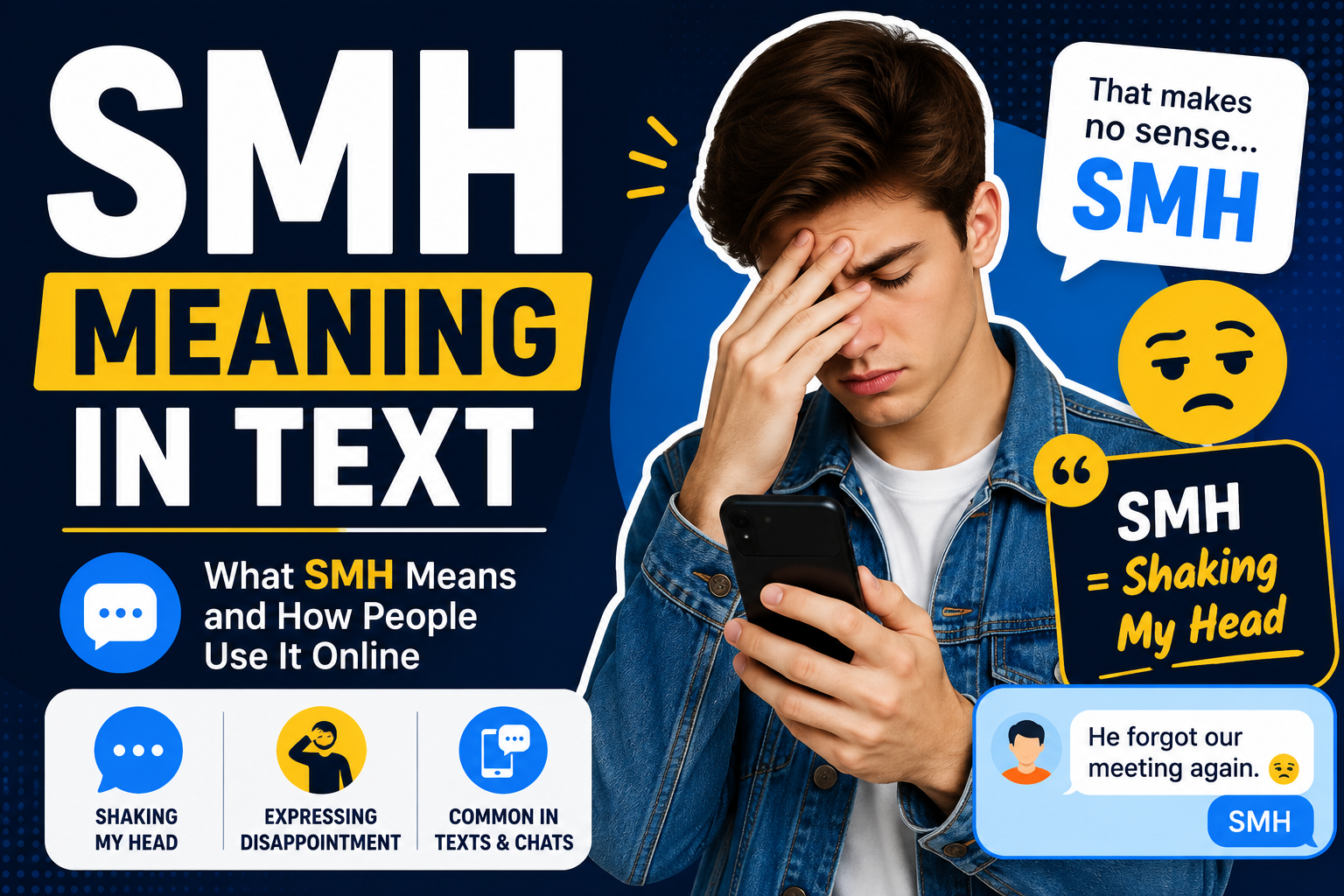
Quick answer: In texting, SMH stands for “shaking my head.” People use it to react to something disappointing, unbelievable, or foolish — sometimes with humor, sometimes with genuine frustration.
| Term | SMH |
| Stands for | “Shaking My Head” |
| Tone | Disappointed, exasperated — often humorous |
| Where you’ll see it | Everywhere: texts, TikTok comments, X/Twitter, Instagram, group chats |
| Safe for work or school? | Borderline — fine in casual chat, not in formal writing |
The Gesture Behind the Letters
SMH works because the head-shake is universal. Across cultures, shaking your head side to side signals “no,” disbelief, or disapproval — it’s one of the first gestures babies understand. Typing SMH is just performing that gesture in text form. That’s why it survived every platform migration from forums to group chats: no translation needed, no generation gap. Your mom probably knows this one.
A Brief History of SMH
SMH is ancient by internet standards. It emerged in the early 2000s on forums, chatrooms, and instant messaging — AIM, MSN Messenger, early Facebook — as one of the first “reaction abbreviations” alongside LOL and OMG. Back then, the internet was inventing a whole body language for text: laughter became LOL, surprise became OMG, and weary disapproval became SMH.
While most slang of that era died (RIP “rawr” and “xD”), SMH endured for a simple reason: the gesture it describes never goes out of style. There’s always something new to shake your head at. Each new platform — from Facebook to Twitter to TikTok — adopted it instantly, because every comment section needs a one-word verdict.
Why SMH Outlived Its Generation
Most early-2000s slang died with the platforms that birthed it. SMH survived for three reasons. First, the gesture is universal — no translation, no learning curve, no explanation needed. Second, it’s emotionally precise: it captures a specific blend of disappointment and disbelief that no other abbreviation nails. Third, every new platform rediscovers it, because every comment section needs a one-word verdict.
LOL got replaced by emojis and “lmao”; SMH never found a replacement, because nothing else does the head-shake in three letters. It may be the most future-proof slang on the internet.
How People Actually Use SMH
1. Self-directed facepalm. “Locked my keys in the car again. SMH.” Disappointed in yourself, said with a laugh.
2. Reacting to someone else’s mess. “He showed up two hours late. SMH.” The classic use — witnessing poor decisions.
3. Comment-section verdict. “SMH, people really believe anything.” TikTok and X’s favorite one-word review.
4. Playful with friends. “You ate the last slice?? SMH” Best served with a laughing emoji.
5. World-weary sigh. “SMH at this weather.” Not angry, just tired of it.
6. Reacting to the news cycle. “Another reboot? SMH.” The abbreviation scales from group chats to global events without breaking a sweat.
7. The gentle roast. “You really thought that would work? SMH, love you though.” Disappointment wrapped in affection.
“SMH My Head” and Other Redundancies
You’ve probably seen “smh my head” — which literally reads “shaking my head my head.” It’s redundant, and everyone knows it, and that’s the joke. Like “ATM machine” or “PIN number,” the doubled word adds emphasis through sheer wrongness. Saying “smh my head” is a meme about how natural the phrase has become — your head is shaking so hard you had to say it twice.
SMH Across Platforms
- TikTok comments: the verdict machine. “SMH” under a video is the audience’s collective head-shake — it can make or break how a clip is perceived.
- X/Twitter: quote-tweet fuel. A bad take with a hundred “smh” replies is a public roasting.
- Instagram: shows up in captions (“smh, Monday again”) and comments alike.
- Group chats: the everyday habitat — reacting to friends’ stories in real time.
- Twitch chat: floods the screen when a streamer makes a baffling decision.
Reading the Tone: Disappointed, Amused, or Done?
- Amused: paired with laughing emojis, about trivial things. “SMH you really did that”
- Genuinely disappointed: no emoji, about something that actually matters. “Smh. Expected better.”
- Done: a standalone “smh” ending a long rant or argument.
- Affectionate: “smh, you’re ridiculous” to a close friend is practically a compliment.
- Sarcastic: “smh, incredible work” after an obvious failure — the praise is the insult.
SMH vs. Its Cousins
| Reaction | What it signals | Difference from SMH |
| SMH | Disappointment, disbelief | The baseline — calm and universal |
| SMDH | Stronger disbelief | “Shaking my damn head” — SMH with the dial turned up |
| Facepalm | Embarrassment, frustration | Stronger; implies “I can’t even look” |
| Bruh | Disbelief, exasperation | More confrontational, directed at a person |
| Sigh / *sigh* | Weariness | Softer, more resigned than SMH |
| “I can’t” | Overwhelmed disbelief | More dramatic; SMH is drier |
When SMH Stings
- Aimed at a person. “SMH at you” hits different from “SMH at this situation” — the first one is judgment.
- Serious confessions. Replying “smh” to someone opening up about a real problem reads as dismissive.
- Punching down. SMH in reply to someone’s genuine mistake or misfortune can feel like mockery.
- With authority figures. It’s informal enough that bosses and teachers may read it as flippant.
SMH FAQs
What does SMH stand for?
“Shaking my head.” It’s a text version of the physical gesture.
Is SMH rude?
Usually not — it’s one of the mildest reaction abbreviations. But aimed directly at a person (“smh at you”), it becomes judgmental.
What does “smh my head” mean?
It’s an intentional redundancy — “shaking my head my head” — used as a meme for extra emphasis.
What’s the difference between SMH and SMDH?
SMDH stands for “shaking my damn head” — SMH with the profanity dial turned up for extra disbelief. Same gesture, stronger feeling. SMH remains the everyday default.
Is SMH outdated?
No. Unlike most early-2000s slang, SMH never left. It’s used across all generations and platforms.
What generation uses SMH the most?
Everyone, honestly. Millennials grew up with it on AIM and Facebook; Gen Z uses it daily; even Gen X knows this one. It’s the rare slang with no generation gap.
Why is SMH so popular in comments?
It’s the perfect low-effort verdict: three letters that say “I disapprove” without starting a fight. Comment sections run on that energy.
Can I use SMH at work?
In casual team chats, occasionally. In emails, reports, or client messages, use “That’s disappointing” or “That’s unfortunate” instead.
The Bottom Line
SMH has survived two decades of internet slang because the gesture is timeless: there will always be something worth shaking your head at. Use it for situations, not people — and when the disappointment is real, consider using your words instead.