
The word “experience” is extremely useful, but it can also be surprisingly broad. It can describe knowledge gained from working in a field, a memorable event, a difficult period in life, practical involvement, or something you personally went through.
For example, you might say:
- “She has five years of experience in marketing.”
- “The trip was an unforgettable experience.”
- “He has firsthand experience with the problem.”
- “The internship gave me valuable experience.”
- “It was a difficult experience, but I learned from it.”
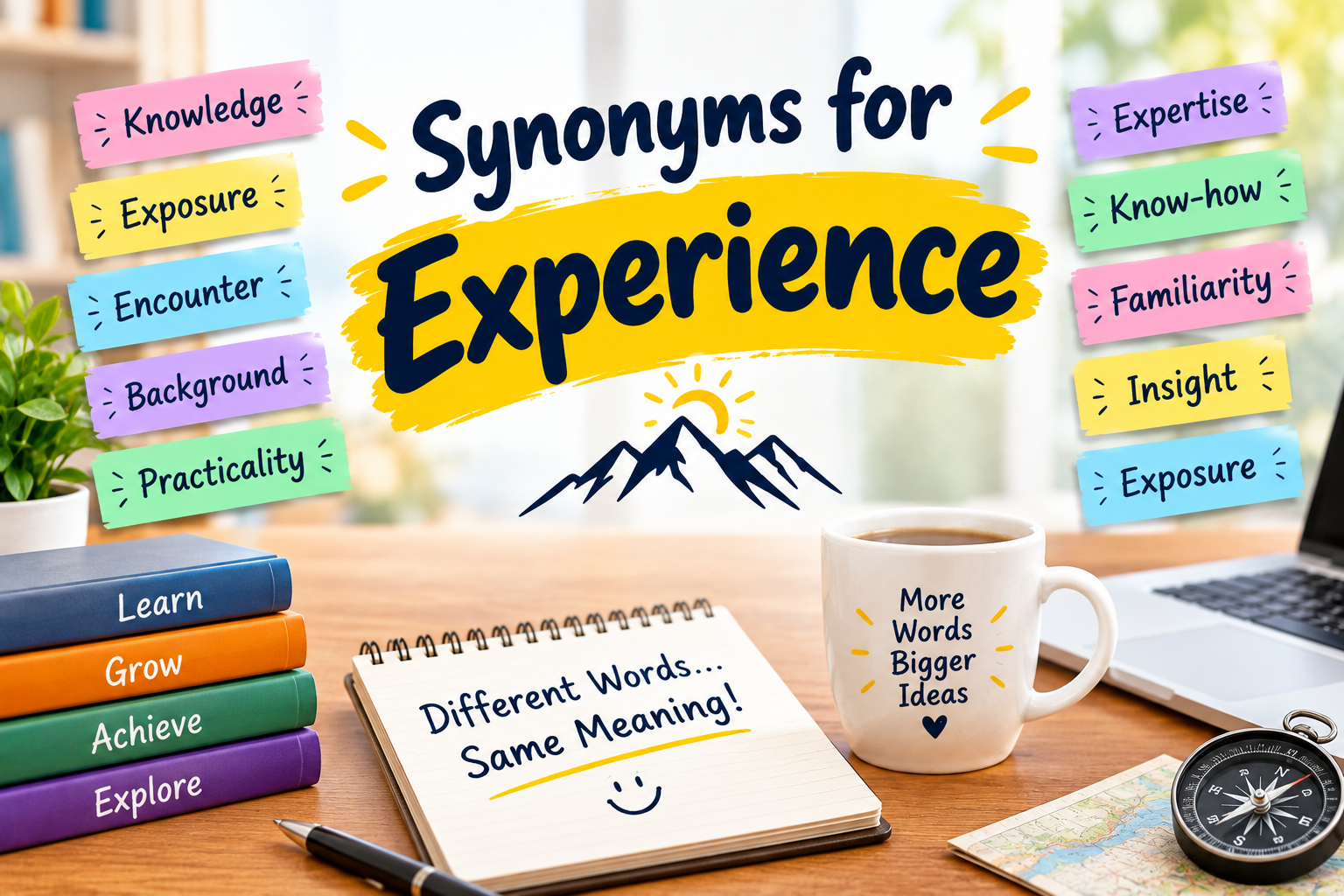
Because “experience” covers so many meanings, the best synonym depends on the context. Expertise may be appropriate when you mean advanced knowledge, while encounter works better for a specific event. Background can describe someone’s professional history, while exposure suggests contact or introduction to something.
This guide explores more than 80 synonyms and alternatives for “experience,” including words for CVs, resumes, professional writing, academic essays, personal stories, difficult experiences, life experiences, practical experience, and everyday conversation.
What Does “Experience” Mean?
Experience has several related meanings.
As a noun, it can refer to:
- Knowledge or skill gained through doing something
- An event or situation that someone has lived through
- Practical involvement in a particular activity
- A personal event that creates a lasting impression
As a verb, experience means to go through, encounter, feel, or undergo something.
Examples
She has ten years of experience in accounting.
Here, “experience” means knowledge and practical skill gained through work.
Visiting Japan was an amazing experience.
Here, “experience” means a memorable event or period.
He experienced severe difficulties during the project.
Here, “experienced” means went through or encountered something.
Quick Reference: Synonyms for Experience
| Synonym | Best Meaning | Example |
|---|---|---|
| Expertise | Advanced knowledge or skill | She has expertise in cybersecurity. |
| Knowledge | Understanding gained through learning | His knowledge of finance is impressive. |
| Background | Education, work, or personal history | She has a background in engineering. |
| Proficiency | High level of ability | He has proficiency in Spanish. |
| Skill | Learned ability | The role requires technical skills. |
| Competence | Ability to perform effectively | Her competence impressed the team. |
| Mastery | Very advanced command | He demonstrated mastery of the subject. |
| Exposure | Contact or introduction | The course gave students exposure to research. |
| Encounter | A particular meeting or event | The encounter changed her perspective. |
| Involvement | Active participation | His involvement in the project was significant. |
| Journey | A process of development | Learning was a rewarding journey. |
| Adventure | Exciting experience | The trip was a memorable adventure. |
| Ordeal | Very difficult experience | Recovery was a painful ordeal. |
| Insight | Deep understanding | The experience gave her valuable insight. |
| Lesson | Knowledge gained from an event | The mistake taught him an important lesson. |
80+ Synonyms for Experience
Not every synonym below can replace “experience” in every sentence. Each emphasizes a slightly different aspect of the original word.
| # | Synonym | Meaning | Example |
|---|---|---|---|
| 1 | Expertise | Advanced knowledge or skill | She has expertise in digital marketing. |
| 2 | Knowledge | Information and understanding | His knowledge of history is extensive. |
| 3 | Skill | Learned ability | The position requires strong communication skills. |
| 4 | Proficiency | High level of ability | She has proficiency in French. |
| 5 | Competence | Ability to perform successfully | His technical competence is impressive. |
| 6 | Mastery | Exceptional command of a subject | She achieved mastery of the instrument. |
| 7 | Know-how | Practical knowledge | He has the know-how to solve the problem. |
| 8 | Background | Previous education or work history | She has a background in finance. |
| 9 | Track record | History of achievements or results | The company has a strong track record. |
| 10 | Exposure | Contact or introduction | The internship provided exposure to research. |
| 11 | Familiarity | Knowledge gained through contact | He has familiarity with the software. |
| 12 | Understanding | Knowledge of how something works | Her understanding of the issue improved. |
| 13 | Insight | Deep understanding gained through observation or experience | The project gave him valuable insight. |
| 14 | Wisdom | Good judgment developed over time | Experience often brings wisdom. |
| 15 | Encounter | A particular meeting or event | The encounter changed her outlook. |
| 16 | Event | Something that happened | The conference was an important event. |
| 17 | Incident | A specific occurrence | The incident taught us a valuable lesson. |
| 18 | Episode | A particular period or event | That episode remained memorable. |
| 19 | Adventure | Exciting experience | The trip was a wonderful adventure. |
| 20 | Ordeal | Very difficult experience | The illness was a difficult ordeal. |
| 21 | Trial | Difficult test or experience | Starting the business was a challenging trial. |
| 22 | Journey | Process of growth or development | Recovery was a long journey. |
| 23 | Affair | Event, matter, or situation | The affair attracted considerable attention. |
| 24 | Happening | Event or occurrence | It was an unusual happening. |
| 25 | Occurrence | Something that takes place | Such occurrences are uncommon. |
| 26 | Sensation | Strong physical or emotional feeling | Flying created a strange sensation. |
| 27 | Impression | Effect left by an event | The interview made a strong impression. |
| 28 | Memory | Something remembered | It remains one of my favorite memories. |
| 29 | Recollection | Recalled event or memory | Her recollection of the event was clear. |
| 30 | Training | Structured learning | The job requires extensive training. |
| 31 | Practice | Repeated activity that develops ability | Years of practice improved his technique. |
| 32 | Fieldwork | Practical work in a real environment | The researchers conducted fieldwork. |
| 33 | Apprenticeship | Learning through practical work with an expert | He completed an apprenticeship. |
| 34 | Grounding | Basic foundation of knowledge | She has a strong grounding in mathematics. |
| 35 | Awareness | Knowledge or recognition | The experience increased his awareness. |
| 36 | Intuition | Instinctive understanding | Her intuition helped her make the decision. |
| 37 | Involvement | Active participation | His involvement lasted several years. |
| 38 | Participation | Taking part in something | Student participation increased. |
| 39 | Engagement | Active connection or participation | Her engagement with the project was valuable. |
| 40 | Observation | Learning by watching | Observation helped him understand the process. |
| 41 | Immersion | Deep involvement | Language immersion accelerated her learning. |
| 42 | Hardship | Difficult life experience | Hardship taught him resilience. |
| 43 | Chapter | Distinct period in life | College was an important chapter of her life. |
| 44 | Milestone | Significant stage or achievement | Graduation was a major milestone. |
| 45 | Lesson | Knowledge gained from an event | Failure became an important lesson. |
| 46 | Acquaintance | Familiarity with something or someone | He has some acquaintance with the subject. |
| 47 | Familiarization | Process of becoming familiar | The training included equipment familiarization. |
| 48 | Practice-based learning | Learning through practical work | The course emphasizes practice-based learning. |
| 49 | Direct involvement | Active firsthand participation | She gained direct involvement in the project. |
| 50 | Firsthand knowledge | Knowledge gained personally | He has firsthand knowledge of the process. |
| 51 | Practical knowledge | Knowledge gained through doing | The position requires practical knowledge. |
| 52 | Real-world experience | Knowledge gained outside theory | Internships provide real-world experience. |
| 53 | Lived experience | Knowledge gained from personally living through something | Her advice comes from lived experience. |
| 54 | Accomplishment | Successful result from experience or effort | The achievement was a major accomplishment. |
| 55 | Achievement | Something successfully completed | The project was an important achievement. |
| 56 | Record | History of actions or achievements | She has an excellent record in management. |
| 57 | History | Past involvement or development | He has a long history in the industry. |
| 58 | Tenure | Period spent in a position | During her tenure, the company expanded. |
| 59 | Career | Professional experience over time | He built a successful career in law. |
| 60 | Work history | Record of previous employment | Her work history is impressive. |
| 61 | Professional background | Career-related history | His professional background is in technology. |
| 62 | Familiarity | Knowledge developed through repeated contact | Her familiarity with the system saved time. |
| 63 | Capability | Ability developed through practice | The role requires strong technical capability. |
| 64 | Aptitude | Natural ability that experience can develop | His aptitude for programming became clear early. |
| 65 | Development | Growth resulting from learning | Professional development is essential. |
| 66 | Growth | Personal or professional improvement | The experience contributed to her growth. |
| 67 | Perspective | Understanding shaped by experience | Travel gave him a broader perspective. |
| 68 | Maturity | Developed judgment and understanding | The experience gave her greater maturity. |
| 69 | Conditioning | Development through repeated exposure | Training created useful physical conditioning. |
| 70 | Experiment | Practical test or trial | The project was an interesting experiment. |
| 71 | Exploration | Process of discovering something | The course encouraged exploration. |
| 72 | Discovery | Something learned through experience | The project led to an important discovery. |
| 73 | Interaction | Experience gained through contact | Interaction with customers improved his skills. |
| 74 | Contact | Direct exposure to something | The role gave her contact with international clients. |
| 75 | Exposure | Opportunity to encounter something | Students gained exposure to different cultures. |
| 76 | Practice | Repeated performance | Regular practice built confidence. |
| 77 | Learning | Knowledge gained through study or experience | The assignment became a valuable learning opportunity. |
| 78 | Developmental experience | Experience that promotes growth | The internship was a developmental experience. |
| 79 | Life event | Important occurrence in someone’s life | Marriage can be a major life event. |
| 80 | Personal history | Events and circumstances from someone’s past | His personal history shaped his perspective. |
What Is Another Word for Experience?
The best alternative depends on which meaning of “experience” you have in mind.
If you mean professional experience, use:
- Background
- Work history
- Track record
- Expertise
- Proficiency
- Professional history
- Career
- Tenure
If you mean knowledge gained through doing, use:
- Practical knowledge
- Know-how
- Expertise
- Skill
- Proficiency
- Competence
- Mastery
- Hands-on knowledge
If you mean a specific event, use:
- Encounter
- Event
- Incident
- Episode
- Occurrence
- Adventure
- Situation
If you mean a difficult experience, use:
- Ordeal
- Hardship
- Trial
- Challenge
- Struggle
- Adversity
If you mean personal growth, use:
- Journey
- Development
- Growth
- Learning
- Milestone
- Lesson
- Transformation
Best Synonyms for Experience on a CV or Resume
“Experience” is extremely common on CVs and resumes, so replacing it with a more specific word can make your writing more precise.
1. Professional Background
Use background when describing your previous education, employment, or professional history.
I have a strong background in software development.
2. Expertise
Use expertise when you genuinely have advanced knowledge or skill.
She brings extensive expertise in SEO strategy.
3. Track Record
Use track record when you want to emphasize proven results.
He has a strong track record of improving sales performance.
4. Proficiency
Use proficiency for specific technical, language, or professional skills.
Demonstrated proficiency in Microsoft Excel and data analysis.
5. Professional History
Use this when referring to previous employment or career development.
His professional history includes leadership roles in several organizations.
6. Hands-On Experience
This phrase emphasizes practical involvement rather than theoretical knowledge.
The internship provided hands-on experience with laboratory equipment.
7. Practical Knowledge
This works well when you want to emphasize knowledge gained by actually doing something.
She has extensive practical knowledge of project management.
Synonyms for Work Experience
When referring specifically to employment or professional activity, consider:
- Professional background
- Work history
- Career history
- Professional history
- Track record
- Employment history
- Practical experience
- Hands-on experience
- Industry experience
- Field experience
- Expertise
- Professional exposure
- Career background
- Tenure
- Practice
Examples
She has five years of industry experience.
He has a strong professional background in finance.
Her track record demonstrates consistent success.
The position requires extensive hands-on experience.
Synonyms for Life Experience
When talking about events that shape someone’s understanding or personality, these alternatives are useful:
- Life journey
- Personal history
- Lived experience
- Life lessons
- Personal growth
- Life events
- Memories
- Encounters
- Adventures
- Challenges
- Hardships
- Milestones
- Lessons
- Personal development
- Perspective
Examples
Travel has been an important part of her life journey.
His lived experience gives him a unique perspective.
Difficulties often become valuable life lessons.
The event became an important milestone in her life.
Synonyms for a Good Experience
If you want to describe a positive or enjoyable experience, “experience” can be replaced with more expressive words.
- Adventure
- Pleasure
- Enjoyment
- Opportunity
- Highlight
- Memory
- Celebration
- Journey
- Discovery
- Achievement
- Milestone
- Delight
- Reward
- Success
- Memorable occasion
Examples
The vacation was an unforgettable adventure.
The internship was a valuable opportunity.
Graduation was one of the biggest milestones of her life.
The concert became a cherished memory.
Synonyms for a Bad or Difficult Experience
When “experience” involves hardship or suffering, stronger vocabulary can communicate the meaning more clearly.
Ordeal
An ordeal is a very difficult or painful experience.
The recovery process was a long ordeal.
Hardship
Hardship describes prolonged difficulty or suffering.
Years of hardship taught her resilience.
Trial
A trial is a difficult situation that tests someone.
The experience was a difficult trial, but he learned from it.
Adversity
Adversity refers to serious difficulty or challenging circumstances.
She developed remarkable strength through adversity.
Struggle
Struggle describes a difficult effort or period of hardship.
Learning a new language was a challenging struggle at first.
Synonyms for Experience in Academic Writing
Academic writing often benefits from precise alternatives rather than repeatedly using “experience.”
Useful choices include:
- Exposure
- Observation
- Immersion
- Practical knowledge
- Empirical knowledge
- Firsthand knowledge
- Direct involvement
- Participation
- Fieldwork
- Familiarity
- Understanding
- Insight
- Investigation
- Engagement
Examples
Instead of:
Students gained experience working in laboratories.
You could write:
Students gained practical knowledge through laboratory work.
Instead of:
The research gave participants experience with the process.
You could write:
The research gave participants direct exposure to the process.
Formal Synonyms for Experience
For formal reports, business writing, academic documents, and professional communication, these words can be useful:
- Expertise
- Proficiency
- Competence
- Background
- Exposure
- Knowledge
- Familiarity
- Track record
- Professional history
- Practical knowledge
- Firsthand knowledge
- Direct involvement
- Training
- Fieldwork
- Mastery
The best choice depends on exactly what you want to communicate.
Informal Synonyms for Experience
In casual conversation, you can use more relaxed expressions such as:
- Adventure
- Story
- Memory
- Encounter
- Lesson
- Chapter
- Journey
- Time
- Thing I went through
- Been through it
- Been there, done that
- Know-how
- Real-world knowledge
Examples:
That trip was quite an adventure.
I’ve been through that before.
That was a tough chapter in my life.
I’ve got the know-how to handle it.
Synonyms for Experience in Personal Writing
For memoirs, personal essays, storytelling, and reflective writing, more emotional alternatives can make the writing vivid.
Consider:
- Journey
- Chapter
- Memory
- Encounter
- Adventure
- Ordeal
- Lesson
- Milestone
- Transformation
- Discovery
- Hardship
- Growth
- Turning point
- Challenge
- Revelation
Example
Basic:
Moving abroad was an experience that changed me.
More expressive:
Moving abroad became a turning point that changed how I saw the world.
Or:
Moving abroad was a transformative journey that reshaped my perspective.
Experience vs. Expertise
These words are related but not identical.
Experience refers to what you have done or been exposed to over time.
Expertise suggests a high level of specialized knowledge or skill.
Compare:
She has ten years of experience in accounting.
This tells us how long she has worked in the field.
She has extensive expertise in corporate taxation.
This emphasizes specialized knowledge and ability.
Someone can have years of experience without necessarily having advanced expertise.
Experience vs. Knowledge
Knowledge refers primarily to what someone knows.
Experience refers more strongly to what someone has actually done or lived through.
He has extensive knowledge of computer science.
He has practical experience developing software.
A person can learn knowledge from books, lectures, or courses without having practical experience.
Experience vs. Exposure
These words are often confused.
Exposure usually means contact, introduction, or familiarity with something.
Experience generally suggests more direct or sustained involvement.
The course gave students exposure to programming.
This suggests they were introduced to programming.
She has three years of experience programming in Python.
This suggests substantial practical involvement.
Experience vs. Background
Background describes someone’s overall history, including education, employment, training, and sometimes personal circumstances.
Experience focuses more specifically on what someone has done.
She has a background in engineering.
This describes her broader professional history.
She has experience managing engineering projects.
This describes a specific type of work she has performed.
Experience vs. Encounter
An encounter is usually a particular event, meeting, or interaction.
An experience can refer to one event or an extended period.
I had an unusual encounter with a stranger on the train.
Living abroad was an important experience.
“Encounter” often suggests something specific and sometimes unexpected.
Experience vs. Journey
A journey emphasizes development, change, or progression.
An experience is broader and can simply refer to something that happened.
Learning to play the piano was a rewarding experience.
Learning to play the piano became a long journey of discovery.
“Journey” is especially effective in reflective or emotional writing but can sound overly dramatic in formal business contexts.
Common Phrases With Experience
1. Years of Experience
Refers to the amount of time someone has spent doing something.
She has ten years of experience in education.
2. Firsthand Experience
Knowledge gained by personally doing or witnessing something.
He has firsthand experience working with international clients.
3. Hands-On Experience
Practical involvement rather than theoretical learning.
The internship provided hands-on experience.
4. Relevant Experience
Experience directly connected to a job, task, or situation.
Please describe your relevant experience.
5. Real-World Experience
Practical knowledge gained outside theoretical or classroom settings.
The program gives students real-world experience.
6. Work Experience
Experience gained through employment or professional activity.
The position requires two years of work experience.
7. Valuable Experience
Experience that provides useful knowledge or skills.
The internship was valuable experience.
8. Learning Experience
An event that teaches something useful.
The mistake became a valuable learning experience.
9. Lived Experience
Knowledge gained through personally living through a particular situation.
Her recommendations are informed by lived experience.
10. Life-Changing Experience
An experience that significantly changes someone’s perspective, behavior, or life.
Studying abroad was a life-changing experience.
11. In My Experience
A phrase used to introduce something learned through personal experience.
In my experience, preparation makes a major difference.
12. Experience Has Taught Me
Used to introduce a lesson learned over time.
Experience has taught me to plan carefully.
How to Avoid Repeating “Experience”
Instead of repeating the word throughout a paragraph, identify what you actually mean.
If you mean skill:
Use:
- Expertise
- Proficiency
- Competence
- Mastery
- Skill
If you mean history:
Use:
- Background
- Track record
- Work history
- Career history
- Professional history
If you mean practical involvement:
Use:
- Hands-on experience
- Practical knowledge
- Direct involvement
- Fieldwork
- Participation
If you mean an event:
Use:
- Encounter
- Incident
- Episode
- Event
- Occurrence
If you mean personal growth:
Use:
- Journey
- Development
- Growth
- Lesson
- Milestone
- Transformation
This approach makes writing more precise rather than simply replacing every occurrence of “experience” with a random synonym.
Common Mistakes When Using Synonyms for Experience
1. Using “Expertise” Too Freely
Expertise suggests a high degree of specialized knowledge.
If you have only recently started learning something, exposure or familiarity may be more accurate.
2. Confusing Exposure With Experience
Exposure can mean simply being introduced to something.
I have exposure to data analysis.
This does not necessarily mean you have extensive practical ability.
3. Using “Journey” in Every Context
Journey works well for personal development and storytelling, but it may sound unnatural in a technical report.
Professional:
She has a strong background in accounting.
Less suitable:
She has been on an accounting journey for eight years.
4. Using Encounter for Long-Term Experience
An encounter normally describes a specific event or interaction.
Incorrect:
He has ten years of encounter in sales.
Correct:
He has ten years of experience in sales.
5. Confusing Experience With Knowledge
Knowledge is what you know; experience is what you have personally done or gone through.
6. Overusing Impressive-Sounding Words
Using words such as “mastery” or “expertise” can make a CV sound exaggerated if your actual skill level does not support them.
Specific and honest wording is generally stronger.
FAQs
What is the best synonym for experience?
There is no single best synonym because “experience” has several meanings. Expertise, background, knowledge, exposure, proficiency, encounter, involvement, journey, and insight are useful alternatives depending on context.
What is another word for experience on a CV?
For a CV, useful alternatives include professional background, work history, track record, expertise, proficiency, practical knowledge, hands-on experience, and professional history.
What is a professional word for experience?
Professional alternatives include expertise, proficiency, competence, background, track record, professional history, practical knowledge, and industry experience.
What is a synonym for work experience?
Possible alternatives include professional experience, employment history, work history, professional background, industry experience, career history, practical experience, and hands-on experience.
What is a synonym for life experience?
Useful alternatives include life journey, lived experience, personal history, life lessons, personal growth, life events, memories, milestones, and personal development.
What is a good synonym for experience in an essay?
Depending on the meaning, use encounter, event, exposure, observation, insight, journey, lesson, hardship, involvement, or personal experience.
What is another word for years of experience?
You can use phrases such as extensive experience, a strong professional background, a long track record, years of practice, extensive expertise, or a proven history.
Is expertise the same as experience?
No. Experience refers to what someone has done or lived through, while expertise suggests advanced knowledge or skill in a particular area.
Is exposure the same as experience?
Not exactly. Exposure generally suggests contact or introduction, while experience usually implies more direct or sustained involvement.
What is a synonym for a difficult experience?
Strong choices include ordeal, hardship, trial, adversity, struggle, challenge, setback, and difficult chapter.
What is a synonym for a positive experience?
Depending on the situation, you can use adventure, opportunity, highlight, memory, achievement, milestone, discovery, pleasure, or rewarding journey.
What is a synonym for firsthand experience?
You can say direct experience, firsthand knowledge, practical knowledge, lived experience, direct involvement, or real-world experience.
What is a synonym for practical experience?
Useful alternatives include hands-on experience, practical knowledge, real-world experience, field experience, direct involvement, and practice-based learning.
Final Thoughts
The word “experience” is versatile because it can describe knowledge, skill, work history, personal events, practical involvement, memories, challenges, and personal growth.
The best synonym depends on what you actually want to communicate.
Use expertise when you mean advanced knowledge, background for someone’s history, track record for proven results, proficiency for developed ability, and exposure for initial contact with a subject.
When describing a specific event, consider encounter, incident, episode, event, or occurrence. For difficult experiences, ordeal, hardship, adversity, and trial may be more precise. For personal development, words such as journey, growth, milestone, lesson, and transformation can make writing more expressive.
The most effective synonym is not necessarily the most sophisticated word. It is the one that communicates your intended meaning accurately.
Instead of simply asking, “What is another word for experience?” ask what kind of experience you mean: skill, knowledge, work history, event, hardship, involvement, or personal growth. Once you identify that meaning, choosing the right alternative becomes much easier.