

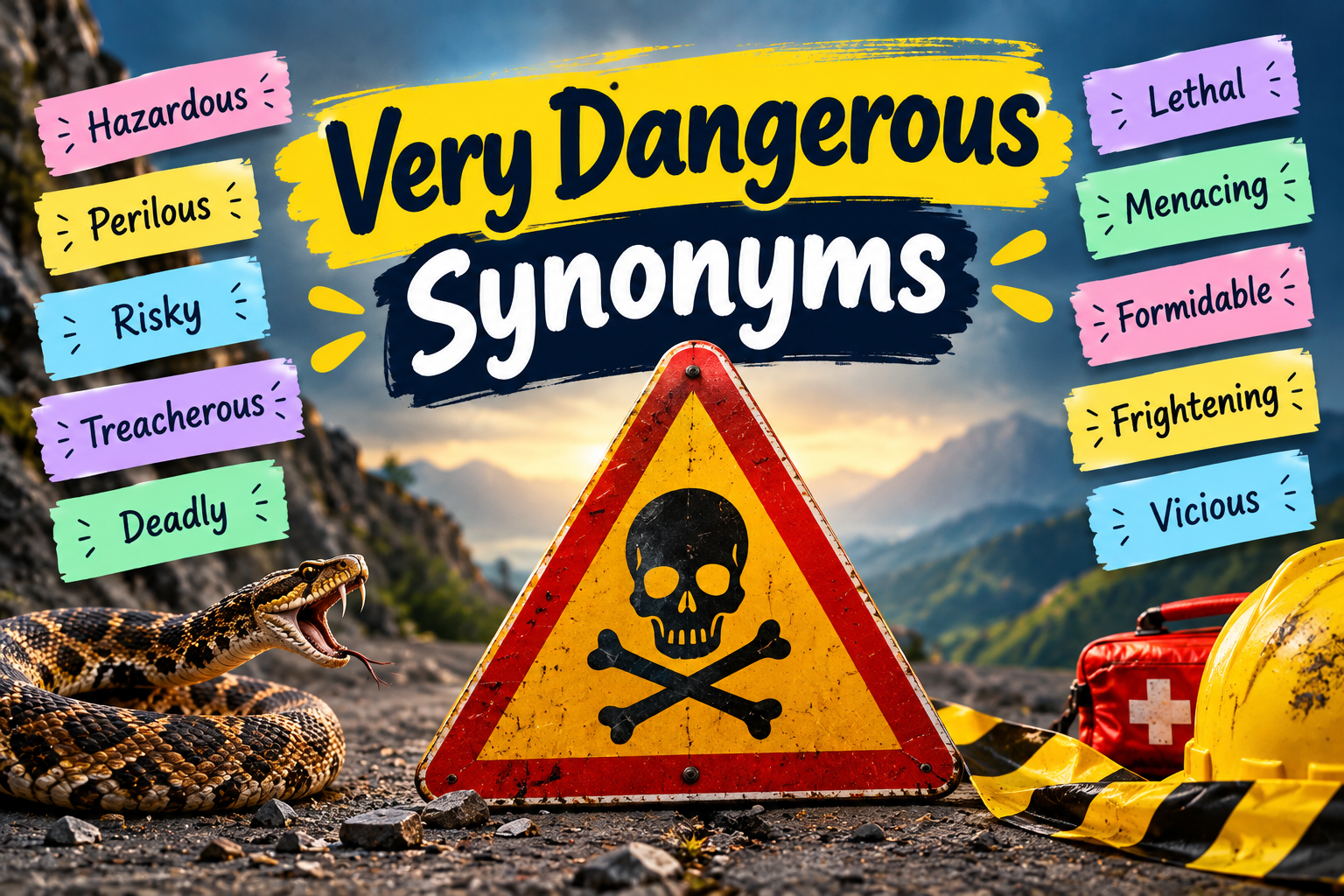
Finding the right synonym for “very dangerous” can make your writing more precise, powerful, and natural. While “very dangerous” is perfectly correct, repeating the same phrase can make an essay, article, report, story, or conversation sound repetitive.
Depending on the context, you might use words such as hazardous, perilous, deadly, lethal, life-threatening, treacherous, risky, unsafe, menacing, or catastrophic.
However, these words are not all interchangeable. Some describe a general risk, while others specifically suggest the possibility of death, hidden danger, serious damage, instability, or an immediate threat.
This guide explains more than 80 natural alternatives to “very dangerous,” including their meanings, examples, levels of intensity, formal alternatives, everyday expressions, and context-specific vocabulary.
What Does “Very Dangerous” Mean?
Very dangerous describes something that presents a high level of risk or has a strong potential to cause serious injury, damage, death, loss, or other harm.
For example:
- Driving at extremely high speeds can be very dangerous.
- The damaged bridge is very dangerous to cross.
- The chemical is very dangerous if inhaled.
- Climbing the mountain without proper equipment is very dangerous.
The best synonym depends on what makes something dangerous and how serious the consequences could be.
Quick Reference Table
| Synonym | Meaning | Best Used For | Example |
|---|---|---|---|
| Hazardous | Likely to cause harm | Safety, work, materials | The chemicals are hazardous. |
| Risky | Involves significant risk | Decisions, actions | That was a risky decision. |
| Perilous | Extremely dangerous | Journeys, situations | They faced a perilous journey. |
| Deadly | Capable of causing death | Weapons, animals, diseases | The snake has a deadly bite. |
| Lethal | Capable of causing death | Chemicals, weapons, doses | The substance can be lethal. |
| Life-threatening | Potentially fatal | Illnesses, injuries, situations | He suffered a life-threatening injury. |
| Treacherous | Dangerous and unpredictable | Roads, terrain, conditions | The mountain path was treacherous. |
| Unsafe | Not safe | Places, practices, environments | The building is unsafe. |
| Menacing | Suggesting a threat | People, behavior, situations | A menacing figure approached. |
| Catastrophic | Causing enormous damage | Disasters, failures | The failure had catastrophic consequences. |
80+ Synonyms for Very Dangerous
Here are natural alternatives to “very dangerous,” arranged according to meaning and usage.
| # | Synonym | Meaning | Example |
|---|---|---|---|
| 1 | Hazardous | Likely to cause harm | The factory contains hazardous materials. |
| 2 | Perilous | Extremely dangerous | The climbers faced a perilous ascent. |
| 3 | Deadly | Capable of causing death | The disease can be deadly. |
| 4 | Lethal | Capable of causing death | The chemical can become lethal in high concentrations. |
| 5 | Life-threatening | Potentially fatal | She suffered a life-threatening injury. |
| 6 | Treacherous | Dangerous and unpredictable | The road becomes treacherous in winter. |
| 7 | Risky | Involving considerable risk | It was a risky investment. |
| 8 | Unsafe | Not safe | The old structure is unsafe. |
| 9 | Threatening | Showing signs of danger | The storm clouds looked threatening. |
| 10 | Menacing | Suggesting a serious threat | The stranger had a menacing appearance. |
| 11 | Fatal | Causing death | The accident resulted in a fatal injury. |
| 12 | Catastrophic | Causing enormous damage | The earthquake had catastrophic effects. |
| 13 | Destructive | Causing significant damage | The hurricane was highly destructive. |
| 14 | Devastating | Causing severe destruction or harm | The wildfire had devastating consequences. |
| 15 | Toxic | Poisonous or harmful | The workers were exposed to toxic fumes. |
| 16 | Poisonous | Containing or producing poison | Some wild plants are poisonous. |
| 17 | Harmful | Causing damage or injury | Excessive exposure can be harmful. |
| 18 | Injurious | Causing physical harm | The activity may be injurious without proper protection. |
| 19 | Volatile | Likely to change or become dangerous suddenly | The chemical is highly volatile. |
| 20 | Unstable | Likely to fail, collapse, or change dangerously | The structure is unstable. |
| 21 | Precarious | Dangerously uncertain or unstable | They stood in a precarious position. |
| 22 | Dire | Extremely serious or urgent | The situation had reached a dire stage. |
| 23 | Grave | Very serious | The accident created a grave risk. |
| 24 | Severe | Extremely serious or intense | The storm caused severe damage. |
| 25 | Extreme | Far beyond normal limits | The workers faced extreme conditions. |
| 26 | High-risk | Carrying a significant possibility of harm | It is a high-risk operation. |
| 27 | Threateningly | In a way that suggests danger | The waves were rising threateningly. |
| 28 | Alarming | Causing fear or concern | The situation became increasingly alarming. |
| 29 | Dangerous | Likely to cause harm | The area remains dangerous. |
| 30 | Exposed | Unprotected from danger | The workers were exposed to extreme weather. |
| 31 | Vulnerable | Easily harmed or attacked | The exposed population was particularly vulnerable. |
| 32 | Unprotected | Lacking protection from harm | The equipment was left unprotected. |
| 33 | Unsecured | Not properly protected or fastened | The chemicals were stored in an unsecured area. |
| 34 | Combustible | Easily capable of catching fire | The warehouse contains combustible materials. |
| 35 | Flammable | Easily catches fire | Keep flammable liquids away from heat. |
| 36 | Explosive | Capable of exploding | The gas mixture was explosive. |
| 37 | Corrosive | Capable of damaging materials or tissue | The laboratory stores corrosive substances. |
| 38 | Radioactive | Emitting potentially harmful radiation | The material is radioactive. |
| 39 | Infectious | Capable of spreading infection | The disease is highly infectious. |
| 40 | Contagious | Easily transmitted between people | The illness is extremely contagious. |
| 41 | Menacing | Creating a sense of threat | The animal appeared menacing. |
| 42 | Intimidating | Causing fear or apprehension | The situation was intimidating. |
| 43 | Formidable | Difficult or dangerous to confront | The team faced a formidable opponent. |
| 44 | Hazard-prone | Frequently exposed to hazards | The region is hazard-prone. |
| 45 | Danger-prone | Likely to involve danger | The activity is danger-prone without training. |
| 46 | Risk-laden | Containing many risks | The proposal was risk-laden. |
| 47 | Fraught with danger | Filled with serious risks | The journey was fraught with danger. |
| 48 | High-stakes | Having potentially serious consequences | It was a high-stakes decision. |
| 49 | Critical | Extremely serious | The patient was in critical condition. |
| 50 | Crisis-level | Reaching a serious emergency stage | The flooding had reached crisis-level conditions. |
| 51 | Peril-filled | Filled with danger | It was a peril-filled expedition. |
| 52 | Threat-filled | Containing many potential threats | The environment was threat-filled. |
| 53 | Hazardous | Presenting a physical or environmental risk | The site contains hazardous waste. |
| 54 | Unsafe | Presenting unacceptable risk | The practice is unsafe. |
| 55 | Toxic | Harmful through poisonous effects | The factory released toxic gases. |
| 56 | Dire | Requiring urgent attention | The community faced dire conditions. |
| 57 | Menacing | Appearing threatening | The approaching vehicle looked menacing. |
| 58 | Grave | Serious enough to cause concern | There was a grave threat to safety. |
| 59 | Devastating | Producing severe consequences | The explosion was devastating. |
| 60 | Destructive | Causing substantial physical damage | The storm was extremely destructive. |
| 61 | Hazard-filled | Containing numerous hazards | The construction site was hazard-filled. |
| 62 | Unpredictable | Difficult to anticipate or control | The weather became unpredictable and dangerous. |
| 63 | Uncontrolled | Not adequately managed or contained | The fire became uncontrolled. |
| 64 | Violent | Involving intense physical force | The storm became violent. |
| 65 | Aggressive | Showing forceful or threatening behavior | The animal became aggressive. |
| 66 | Hostile | Unfriendly or threatening | They entered a hostile environment. |
| 67 | Dangerous-looking | Appearing unsafe or threatening | The abandoned structure looked dangerous. |
| 68 | Perilous | Involving serious risk | The crossing was perilous. |
| 69 | Fatal | Resulting in death | The collision proved fatal. |
| 70 | Lethal | Capable of killing | Even a small amount may be lethal. |
| 71 | Life-endangering | Putting someone’s life at risk | The behavior was life-endangering. |
| 72 | Life-risking | Involving serious risk to life | The rescue required life-risking work. |
| 73 | Potentially fatal | Capable of causing death | The condition can be potentially fatal. |
| 74 | Seriously hazardous | Presenting substantial danger | The site is seriously hazardous. |
| 75 | Extremely risky | Involving a very high level of risk | The maneuver was extremely risky. |
| 76 | Highly dangerous | Having a particularly high risk of harm | The substance is highly dangerous. |
| 77 | Extremely hazardous | Presenting an exceptionally serious hazard | The material is extremely hazardous. |
| 78 | Seriously threatening | Creating a serious threat | The situation became seriously threatening. |
| 79 | Potentially deadly | Capable of causing death | The combination can be potentially deadly. |
| 80 | Extremely perilous | Presenting exceptional danger | The route was extremely perilous. |
What Is the Strongest Word for “Very Dangerous”?
There is no single strongest synonym for every situation because the most appropriate word depends on the type of danger.
If you specifically mean a possibility of death, strong choices include:
- Deadly
- Lethal
- Fatal
- Life-threatening
- Potentially fatal
- Potentially deadly
If you mean extreme physical risk, consider:
- Perilous
- Treacherous
- Extremely hazardous
- Highly dangerous
- Extremely risky
If you mean massive damage or destruction, consider:
- Catastrophic
- Devastating
- Destructive
Examples
- “The poison is deadly.”
- “The chemical can be lethal.”
- “The injury was life-threatening.”
- “The mountain route was perilous.”
- “The hurricane caused catastrophic damage.”
The important distinction is that deadly and lethal imply the potential for death, while words such as risky or hazardous do not necessarily imply a fatal outcome.
Synonyms for Very Dangerous by Context
The best synonym changes depending on what you are describing.
Very Dangerous Person
When describing a person, choose words based on the behavior or threat involved.
Useful alternatives include:
- Menacing
- Threatening
- Violent
- Aggressive
- Hostile
- Dangerous
- Intimidating
- Criminal
- Violent individual
- Threatening individual
Examples:
The man appeared menacing.
Police warned residents about a dangerous individual.
The suspect was considered highly threatening.
Be careful with words such as criminal because being dangerous and being a criminal are not automatically the same thing.
Very Dangerous Situation
For a dangerous situation, these alternatives work well:
- Perilous
- Risky
- Critical
- Dire
- Serious
- High-risk
- Threatening
- Unstable
- Dangerous
- Life-threatening
Examples:
The rescue operation became perilous.
The region is experiencing a critical situation.
They found themselves in a high-risk situation.
Very Dangerous Road
When describing roads or routes, natural choices include:
- Treacherous
- Hazardous
- Perilous
- Unsafe
- Risky
- Dangerous
- Unstable
- Poorly maintained
Examples:
The mountain road is treacherous after heavy rain.
Driving on the damaged road is hazardous.
The route becomes perilous during winter.
Treacherous is especially useful when the danger is difficult to predict or the conditions can suddenly become unsafe.
Very Dangerous Animal
Depending on the type of danger, you can use:
- Deadly
- Lethal
- Aggressive
- Predatory
- Threatening
- Menacing
- Venomous
- Poisonous
- Dangerous
Examples:
The snake has a deadly bite.
The animal becomes aggressive when threatened.
Some species are venomous rather than poisonous.
That last distinction matters: venomous generally refers to an animal that injects venom, while poisonous generally refers to something harmful when eaten, touched, or otherwise absorbed.
Very Dangerous Situation at Work
Professional and workplace writing usually benefits from precise terms such as:
- Hazardous
- High-risk
- Unsafe
- Potentially harmful
- Life-threatening
- Dangerous
- Volatile
- Toxic
- Critical
Examples:
Employees were exposed to hazardous chemicals.
The procedure involves high-risk machinery.
The working conditions were considered unsafe.
For safety documentation, hazardous, unsafe, and high-risk are often more useful than dramatic words such as “deadly.”
Very Dangerous Weather
Weather can be described with:
- Severe
- Extreme
- Hazardous
- Treacherous
- Dangerous
- Violent
- Destructive
- Life-threatening
- Catastrophic
Examples:
The storm created hazardous travel conditions.
The region experienced extreme weather.
The hurricane caused devastating damage.
The flooding created life-threatening conditions.
Very Dangerous Chemicals
When discussing chemicals, specificity is important.
Useful terms include:
- Toxic
- Poisonous
- Hazardous
- Corrosive
- Flammable
- Combustible
- Explosive
- Volatile
- Radioactive
Examples:
The laboratory stores corrosive chemicals.
The gas is highly flammable.
Workers must avoid exposure to toxic fumes.
These words are not interchangeable. Flammable describes how easily something catches fire, while toxic describes harmful effects from exposure.
Formal Synonyms for Very Dangerous
For academic papers, reports, professional documents, and formal writing, consider:
- Hazardous
- Perilous
- High-risk
- Life-threatening
- Potentially fatal
- Severe
- Critical
- Grave
- Volatile
- Precarious
- Catastrophic
- Treacherous
Formal Examples
Instead of:
The conditions were very dangerous.
Write:
The conditions were hazardous.
Or:
The workers operated under high-risk conditions.
Instead of:
The journey was very dangerous.
Write:
The journey was perilous.
Instead of:
The situation was very dangerous.
Write:
The situation presented a grave risk to public safety.
Academic Synonyms for Very Dangerous
Academic writing usually benefits from precision rather than exaggeration.
Useful choices include:
- Hazardous
- Risky
- High-risk
- Harmful
- Potentially harmful
- Life-threatening
- Toxic
- Severe
- Volatile
- Precarious
- Adverse
Examples:
Prolonged exposure to the substance may have harmful effects.
The treatment carries a high risk of complications.
The researchers identified several hazardous conditions.
Casual Alternatives to Very Dangerous
In everyday conversations, simpler language usually sounds more natural.
You can say:
- Risky
- Unsafe
- Scary
- Dangerous
- Seriously risky
- Extremely risky
- Bad idea
- Not safe
- Asking for trouble
Examples:
That looks really risky.
Going there alone sounds unsafe.
Driving that fast is seriously dangerous.
Climbing without equipment is asking for trouble.
“Scary” can communicate fear, but it does not always mean something is objectively dangerous. For example, a horror movie can be scary without presenting any physical danger.
Synonyms for Extremely Dangerous
If you need a stronger alternative to “very dangerous,” these are useful:
- Deadly
- Lethal
- Perilous
- Life-threatening
- Fatal
- Catastrophic
- Treacherous
- Highly hazardous
- Extremely risky
- Potentially deadly
- Potentially fatal
- Dangerously unstable
Example Sentences
The chemical is potentially lethal.
The climbers faced extremely perilous conditions.
The damaged structure was dangerously unstable.
The storm created life-threatening conditions.
Another Word for “Dangerous”
If you simply need a replacement for “dangerous,” common alternatives include:
- Risky
- Hazardous
- Unsafe
- Perilous
- Deadly
- Lethal
- Threatening
- Menacing
- Treacherous
- Harmful
- High-risk
- Life-threatening
- Volatile
- Unstable
- Precarious
The correct choice depends on the exact meaning you want.
For example:
- Risky → involves uncertainty or potential loss.
- Hazardous → presents a recognized physical or safety hazard.
- Deadly → capable of causing death.
- Treacherous → dangerous in a deceptive or unpredictable way.
- Menacing → appears threatening.
- Toxic → harmful because of poisonous substances.
- Precarious → dangerously unstable or uncertain.
“Very Dangerous” vs. “Risky”
These words overlap, but they are not identical.
Risky means something involves a significant possibility of an undesirable outcome.
Very dangerous emphasizes the seriousness of the potential harm.
Examples:
Investing in a new company can be risky.
Walking across a collapsing bridge is very dangerous.
A risky activity may involve financial loss, failure, embarrassment, or physical harm. It does not necessarily mean severe physical danger.
“Very Dangerous” vs. “Hazardous”
Hazardous is commonly used for conditions, materials, environments, and activities that present a recognized danger.
Examples:
The chemicals are hazardous.
The road conditions are hazardous.
The work involves hazardous materials.
“Hazardous” often sounds more formal and technical than “very dangerous.”
“Very Dangerous” vs. “Deadly”
Deadly specifically suggests the possibility of death.
Compare:
The road is very dangerous.
This means the road presents serious danger.
The disease is deadly.
This means the disease can cause death.
Therefore, “deadly” should not be used simply because something is unpleasant, difficult, or mildly unsafe.
“Very Dangerous” vs. “Perilous”
Perilous means extremely dangerous and is particularly common in formal, literary, or descriptive writing.
Examples:
They embarked on a perilous journey.
The climbers faced a perilous descent.
It creates a stronger and more dramatic tone than the everyday word “risky.”
“Very Dangerous” vs. “Treacherous”
Treacherous describes something that is dangerous because it is unpredictable, deceptive, unstable, or difficult to navigate safely.
Examples:
The icy road was treacherous.
The mountain terrain was treacherous.
It is especially useful for roads, weather, terrain, circumstances, and sometimes people.
“Very Dangerous” vs. “Lethal”
Lethal means capable of causing death.
Examples:
The substance can be lethal in high concentrations.
The weapon has lethal potential.
“Lethal” is more precise and formal than “very dangerous” when death is specifically the concern.
Synonyms for Danger as a Noun
You do not always need another adjective. Changing the sentence structure can make your writing more natural.
Useful nouns include:
- Danger
- Risk
- Hazard
- Threat
- Peril
- Menace
- Emergency
- Crisis
- Exposure
- Vulnerability
Examples:
The project involves significant risk.
The workers face a serious hazard.
The area is under threat.
The expedition was filled with peril.
This approach can often make writing more concise than repeatedly using “dangerous.”
Adverbs Similar to “Dangerously”
Sometimes you need to describe how something happens rather than what something is.
Useful adverbs include:
- Recklessly
- Riskily
- Hazardously
- Perilously
- Unsafely
- Threateningly
- Alarmingly
- Dangerously
Examples:
He drove recklessly through the crowded street.
The climbers stood perilously close to the edge.
The machine was operating unsafely.
Recklessly is not an exact synonym for “dangerously.” It usually suggests that someone is acting without sufficient care.
Strong Words for Dangerous Writing
If you’re writing a story, article, or descriptive passage and want a stronger tone, these words can add variety:
- Perilous
- Treacherous
- Menacing
- Lethal
- Deadly
- Dire
- Grave
- Catastrophic
- Devastating
- Formidable
- Volatile
- Precarious
Creative Examples
The explorers entered a perilous valley.
A menacing silence filled the room.
The river became treacherous after the storm.
The unstable structure posed a grave threat.
The experiment carried potentially lethal consequences.
Antonyms of Very Dangerous
Sometimes you need the opposite meaning.
| Antonym | Meaning | Example |
|---|---|---|
| Safe | Free from danger | The area is safe. |
| Secure | Protected from harm | The building is secure. |
| Harmless | Unable or unlikely to cause harm | The substance is harmless. |
| Stable | Not likely to collapse or change dangerously | The structure is stable. |
| Protected | Kept safe from harm | The workers are protected. |
| Peaceful | Free from conflict or disturbance | The area is peaceful. |
| Mild | Not severe | The weather is mild. |
| Benign | Not harmful or dangerous | The condition is benign. |
| Safe-to-use | Suitable without significant danger | The product is safe to use. |
| Reliable | Unlikely to fail unexpectedly | The equipment is reliable. |
Common Phrases With “Very Dangerous”
Here are natural phrases you may encounter in everyday English:
- Very dangerous road
- Very dangerous situation
- Very dangerous animal
- Very dangerous chemical
- Very dangerous place
- Very dangerous person
- Very dangerous decision
- Very dangerous mistake
- Very dangerous weather
- Very dangerous conditions
- Very dangerous behavior
- Very dangerous activity
- Very dangerous environment
- Very dangerous disease
- Very dangerous substance
You can replace the phrase with a more specific expression:
Very dangerous road → treacherous road
Very dangerous chemical → toxic or hazardous chemical
Very dangerous animal → deadly or aggressive animal
Very dangerous weather → severe or life-threatening weather
Very dangerous decision → high-risk decision
Examples of Replacing “Very Dangerous”
Here are practical sentence transformations.
Original:
The road is very dangerous during winter.
Better:
The road is treacherous during winter.
Original:
The chemical is very dangerous.
Better:
The chemical is highly toxic.
Original:
The mountain climb was very dangerous.
Better:
The mountain climb was perilous.
Original:
The situation became very dangerous.
Better:
The situation became critical.
Original:
The storm was very dangerous.
Better:
The storm created life-threatening conditions.
Original:
He made a very dangerous decision.
Better:
He made an extremely risky decision.
How to Choose the Right Synonym
The best synonym is not necessarily the strongest word. It is the word that communicates the most accurate meaning.
Use this simple guide:
| If you mean… | Use… |
|---|---|
| General risk | Risky |
| Safety hazard | Hazardous |
| Possibility of death | Deadly / lethal |
| Serious threat to life | Life-threatening |
| Unpredictable danger | Treacherous |
| Extremely dangerous journey | Perilous |
| Poisonous substance | Toxic |
| Easy to catch fire | Flammable |
| Capable of exploding | Explosive |
| Dangerous instability | Precarious |
| Threatening appearance | Menacing |
| Serious emergency | Critical |
| Enormous damage | Catastrophic |
| Severe destruction | Devastating |
| Dangerous behavior | Reckless / aggressive |
| Serious uncertainty | High-risk |
Common Mistakes When Using Dangerous Synonyms
1. Treating Every Synonym as Identical
Words such as risky, hazardous, deadly, and treacherous are related, but each carries a slightly different meaning.
For example, an investment can be risky, but calling it lethal would be inappropriate unless there is a genuine risk to life.
2. Using “Deadly” for Minor Risks
“Deadly” implies that something can cause death.
Avoid using it simply to make your writing sound dramatic.
Incorrect:
This slightly uncomfortable chair is deadly.
Better:
This chair is uncomfortable.
3. Confusing Toxic and Dangerous
“Toxic” specifically relates to harmful poisonous effects. Not every dangerous object is toxic.
A speeding car can be dangerous but is not toxic.
4. Using “Treacherous” Everywhere
Treacherous works especially well for unpredictable roads, terrain, weather, circumstances, and similar situations.
It is not a universal replacement for dangerous.
5. Overusing Dramatic Vocabulary
Words such as catastrophic, lethal, deadly, and devastating are strong. Using them for every minor risk can make writing sound exaggerated.
Choose vocabulary that matches the actual severity.
6. Ignoring Context
A workplace safety report, academic paper, text message, and fictional story may require completely different vocabulary.
For example:
- Casual: That sounds risky.
- Professional: The procedure presents a significant hazard.
- Academic: The activity may pose substantial risks.
- Literary: The journey was perilous.
FAQs
What is another word for very dangerous?
Common alternatives include hazardous, perilous, deadly, lethal, life-threatening, treacherous, risky, unsafe, and high-risk.
What is a stronger word than dangerous?
Depending on the context, deadly, lethal, life-threatening, perilous, or catastrophic can communicate a stronger level of danger. However, these words should only be used when their specific meanings are accurate.
What is a synonym for extremely dangerous?
Useful choices include deadly, lethal, perilous, life-threatening, highly hazardous, catastrophic, treacherous, and potentially fatal.
Is “hazardous” another word for dangerous?
Yes. Hazardous describes something that presents a potential source of harm or danger. It is especially common in safety, workplace, environmental, and technical contexts.
What is a formal word for very dangerous?
Hazardous, perilous, high-risk, life-threatening, grave, severe, and potentially fatal can work in formal writing, depending on the context.
What is a word for dangerous and unpredictable?
Treacherous is one of the best choices. Volatile and unstable may also work when the danger comes from sudden changes or lack of stability.
What is another word for a dangerous person?
Depending on the person’s behavior, you might use menacing, threatening, violent, aggressive, hostile, intimidating, or dangerous individual.
Be precise: these words describe different characteristics and should not automatically be treated as interchangeable.
What is another word for a dangerous situation?
Possible alternatives include perilous situation, high-risk situation, critical situation, threatening situation, hazardous situation, and life-threatening situation.
What is the opposite of very dangerous?
Depending on context, the opposite may be safe, secure, harmless, protected, stable, benign, or low-risk.
What is the difference between deadly and lethal?
Both words mean capable of causing death. Deadly is generally more common in everyday English, while lethal often sounds more technical or formal.
What is the difference between risky and dangerous?
Risky emphasizes the possibility of an undesirable outcome, while dangerous emphasizes the potential for harm. Something can be risky without necessarily being physically dangerous.
Final Thoughts
There are many effective ways to replace “very dangerous,” but the strongest vocabulary choice is the one that accurately describes the type and severity of danger.
Use risky for situations involving uncertainty, hazardous for recognized safety risks, perilous for extreme danger, deadly or lethal when death is possible, treacherous for unpredictable danger, and life-threatening when a person’s life is seriously at risk.
For professional and academic writing, precise terms usually work better than simply adding “very” before dangerous. Instead of writing “very dangerous chemical,” for example, toxic, corrosive, flammable, or hazardous may communicate the actual risk much more clearly.
The goal is not simply to use more complicated words. The goal is to choose the most accurate word for the situation.
Once you understand these distinctions, your writing becomes more varied, precise, and natural—whether you’re writing an essay, report, blog post, story, email, or everyday message.