
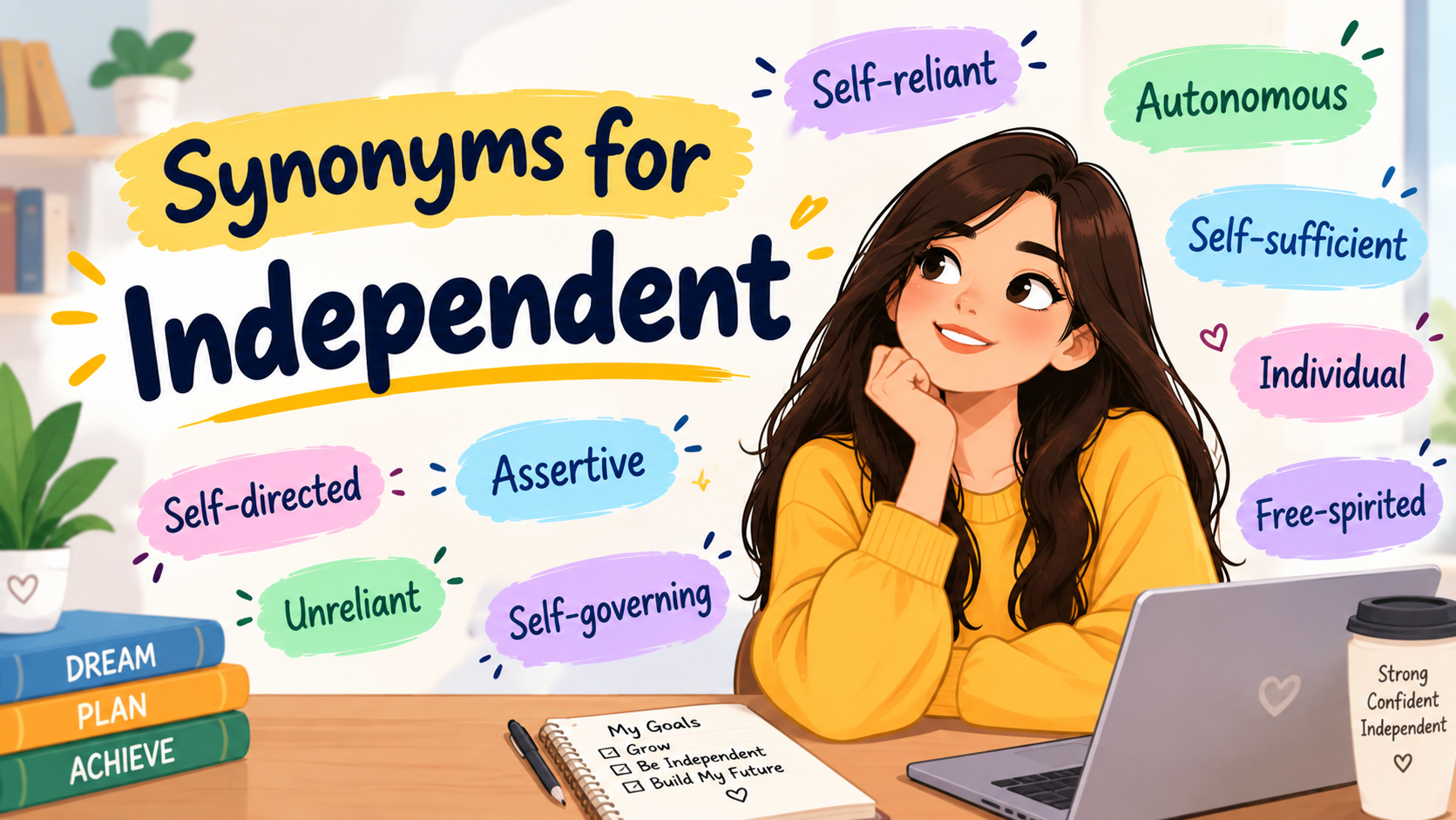
The word independent describes someone or something that is not controlled by others, does not rely heavily on outside help, or is free to make decisions and operate on its own. It can describe a person, organization, country, business, system, opinion, or lifestyle.
However, “independent” can mean slightly different things depending on the situation. A person may be self-reliant, a country may be sovereign, a machine may be self-operating, and an opinion may be independent-minded.
Using the right synonym can make your writing more precise and natural. Instead of repeating “independent” throughout an essay, resume, article, email, or conversation, you can choose a word that communicates the exact type of independence you mean.
This guide covers 80+ synonyms for independent, along with meanings, examples, contextual differences, antonyms, and tips for choosing the right alternative.
What Does “Independent” Mean?
Independent generally means free from control, influence, or dependence on another person or organization.
It can refer to:
- A person who manages things without relying on others
- Someone who makes their own decisions
- A business that operates separately from another company
- A country that governs itself
- A person who forms opinions without simply following others
- A system that works without external assistance
- Something that exists or functions separately
Quick Definition
Independent means free to act, decide, or operate without depending on or being controlled by someone or something else.
For example:
- “She is an independent woman who manages her finances herself.”
- “The company became independent from its parent organization.”
- “He is an independent thinker.”
- “The country became independent after years of political struggle.”
The best synonym depends on which type of independence you are describing.
Quick Reference: Synonyms for Independent
| Synonym | Meaning | Best Context | Example |
|---|---|---|---|
| Self-reliant | Able to depend on yourself | People | She is highly self-reliant. |
| Autonomous | Able to govern or operate independently | Formal/technical | The region is autonomous. |
| Self-sufficient | Able to meet your own needs | Lifestyle/resources | The farm is self-sufficient. |
| Self-directed | Guided by your own decisions | Education/work | He is a self-directed learner. |
| Free-thinking | Forming your own opinions | Ideas/people | She is a free-thinking writer. |
| Self-supporting | Able to support yourself | Financial | He is financially self-supporting. |
| Self-governing | Governing itself | Government/organizations | The territory is self-governing. |
| Sovereign | Having supreme authority | Countries/states | The nation is sovereign. |
| Unaffiliated | Not connected to a particular group | Organizations/people | She is an unaffiliated researcher. |
| Separate | Existing apart from others | General | The two businesses are separate. |
| Standalone | Operating independently | Technology/business | It is a standalone application. |
| Unrestricted | Free from limitations | Access/freedom | Members have unrestricted access. |
| Independent-minded | Thinking for yourself | Personality | He is independent-minded. |
| Self-managed | Managed without outside control | Teams/business | The department is self-managed. |
| Self-sufficient | Not dependent on outside resources | Economics/lifestyle | The community became self-sufficient. |
80+ Synonyms for Independent
Not every word below is interchangeable with “independent” in every sentence. Some are direct synonyms, while others describe a particular form of independence.
1. Self-Reliant
Self-reliant describes someone who is capable of handling problems and responsibilities without depending on other people.
Example:
“She became self-reliant after moving away from home.”
2. Autonomous
Autonomous means having the freedom or authority to make decisions and operate independently.
Example:
“The department operates as an autonomous unit.”
3. Self-Sufficient
Someone or something self-sufficient can provide what is needed without relying heavily on outside assistance.
Example:
“The family hopes to become self-sufficient by growing its own food.”
4. Self-Directed
Self-directed describes someone who determines their own goals, actions, or learning process.
Example:
“She is a self-directed learner who enjoys studying independently.”
5. Free-Thinking
A free-thinking person forms opinions independently rather than simply accepting conventional ideas.
Example:
“He is known as a free-thinking journalist.”
6. Independent-Minded
Independent-minded means willing to think and make decisions for yourself.
Example:
“She is independent-minded and rarely follows the crowd.”
7. Self-Supporting
Self-supporting means able to provide your own financial or practical support.
Example:
“After graduation, he became completely self-supporting.”
8. Self-Governing
Self-governing means capable of managing its own affairs without external control.
Example:
“The territory has a self-governing administration.”
9. Sovereign
Sovereign primarily describes a state or nation with supreme authority over its own affairs.
Example:
“Every sovereign nation has the authority to govern itself.”
10. Unaffiliated
Unaffiliated means not formally connected to a particular organization, group, or institution.
Example:
“She works as an unaffiliated consultant.”
11. Unattached
Unattached can mean not connected to or dependent upon another person or organization.
Example:
“He prefers to remain unattached to any particular political organization.”
12. Separate
Separate means existing apart from another person or thing.
Example:
“The company operates as a separate business.”
13. Standalone
Standalone describes something that functions independently rather than requiring another system.
Example:
“This is a standalone software application.”
14. Self-Managed
Self-managed means controlled or organized by the people involved rather than by an outside authority.
Example:
“The employees work in a self-managed team.”
15. Self-Controlled
Self-controlled emphasizes the ability to regulate your own behavior or reactions.
Example:
“She remained self-controlled during the difficult conversation.”
16. Self-Determining
Self-determining describes the ability to decide your own goals or future.
Example:
“People want to be self-determining in important areas of their lives.”
17. Self-Made
Self-made usually describes someone who achieved success largely through their own efforts.
Example:
“He is a self-made entrepreneur.”
18. Self-Possessed
Self-possessed means calm, confident, and in control of yourself.
Example:
“She remained self-possessed despite the pressure.”
19. Self-Sustaining
Self-sustaining means capable of continuing without continuous outside assistance.
Example:
“The project is designed to become self-sustaining.”
20. Self-Sustained
Self-sustained describes something maintained through its own resources or processes.
Example:
“The community developed a self-sustained energy system.”
21. Free
Free can describe someone who is not controlled, restricted, or forced by another person.
Example:
“She wanted to live a free and independent life.”
22. Unbound
Unbound means not restricted or tied down.
Example:
“He felt unbound by traditional expectations.”
23. Unrestricted
Unrestricted means free from limitations or controls.
Example:
“The researchers were given unrestricted access to the data.”
24. Uncontrolled
Uncontrolled can mean not controlled by another force, although it often has a negative meaning depending on context.
Example:
“The experiment involved an uncontrolled variable.”
25. Self-Operating
Self-operating means functioning without continuous human intervention.
Example:
“The facility uses a self-operating monitoring system.”
26. Self-Acting
Self-acting means operating automatically or without direct external action.
Example:
“The device has a self-acting mechanism.”
27. Self-Functioning
Self-functioning describes something capable of operating on its own.
Example:
“The system is designed to be self-functioning.”
28. Self-Powered
Self-powered means capable of generating or supplying its own energy.
Example:
“The sensor is self-powered.”
29. Free-Standing
Free-standing describes something physically or organizationally separate from supporting structures.
Example:
“The museum is housed in a free-standing building.”
30. Nondependent
Nondependent means not dependent upon another person or thing.
Example:
“The organization operates as a nondependent entity.”
31. Self-Determined
Self-determined means decided or controlled by oneself.
Example:
“She followed a self-determined career path.”
32. Self-Guided
Self-guided means directed by the individual rather than by an instructor or external authority.
Example:
“He completed a self-guided course online.”
33. Self-Led
Self-led means initiated and directed by oneself.
Example:
“The program encourages self-led learning.”
34. Self-Motivated
Self-motivated describes someone who can generate their own motivation without constant supervision.
Example:
“We are looking for a self-motivated employee.”
35. Self-Starting
Self-starting describes a person who takes initiative without needing to be told what to do.
Example:
“She is a self-starting professional.”
36. Self-Sufficient-Minded
This phrase is less common than self-sufficient and should generally be replaced by more natural wording such as “self-reliant” or “self-sufficient.”
Example:
“He developed a self-sufficient approach to everyday life.”
37. Individualistic
Individualistic describes someone who emphasizes personal choice, individuality, and independence.
Example:
“Her individualistic personality makes her comfortable working alone.”
38. Nonconformist
A nonconformist does not simply follow established customs or conventional expectations.
Example:
“He has always been a nonconformist thinker.”
39. Unconventional
Unconventional means different from what is traditional or usual.
Example:
“She took an unconventional approach to building her career.”
It can suggest independence of thought, although it is not a direct synonym for independent.
40. Original
Original can describe ideas or approaches that are independently developed rather than copied.
Example:
“The researcher presented an original argument.”
41. Self-Reliant in Spirit
This phrase emphasizes an individual’s ability and willingness to depend on themselves.
Example:
“She has always been self-reliant in spirit.”
For concise writing, however, simply use self-reliant.
42. Free-Minded
Free-minded can describe someone willing to think without rigid restrictions.
Example:
“He is known for his free-minded approach to creativity.”
43. Self-Confident
Self-confident means having confidence in your own abilities.
Example:
“She became more self-confident after gaining experience.”
Self-confidence and independence often overlap, but they are not identical.
44. Strong-Willed
Strong-willed describes someone determined to make their own choices and resist pressure.
Example:
“She is strong-willed and determined to follow her own path.”
45. Self-Assured
Self-assured means confident in your abilities or decisions.
Example:
“He sounded self-assured during the presentation.”
46. Resolute
Resolute means firmly determined.
Example:
“She remained resolute in her decision.”
47. Determined
Determined describes someone committed to achieving a goal despite obstacles.
Example:
“He is determined to build his career independently.”
48. Self-Sufficient Financially
This phrase specifically emphasizes financial independence.
Example:
“She became financially self-sufficient within two years.”
49. Financially Independent
Financially independent means able to support yourself without depending on another person’s income.
Example:
“He became financially independent after starting his business.”
50. Economically Independent
Economically independent focuses on freedom from financial dependence.
Example:
“The organization became economically independent.”
51. Politically Independent
Politically independent describes someone or something not formally controlled or aligned with a particular political group.
Example:
“She works as an independent political analyst.”
52. Nonaligned
Nonaligned means not formally aligned with a particular group, alliance, or side.
Example:
“The organization remained nonaligned.”
53. Neutral
Neutral means not taking a particular side.
Example:
“The mediator remained neutral during the discussion.”
Neutrality is related to independence in some contexts, but the words are not interchangeable.
54. Autonomous
Autonomous deserves special attention because it is one of the most useful formal alternatives to independent.
Example:
“The research team operates as an autonomous unit.”
55. Self-Governing
Self-governing is particularly useful when discussing communities, territories, or institutions.
Example:
“The organization is largely self-governing.”
56. Sovereign
Sovereign is most appropriate for states or entities possessing supreme governing authority.
Example:
“The country is a sovereign state.”
57. Self-Ruling
Self-ruling means governed by itself rather than by an outside authority.
Example:
“The community became self-ruling.”
58. Self-Administered
Self-administered means managed by the individual or organization itself.
Example:
“The region has a self-administered local government.”
59. Self-Regulated
Self-regulated means controlled or monitored internally.
Example:
“The industry operates under a self-regulated framework.”
60. Self-Organized
Self-organized describes a group or system that organizes itself without central direction.
Example:
“The volunteers formed a self-organized community.”
61. Self-Determining
Self-determining emphasizes the ability to choose one’s own direction.
Example:
“The community wanted a more self-determining system.”
62. Self-Reliant
Self-reliant is one of the most natural choices when describing a person’s practical independence.
Example:
“Living alone taught him to become self-reliant.”
63. Self-Directed
Self-directed works especially well for students, employees, and learners.
Example:
“She is a highly self-directed employee.”
64. Self-Motivated
Self-motivated is useful in resumes and professional descriptions.
Example:
“We need a self-motivated candidate who can work independently.”
65. Self-Sustaining
Use self-sustaining when something can continue without ongoing outside support.
Example:
“The initiative aims to become self-sustaining.”
66. Unconnected
Unconnected means not linked to another person, group, system, or event.
Example:
“The two organizations are completely unconnected.”
67. Disconnected
Disconnected means separated or lacking a connection.
Example:
“The device can operate in a disconnected environment.”
68. Distinct
Distinct means clearly separate or different.
Example:
“The company maintains a distinct identity from its parent brand.”
69. Autonomous-Minded
This is uncommon and generally less natural than independent-minded or self-directed.
When writing professionally, prefer the more established alternatives.
70. Self-Sufficient Organization
This phrase describes an organization that can function without depending heavily on another organization.
Example:
“The nonprofit became a self-sufficient organization.”
71. Independent Operator
An independent operator is a person or business working without being controlled by a larger organization.
Example:
“She works as an independent operator in the consulting industry.”
72. Free Agent
A free agent is someone who is not tied to a particular employer, team, or organization.
Example:
“After leaving the company, he became a free agent.”
73. Lone
Lone means alone or without companions, though it does not necessarily imply self-sufficiency.
Example:
“She was the lone researcher on the project.”
74. Solo
Solo means done alone or individually.
Example:
“He launched the project as a solo entrepreneur.”
75. Separate Entity
A separate entity is an organization or unit legally or operationally distinct from another.
Example:
“The new company operates as a separate entity.”
76. Independent Entity
An independent entity exists or operates without being controlled by another organization.
Example:
“The foundation operates as an independent entity.”
77. Self-Contained
Self-contained means able to function or exist without requiring external components or assistance.
Example:
“The software package is self-contained.”
78. Self-Sufficient System
This phrase describes a system capable of functioning without substantial external support.
Example:
“The engineers designed a self-sufficient system.”
79. Self-Ruling
Self-ruling emphasizes control over one’s own affairs.
Example:
“The community became increasingly self-ruling.”
80. Self-Determined
Self-determined emphasizes choices made according to one’s own decisions.
Example:
“She pursued a self-determined career path.”
Best Synonyms for Independent by Context
The right synonym depends heavily on what you mean by “independent.”
| Context | Best Alternative | Why |
|---|---|---|
| Personal independence | Self-reliant | Emphasizes relying on yourself |
| Financial independence | Financially independent | Specifically relates to money |
| Academic writing | Autonomous | Formal and precise |
| Student | Self-directed | Emphasizes independent learning |
| Workplace | Self-motivated | Highlights initiative |
| Business | Standalone | Describes independent operation |
| Government | Sovereign | Describes political independence |
| Territory | Self-governing | Emphasizes internal government |
| Opinions | Independent-minded | Describes independent thinking |
| Creativity | Free-thinking | Emphasizes original thought |
| Technology | Standalone | Works without another system |
| Lifestyle | Self-sufficient | Emphasizes meeting one’s own needs |
| Teams | Self-managed | Operates without external management |
| Personal confidence | Self-assured | Emphasizes confidence |
| Determination | Strong-willed | Emphasizes firmness |
| Organizations | Unaffiliated | Not formally connected |
| Career | Self-directed | Guided by one’s own choices |
| Entrepreneurship | Self-made | Success through one’s own efforts |
Synonyms for an Independent Person
When describing a person who does not depend heavily on others, these are particularly useful:
- Self-reliant
- Self-sufficient
- Self-supporting
- Self-directed
- Self-motivated
- Self-assured
- Independent-minded
- Free-thinking
- Strong-willed
- Self-determined
- Self-managing
- Self-sustaining
- Self-confident
- Individualistic
- Nonconformist
- Free-spirited
- Autonomous
- Resourceful
- Self-sufficient
- Self-possessed
Examples
Instead of:
“She is an independent person.”
You could write:
- “She is highly self-reliant.”
- “She is a self-directed professional.”
- “She is an independent-minded thinker.”
- “She is a self-motivated employee.”
- “She is a strong-willed individual.”
- “She is financially self-sufficient.”
Each version highlights a slightly different quality.
Synonyms for Independent Thinking
If you are describing someone who develops their own opinions, consider:
- Independent-minded
- Free-thinking
- Critical-thinking
- Open-minded
- Original
- Nonconformist
- Unconventional
- Individualistic
- Self-directed
- Thoughtful
- Analytical
- Original-minded
Example
Instead of:
“She is an independent thinker.”
You might say:
“She is a free-thinking researcher who develops original ideas.”
Or:
“He is an independent-minded student who questions conventional assumptions.”
Synonyms for Financially Independent
When independence specifically relates to money, use:
- Financially independent
- Self-supporting
- Self-sufficient
- Economically independent
- Financially self-sufficient
- Self-funded
- Self-financed
- Self-supporting financially
Examples
- “She became financially independent at 25.”
- “He built a self-supporting business.”
- “The organization is now financially self-sufficient.”
- “The project became self-funded after its first year.”
Synonyms for an Independent Business
For businesses or organizations that operate without a parent company or controlling organization, useful terms include:
- Standalone
- Self-managed
- Autonomous
- Independent entity
- Separate entity
- Unaffiliated
- Self-sustaining
- Privately operated
- Independently operated
- Self-governing
Examples
- “The brand operates as a standalone business.”
- “The company is an independent entity.”
- “The store is independently operated.”
- “The department became an autonomous unit.”
Synonyms for Independent in a Resume
“Independent” can be useful on a resume, but a more specific term may communicate your strengths better.
Good professional alternatives
- Self-motivated
- Self-directed
- Self-reliant
- Autonomous
- Proactive
- Resourceful
- Self-managed
- Independent-minded
- Self-sufficient
- Self-starting
Resume Examples
Basic:
“Independent worker with strong organizational skills.”
More specific:
“Self-motivated professional capable of managing projects with minimal supervision.”
Another option:
“Self-directed professional with strong problem-solving and organizational skills.”
These descriptions communicate what “independent” actually means in a workplace.
Independent vs. Self-Reliant
These words are closely related but not identical.
Independent means free from dependence or control.
Self-reliant specifically means capable of relying on yourself to solve problems or meet your needs.
Compare:
“She is independent.”
This could refer to her lifestyle, decisions, finances, or general freedom.
“She is self-reliant.”
This specifically emphasizes her ability to handle things herself.
Independent vs. Autonomous
Independent is a broad everyday word.
Autonomous is more formal and often refers to organizations, systems, regions, machines, or people with decision-making freedom.
Examples:
- “He is an independent worker.”
- “The department is an autonomous unit.”
“Autonomous” is particularly useful in academic, technical, governmental, and professional writing.
Independent vs. Self-Sufficient
Independent means not controlled or dependent.
Self-sufficient focuses more specifically on being able to meet your own needs.
For example:
“She is independent.”
This describes general freedom.
“She is self-sufficient.”
This suggests that she can take care of herself without needing substantial outside assistance.
Independent vs. Free
Free is broader and can refer to physical freedom, emotional freedom, legal freedom, or lack of restrictions.
Independent more strongly emphasizes self-direction or freedom from dependence.
Compare:
- “He is free to choose.”
- “He is financially independent.”
The first emphasizes freedom of choice. The second emphasizes lack of financial dependence.
Independent vs. Self-Directed
Self-directed focuses on making your own decisions and setting your own goals.
Independent has a broader meaning.
For example:
“She is an independent student.”
This could mean she studies without much help.
“She is a self-directed student.”
This specifically emphasizes that she manages her own learning.
Independent vs. Sovereign
Sovereign is much more specific.
It generally refers to a state or governing authority possessing supreme power over its own affairs.
For example:
“The country is independent.”
“The country is a sovereign state.”
You would normally not describe an ordinary person as “sovereign” when you simply mean independent.
Independent vs. Individualistic
Independent describes freedom from dependence or control.
Individualistic describes a preference for individuality and personal choice.
Someone can be independent without being strongly individualistic.
Example:
“She is independent and can manage her own affairs.”
versus:
“She has an individualistic style and prefers to do things differently.”
Antonyms of Independent
Understanding opposites can also help clarify the meaning of independent.
| Antonym | Meaning | Example |
|---|---|---|
| Dependent | Relying on someone else | The child is dependent on his parents. |
| Reliant | Depending on another source | The system is reliant on external funding. |
| Subordinate | Lower in authority or position | The department is subordinate to headquarters. |
| Controlled | Directed by another person/system | The process is externally controlled. |
| Restricted | Limited by rules or conditions | Access is restricted. |
| Constrained | Limited or held back | The project was constrained by its budget. |
| Bound | Restricted or obligated | They were bound by the agreement. |
| Submissive | Willing to accept another’s control | He appeared submissive during negotiations. |
| Attached | Closely connected | The organization is attached to the university. |
| Supervised | Managed or monitored by someone else | The trainees work under supervised conditions. |
| Managed | Directed by another person | The team is managed by a central office. |
| Influenced | Affected by another person’s ideas or actions | His decisions were heavily influenced by others. |
Common Phrases With “Independent”
Here are some natural expressions that use the word independent:
Independent thinker
Someone who develops their own ideas and opinions.
Example:
“She is an independent thinker who challenges assumptions.”
Independent worker
Someone capable of working without constant supervision.
Example:
“We need an independent worker who can manage deadlines.”
Independent business
A business that operates separately from a larger controlling organization.
Example:
“He owns an independent business.”
Independent contractor
A person who provides services independently rather than functioning as a traditional employee.
Example:
“She works as an independent contractor.”
Independent decision
A decision made without inappropriate outside influence.
Example:
“The committee made an independent decision.”
Independent lifestyle
A way of living that involves substantial personal autonomy.
Example:
“She enjoys an independent lifestyle.”
Independent research
Research conducted without inappropriate dependence on an interested outside party.
Example:
“The organization commissioned independent research.”
Common Mistakes When Using Synonyms for Independent
1. Treating every related word as an exact synonym
Words such as confident, strong-willed, and individualistic can be associated with independence but do not always mean independent.
Choose the word according to the specific meaning you want.
2. Using “sovereign” for ordinary people
“Sovereign” is primarily associated with states, territories, and supreme authority.
For people, self-reliant, self-directed, or independent-minded is usually more natural.
3. Using “autonomous” in casual conversation unnecessarily
“Autonomous” is perfectly correct, but it can sound formal.
Instead of:
“My brother is autonomous.”
Natural everyday English would usually be:
“My brother is independent.”
4. Confusing confidence with independence
Someone can be confident but still depend heavily on others.
Likewise, an independent person may not always be confident.
Use self-assured when confidence is the main idea.
5. Confusing independence with being alone
Being independent does not necessarily mean avoiding relationships or working alone.
Someone can be independent while maintaining strong friendships, family relationships, and professional partnerships.
How to Choose the Right Synonym
Ask yourself what kind of independence you are describing.
If you mean “doesn’t need much help”:
Use self-reliant or self-sufficient.
If you mean “makes their own decisions”:
Use self-directed, autonomous, or self-determined.
If you mean “thinks for themselves”:
Use independent-minded or free-thinking.
If you mean “supports themselves financially”:
Use financially independent or self-supporting.
If you mean “works without supervision”:
Use self-motivated, self-directed, or self-managing.
If you mean “a country governs itself”:
Use sovereign or self-governing.
If you mean “a system works on its own”:
Use standalone, self-operating, or self-contained.
If you mean “not connected to an organization”:
Use unaffiliated, separate, or independent entity.
Examples of Independent Synonyms in Sentences
Academic Writing
- “Students should become more self-directed in their learning.”
- “The researchers conducted an independent investigation.”
- “The autonomous region manages many of its internal affairs.”
- “The study encourages independent thinking.”
Professional Writing
- “We are seeking a self-motivated candidate.”
- “She is capable of working independently with minimal supervision.”
- “The department operates as an autonomous unit.”
- “He is a self-directed project manager.”
Everyday Conversation
- “My sister is very self-reliant.”
- “He likes being independent.”
- “She has always been independent-minded.”
- “I want to become financially independent.”
Business Writing
- “The company operates as a standalone business.”
- “The two organizations are separate entities.”
- “The team is largely self-managed.”
- “The organization is financially self-sufficient.”
Synonyms for Independent: Quick Category Guide
Formal Synonyms
- Autonomous
- Sovereign
- Self-governing
- Self-administered
- Self-regulated
- Self-determining
Professional Synonyms
- Self-motivated
- Self-directed
- Self-managed
- Self-reliant
- Self-sufficient
- Proactive
Personality Synonyms
- Independent-minded
- Free-thinking
- Strong-willed
- Self-assured
- Self-possessed
- Individualistic
Financial Synonyms
- Financially independent
- Self-supporting
- Economically independent
- Self-funded
- Financially self-sufficient
Technical Synonyms
- Standalone
- Self-contained
- Self-operating
- Self-powered
- Self-functioning
- Autonomous
Government and Political Context
- Sovereign
- Self-governing
- Self-ruling
- Autonomous
- Self-administered
- Nonaligned
FAQs
What is another word for independent?
Common alternatives include self-reliant, autonomous, self-sufficient, self-directed, self-supporting, free-thinking, independent-minded, and self-motivated. The best option depends on the context.
What is the strongest synonym for independent?
There is no single strongest synonym because different words emphasize different forms of independence. Autonomous emphasizes independent authority or operation, self-reliant emphasizes personal capability, and sovereign emphasizes supreme authority over one’s own affairs.
What is a good synonym for an independent person?
Self-reliant is one of the most natural choices. Other possibilities include self-sufficient, self-directed, self-motivated, independent-minded, self-assured, and free-thinking.
What is a synonym for independent thinking?
Good alternatives include independent-minded, free-thinking, original, nonconformist, and self-directed.
What is another word for financially independent?
You can use financially self-sufficient, self-supporting, economically independent, self-funded, or financially self-reliant, depending on the sentence.
What is a formal synonym for independent?
Autonomous is a useful formal synonym in many contexts. Self-governing, self-determining, and sovereign can also work when their specific meanings fit.
Is self-reliant the same as independent?
They are closely related but not identical. Independent broadly means free from dependence or control, while self-reliant specifically emphasizes the ability to depend on yourself.
Is autonomous the same as independent?
Not always. Autonomous generally emphasizes the ability or authority to make decisions or operate without external control. It is often more formal than “independent.”
What is the opposite of independent?
The most direct opposite is dependent. Other contextual opposites include controlled, restricted, subordinate, reliant, constrained, attached, and supervised.
What is a good synonym for independent on a resume?
Self-motivated, self-directed, self-reliant, proactive, resourceful, and autonomous can be effective, provided they accurately describe your actual working style.
Final Thoughts
“Independent” is a versatile word, but using a more precise alternative can make your writing clearer and more expressive.
Choose self-reliant when you mean someone can handle things on their own. Use self-sufficient when the focus is on meeting one’s own needs. Choose self-directed for learning or work, independent-minded for opinions, and self-motivated for professional situations.
For organizations and systems, autonomous, standalone, self-managed, or self-operating may be more precise. When discussing countries or territories, sovereign and self-governing can express political independence more accurately.
The key is not simply to replace “independent” with a more complicated word. Instead, choose the synonym that communicates the specific type of independence you want your reader to understand.
A precise synonym can make an essay, resume, article, email, or everyday conversation sound more natural without making the language unnecessarily complicated.