
The phrase “very interesting” is useful, but it can become repetitive when you use it too often. Whether you are writing an essay, describing a book, reviewing a movie, talking about an experience, or creating professional content, a more precise word can make your writing clearer and more expressive.
Instead of saying:
“The book was very interesting.”
you might say:
“The book was captivating.”
Or:
“The book was thought-provoking.”
Or:
“The book was riveting.”
Each word communicates a slightly different type of interest.
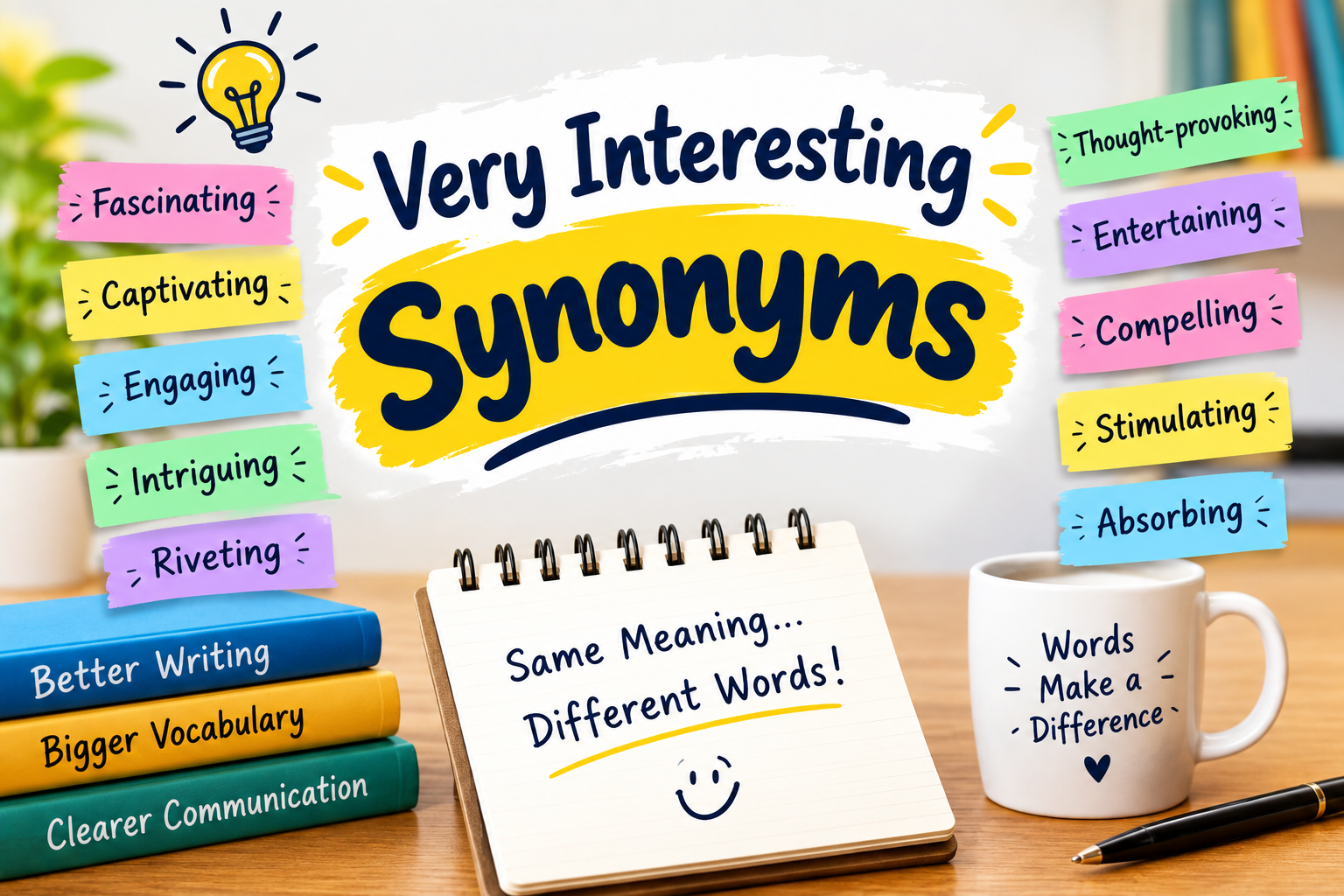
Fascinating suggests that something strongly attracts your attention. Intriguing suggests mystery or curiosity. Captivating emphasizes the ability to hold someone’s attention. Thought-provoking describes something that makes you think deeply. Engaging suggests that something keeps you involved.
This guide covers 80+ synonyms and alternatives for “very interesting,” with meanings, examples, contextual differences, formal alternatives, casual expressions, antonyms, and practical tips for choosing the right word.
What Does “Very Interesting” Mean?
“Very interesting” describes something that strongly attracts your attention, creates curiosity, holds your interest, or makes you want to know more.
The word interesting itself can describe many different things:
- A fascinating idea
- An unusual person
- An engaging book
- A compelling story
- A thought-provoking question
- An exciting experience
- An informative article
- A remarkable discovery
Adding “very” increases the intensity, but it does not explain why something is interesting.
For example:
“The documentary was very interesting.”
This tells the reader that you liked or noticed the documentary, but it does not explain whether it was educational, exciting, mysterious, surprising, or emotionally powerful.
A more precise sentence might be:
“The documentary was eye-opening because it revealed information I had never encountered before.”
That is why specific synonyms can make writing stronger.
Quick Reference: Very Interesting Synonyms
| Synonym | Meaning | Best Context | Example |
|---|---|---|---|
| Fascinating | Extremely interesting | General | The subject is fascinating. |
| Intriguing | Creates curiosity | Mysteries/ideas | Her explanation was intriguing. |
| Captivating | Holds attention strongly | Stories/media | The film was captivating. |
| Engaging | Keeps attention | Books/presentations | It was an engaging lecture. |
| Compelling | Very convincing or attention-grabbing | Ideas/stories | He presented a compelling argument. |
| Riveting | Extremely absorbing | Stories/speeches | It was a riveting documentary. |
| Thought-provoking | Makes you think deeply | Ideas/discussions | The book was thought-provoking. |
| Absorbing | Holds your complete attention | Books/activities | It was an absorbing novel. |
| Gripping | Exciting and difficult to stop watching/reading | Stories | The thriller was gripping. |
| Enlightening | Provides new understanding | Education | The lecture was enlightening. |
| Eye-opening | Reveals something unexpected | Experiences | The trip was eye-opening. |
| Stimulating | Encourages mental activity | Discussions | It was a stimulating debate. |
| Remarkable | Worthy of attention | Achievements/events | The results were remarkable. |
| Noteworthy | Worth noticing | Formal writing | The finding was noteworthy. |
| Insightful | Shows deep understanding | Comments/ideas | Her analysis was insightful. |
| Memorable | Easy to remember | Experiences | It was a memorable evening. |
| Extraordinary | Unusually impressive | Events/experiences | It was an extraordinary experience. |
| Mesmerizing | Holds attention intensely | Visuals/performances | The performance was mesmerizing. |
| Spellbinding | Extremely captivating | Stories/performances | It was a spellbinding story. |
| Enthralling | Delights and holds attention | Books/films | The novel was enthralling. |
80+ Synonyms for “Very Interesting”
1. Fascinating
Fascinating is one of the best alternatives to “very interesting.” It describes something that strongly attracts your attention because it is unusual, complex, surprising, or enjoyable to learn about.
Example:
“The history of ancient civilizations is fascinating.”
2. Intriguing
Intriguing describes something that creates curiosity and makes you want to discover more.
Example:
“The researcher presented an intriguing theory.”
Use this word when mystery or unanswered questions are important.
3. Captivating
Captivating means extremely attractive or interesting in a way that holds your attention.
Example:
“The speaker gave a captivating presentation.”
4. Engaging
Engaging describes something that successfully keeps someone’s attention and involvement.
Example:
“The teacher created an engaging lesson.”
It works especially well for books, presentations, classes, websites, and conversations.
5. Compelling
Compelling describes something powerful enough to make you pay attention, believe something, or continue reading or watching.
Example:
“She presented a compelling argument.”
6. Riveting
Riveting means extremely interesting or exciting.
Example:
“The documentary was riveting from beginning to end.”
It is particularly effective for films, books, speeches, and stories.
7. Thought-Provoking
Thought-provoking describes something that causes you to think carefully or deeply.
Example:
“The article raised several thought-provoking questions.”
8. Absorbing
Absorbing means so interesting that it takes up your attention completely.
Example:
“I found the novel completely absorbing.”
9. Gripping
Gripping describes something exciting or emotionally intense that keeps you wanting to know what happens next.
Example:
“The detective story was gripping.”
10. Enthralling
Enthralling means extremely enjoyable and captivating.
Example:
“The audience watched an enthralling performance.”
11. Spellbinding
Spellbinding suggests that something holds your attention almost magically.
Example:
“She gave a spellbinding speech.”
12. Mesmerizing
Mesmerizing describes something so attractive or fascinating that it holds your attention completely.
Example:
“The dancer gave a mesmerizing performance.”
13. Stimulating
Stimulating means encouraging mental activity, discussion, or thought.
Example:
“We had a stimulating conversation about artificial intelligence.”
14. Enlightening
Enlightening means providing useful knowledge or a new understanding.
Example:
“The lecture was extremely enlightening.”
15. Eye-Opening
Eye-opening describes something that gives you a new perspective or reveals information you did not previously understand.
Example:
“Traveling abroad was an eye-opening experience.”
16. Insightful
Insightful describes an idea, comment, or observation that demonstrates deep understanding.
Example:
“She offered an insightful explanation of the problem.”
17. Informative
Informative means providing useful information or knowledge.
Example:
“The article was informative and easy to understand.”
This is a good alternative when the main reason something is interesting is that you learned something from it.
18. Remarkable
Remarkable describes something unusually impressive or worthy of attention.
Example:
“The scientist achieved remarkable results.”
19. Noteworthy
Noteworthy means deserving attention or consideration.
Example:
“The study produced several noteworthy findings.”
It is especially useful in formal writing.
20. Memorable
Memorable describes something that is likely to remain in your memory.
Example:
“It was a memorable experience.”
21. Extraordinary
Extraordinary means unusually impressive, remarkable, or different from what is normal.
Example:
“She had an extraordinary career.”
22. Exceptional
Exceptional means unusually good or impressive.
Example:
“The presentation was exceptional.”
23. Impressive
Impressive describes something that causes admiration because of its quality, scale, achievement, or effect.
Example:
“The research produced impressive results.”
24. Amazing
Amazing describes something that causes strong surprise or admiration.
Example:
“The view from the mountain was amazing.”
It is common in everyday English.
25. Astonishing
Astonishing means extremely surprising or impressive.
Example:
“The experiment produced astonishing results.”
26. Stunning
Stunning describes something extremely impressive, beautiful, or surprising.
Example:
“The documentary featured stunning photographs.”
27. Surprising
Surprising describes something unexpected.
Example:
“The results were surprisingly interesting.”
28. Unexpected
Unexpected describes something that was not anticipated.
Example:
“The discussion took an unexpected direction.”
29. Curious
Curious can describe something unusual or strange enough to attract attention.
Example:
“That is a curious detail.”
30. Unusual
Unusual means different from what is common or expected.
Example:
“She had an unusual perspective on the issue.”
31. Peculiar
Peculiar describes something strange or distinctive.
Example:
“There was something peculiar about the story.”
Depending on context, it can be neutral or slightly negative.
32. Remarkable
Remarkable is useful when something deserves attention because it is unusual or impressive.
Example:
“The transformation was remarkable.”
33. Compelling
A second important use of compelling is for information or evidence that demands attention.
Example:
“The report provides compelling evidence.”
34. Dynamic
Dynamic describes something energetic, active, or constantly changing.
Example:
“The discussion was dynamic and engaging.”
35. Lively
Lively means energetic, active, and full of enthusiasm.
Example:
“The class developed into a lively discussion.”
36. Vibrant
Vibrant describes something full of energy, color, activity, or enthusiasm.
Example:
“The city has a vibrant cultural scene.”
37. Exciting
Exciting means producing enthusiasm or anticipation.
Example:
“The trip was exciting from start to finish.”
38. Entertaining
Entertaining means enjoyable or amusing.
Example:
“The show was entertaining and informative.”
39. Enjoyable
Enjoyable means pleasant and fun.
Example:
“The lecture was surprisingly enjoyable.”
40. Amusing
Amusing means funny or entertaining.
Example:
“She told an amusing story about her travels.”
41. Delightful
Delightful describes something highly pleasant or enjoyable.
Example:
“We had a delightful conversation.”
42. Charming
Charming describes something pleasant, attractive, or appealing.
Example:
“It was a charming little story.”
43. Appealing
Appealing means attractive or interesting in a way that makes something desirable.
Example:
“The idea is appealing to younger audiences.”
44. Alluring
Alluring means strongly attractive or tempting.
Example:
“The proposal offered an alluring opportunity.”
45. Attractive
Attractive can describe an idea, offer, topic, or possibility that draws attention or interest.
Example:
“The proposal is attractive because it offers greater flexibility.”
46. Inspiring
Inspiring means causing people to feel motivated, encouraged, or uplifted.
Example:
“Her story was incredibly inspiring.”
47. Motivating
Motivating describes something that encourages action or effort.
Example:
“The speaker gave a motivating presentation.”
48. Fascinating
Fascinating is particularly useful when describing a subject that you could spend a long time exploring.
Example:
“Human psychology is a fascinating subject.”
49. Absorbing
Absorbing is especially appropriate for activities that occupy your attention for a long period.
Example:
“The historical novel was absorbing.”
50. Engrossing
Engrossing means absorbing your complete attention.
Example:
“The series was so engrossing that I watched all six episodes.”
51. Intriguing
Intriguing is ideal for ideas, clues, questions, and situations that create curiosity.
Example:
“The mystery surrounding the discovery is intriguing.”
52. Thoughtful
Thoughtful can describe an idea or comment that demonstrates careful consideration.
Example:
“She made a thoughtful observation during the discussion.”
53. Significant
Significant means important or meaningful.
Example:
“The study revealed several significant findings.”
It is useful in academic writing when “interesting” really means “important.”
54. Valuable
Valuable means useful or worthwhile.
Example:
“The workshop provided valuable insights.”
55. Meaningful
Meaningful describes something that has importance, significance, or emotional value.
Example:
“We had a meaningful conversation.”
56. Relevant
Relevant means closely connected to the subject or situation.
Example:
“She raised several relevant questions.”
57. Worthwhile
Worthwhile means worth the time, effort, or attention invested in it.
Example:
“The book is definitely worthwhile.”
58. Unique
Unique describes something distinct or unlike anything else.
Example:
“She has a unique approach to design.”
59. Innovative
Innovative describes something involving new ideas or methods.
Example:
“The company developed an innovative solution.”
60. Original
Original means new, creative, or not copied from something else.
Example:
“He presented an original idea.”
61. Creative
Creative describes something imaginative or inventive.
Example:
“She proposed a creative solution.”
62. Brilliant
Brilliant can describe an exceptionally clever or impressive idea.
Example:
“That is a brilliant solution.”
63. Clever
Clever describes something intelligent, skillful, or inventive.
Example:
“The writer used a clever storytelling technique.”
64. Insightful
Insightful is particularly useful when an interesting observation reveals something meaningful.
Example:
“His comments were insightful and practical.”
65. Perceptive
Perceptive describes someone or something that demonstrates an ability to notice and understand subtle details.
Example:
“She made a perceptive observation about the situation.”
66. Revealing
Revealing means providing information that was previously unknown or unclear.
Example:
“The interview was revealing.”
67. Informative
Informative is best when the value comes from learning useful information.
Example:
“The documentary was highly informative.”
68. Educational
Educational describes something that teaches or develops knowledge.
Example:
“The museum visit was both educational and enjoyable.”
69. Instructive
Instructive means useful for learning or understanding something.
Example:
“The case study was highly instructive.”
70. Illuminating
Illuminating means helping to clarify or explain something.
Example:
“The professor offered an illuminating explanation.”
71. Thought-Provoking
Thought-provoking is especially useful when something challenges assumptions or encourages deeper reflection.
Example:
“The film raised several thought-provoking questions.”
72. Challenging
Challenging can describe an idea that requires serious thought.
Example:
“The discussion presented several challenging questions.”
73. Stimulating
Stimulating is excellent for intellectual discussions and activities.
Example:
“It was a stimulating exchange of ideas.”
74. Provocative
Provocative describes something that deliberately causes strong thought, discussion, or reaction.
Example:
“The author presents a provocative argument.”
It does not necessarily mean “good” or “bad.”
75. Controversial
Controversial describes something likely to cause disagreement or debate.
Example:
“The speaker raised a controversial question.”
Something can be controversial without being interesting, so use this word only when disagreement is relevant.
76. Unforgettable
Unforgettable describes something so powerful or unusual that it is unlikely to be forgotten.
Example:
“It was an unforgettable experience.”
77. Spectacular
Spectacular describes something extremely impressive or visually striking.
Example:
“The fireworks were spectacular.”
78. Phenomenal
Phenomenal means exceptionally impressive or remarkable.
Example:
“She delivered a phenomenal performance.”
79. Mind-Blowing
Mind-blowing is an informal expression for something extremely surprising, impressive, or difficult to believe.
Example:
“That scientific discovery was mind-blowing.”
80. Awesome
Awesome is a common informal word meaning extremely good, impressive, or exciting.
Example:
“That was an awesome experience.”
81. Cool
Cool is a casual way to say something is interesting, impressive, or appealing.
Example:
“That is a really cool idea.”
82. Fascinatingly Complex
This phrase works when something is interesting because of its complexity.
Example:
“The human brain is fascinatingly complex.”
83. Highly Engaging
Highly engaging is a useful professional phrase for content that holds attention.
Example:
“The course provides highly engaging lessons.”
84. Exceptionally Interesting
Sometimes the most natural solution is simply to strengthen the original phrase.
Example:
“The research produced exceptionally interesting results.”
What Is a Stronger Word Than “Interesting”?
There is no single strongest synonym because the right word depends on why something is interesting.
If it creates curiosity
Use:
- Intriguing
- Curious
- Mysterious
- Enigmatic
- Puzzling
Example:
“The mysterious discovery was intriguing.”
If it holds attention
Use:
- Captivating
- Engrossing
- Absorbing
- Riveting
- Gripping
- Spellbinding
Example:
“The novel was absolutely gripping.”
If it makes you think
Use:
- Thought-provoking
- Stimulating
- Insightful
- Challenging
- Provocative
Example:
“The discussion was genuinely thought-provoking.”
If it teaches something
Use:
- Informative
- Enlightening
- Educational
- Instructive
- Illuminating
- Eye-opening
Example:
“The documentary was eye-opening.”
If it is surprising
Use:
- Astonishing
- Remarkable
- Extraordinary
- Stunning
- Unbelievable
- Phenomenal
Example:
“The results were astonishing.”
Very Interesting Synonyms by Strength
Not every alternative has the same intensity.
| Strength | Words |
|---|---|
| Mild | Appealing, enjoyable, curious, pleasant |
| Moderate | Interesting, engaging, lively, informative |
| Strong | Intriguing, fascinating, compelling, thought-provoking |
| Very strong | Captivating, riveting, absorbing, engrossing |
| Extremely strong | Mesmerizing, spellbinding, mind-blowing, extraordinary |
Remember that strength is subjective. A word such as remarkable may express admiration rather than simply a high level of curiosity.
Synonyms for “Very Interesting” for a Book
When describing a book, consider what makes it interesting.
If you could not stop reading
Use:
- Gripping
- Riveting
- Absorbing
- Engrossing
- Captivating
Example:
“The mystery novel was so gripping that I finished it in one evening.”
If it makes you think
Use:
- Thought-provoking
- Insightful
- Stimulating
- Challenging
- Philosophical
Example:
“It is a thought-provoking book about human relationships.”
If it teaches you something
Use:
- Informative
- Educational
- Enlightening
- Instructive
- Eye-opening
Example:
“It was an enlightening book about ancient history.”
If it is enjoyable
Use:
- Entertaining
- Engaging
- Enjoyable
- Delightful
- Absorbing
Example:
“It is an engaging novel with memorable characters.”
Very Interesting Synonyms for a Story
Good alternatives include:
- Captivating
- Gripping
- Riveting
- Compelling
- Engrossing
- Absorbing
- Spellbinding
- Enthralling
- Fascinating
- Intriguing
Examples
Instead of:
“It was a very interesting story.”
Try:
“It was a captivating story.”
“It was a gripping story.”
“It was an intriguing story.”
“It was a compelling story.”
The choice depends on whether you want to emphasize emotional involvement, suspense, curiosity, or overall appeal.
Very Interesting Synonyms for a Person
When describing a person, “interesting” can mean many things.
Personality
- Fascinating
- Intriguing
- Charismatic
- Charming
- Engaging
- Lively
- Dynamic
Example:
“She is a fascinating person with an unusual background.”
Intelligence
- Insightful
- Perceptive
- Thoughtful
- Brilliant
- Clever
- Knowledgeable
Example:
“He is an insightful person who asks excellent questions.”
Unusual character
- Quirky
- Unconventional
- Eccentric
- Unique
- Curious
Example:
“She has a quirky personality that makes conversations memorable.”
Very Interesting Synonyms for an Idea
For ideas, “interesting” can often be replaced with more precise vocabulary.
- Intriguing
- Compelling
- Innovative
- Thought-provoking
- Insightful
- Original
- Creative
- Promising
- Remarkable
- Significant
- Stimulating
- Provocative
Examples
“She proposed an innovative idea.”
“He presented a compelling argument.”
“The professor raised a thought-provoking question.”
“The team developed a promising concept.”
Very Interesting Synonyms for a Conversation
Useful choices include:
- Engaging
- Stimulating
- Lively
- Insightful
- Thought-provoking
- Fascinating
- Meaningful
- Entertaining
- Dynamic
- Informative
Example
Instead of:
“We had a very interesting conversation.”
You could say:
“We had a stimulating conversation about technology.”
Or:
“We had a meaningful conversation about our future plans.”
Very Interesting Synonyms for an Experience
Depending on the experience, you could use:
- Memorable
- Unforgettable
- Eye-opening
- Exciting
- Fascinating
- Extraordinary
- Remarkable
- Inspiring
- Transformative
- Enlightening
Examples
“The trip was an eye-opening experience.”
“It was an unforgettable experience.”
“The workshop was an enlightening experience.”
Very Interesting Synonyms for Academic Writing
The phrase “very interesting” can sound vague in academic writing. A more precise word often makes the sentence stronger.
Good academic alternatives
- Intriguing
- Thought-provoking
- Insightful
- Compelling
- Significant
- Noteworthy
- Remarkable
- Informative
- Enlightening
- Stimulating
- Relevant
- Valuable
- Illuminating
Examples
Instead of:
“This is a very interesting result.”
Write:
“This is a significant result.”
If the result is surprising:
“This is a remarkable result.”
If it raises questions:
“This is an intriguing result.”
If it provides new understanding:
“This is an illuminating result.”
Precision is usually more valuable than simply choosing a stronger adjective.
Very Interesting Synonyms for Essays
If you are writing an essay, useful alternatives include:
- Fascinating
- Intriguing
- Compelling
- Thought-provoking
- Insightful
- Significant
- Noteworthy
- Remarkable
- Relevant
- Valuable
- Informative
- Enlightening
Example
Basic:
“This is a very interesting issue.”
More precise:
“This is a complex and thought-provoking issue.”
Another option:
“This is a significant issue that deserves further examination.”
Very Interesting Synonyms for Professional Writing
In business communication, “very interesting” can sometimes sound vague.
Instead, choose a word that describes the specific value.
If you like a proposal
Use:
- Promising
- Appealing
- Compelling
- Valuable
- Practical
Example:
“That is a promising proposal.”
If the information is useful
Use:
- Informative
- Valuable
- Insightful
- Relevant
Example:
“Thank you for sharing those valuable insights.”
If the idea is new
Use:
- Innovative
- Original
- Creative
- Novel
Example:
“That is an innovative approach to the problem.”
If something deserves attention
Use:
- Noteworthy
- Significant
- Remarkable
- Important
Example:
“The report contains several noteworthy findings.”
Very Interesting Synonyms for IELTS
For IELTS writing, avoid replacing every instance of “interesting” with an unnecessarily advanced word. Instead, choose vocabulary that accurately expresses your meaning.
Useful options include:
- Fascinating
- Intriguing
- Compelling
- Thought-provoking
- Significant
- Noteworthy
- Informative
- Insightful
- Remarkable
- Engaging
Example
Basic:
“Technology is a very interesting topic.”
Better:
“Technology is a fascinating topic because it continues to transform modern society.”
Even better when discussing its effect:
“The rapid development of technology raises several thought-provoking questions about the future of employment.”
The final version is stronger because it explains what makes the subject interesting.
Very Interesting Synonyms in Casual Conversation
In everyday speech, natural alternatives include:
- Fascinating
- Amazing
- Awesome
- Cool
- Exciting
- Fun
- Intriguing
- Wild
- Incredible
- Mind-blowing
- Super interesting
- Really engaging
Examples
“That’s fascinating!”
“That’s really cool.”
“Wow, that’s mind-blowing.”
“That sounds exciting.”
“That’s actually pretty intriguing.”
These are more natural in conversation than highly formal words such as “noteworthy” or “illuminating.”
Interesting vs. Fascinating
Interesting means something catches your attention.
Fascinating suggests a much stronger level of interest.
Compare:
“The documentary was interesting.”
“The documentary was fascinating.”
The second sentence communicates stronger enthusiasm.
Use fascinating when something holds your attention because it is unusually compelling, complex, surprising, or enjoyable.
Interesting vs. Intriguing
Interesting is broad.
Intriguing focuses on curiosity.
For example:
“The topic is interesting.”
means the topic catches your attention.
“The mystery is intriguing.”
suggests that you want to understand or discover more.
Interesting vs. Captivating
Captivating emphasizes the ability to hold someone’s attention.
For example:
“The presentation was interesting.”
simply means it caught your attention.
“The presentation was captivating.”
suggests that it held your attention strongly.
Interesting vs. Thought-Provoking
These words describe different types of interest.
Interesting means attention-grabbing in a broad sense.
Thought-provoking means something makes you think deeply.
Example:
“The article was interesting.”
versus:
“The article was thought-provoking.”
The second sentence suggests that the article challenged your assumptions or encouraged reflection.
Interesting vs. Engaging
Engaging focuses on active involvement and sustained attention.
For example:
“The lesson was interesting.”
means students found it worth paying attention to.
“The lesson was engaging.”
suggests that students were actively involved and interested.
Interesting vs. Compelling
Compelling is stronger and often suggests that something is powerful enough to demand attention or persuade.
Examples:
“She made an interesting argument.”
“She made a compelling argument.”
The second sentence suggests that the argument was particularly persuasive or powerful.
Interesting vs. Remarkable
Remarkable does not simply mean “very interesting.” It means worthy of notice because something is unusual, impressive, or significant.
Example:
“The results were interesting.”
versus:
“The results were remarkable.”
The second suggests that the results were unusually impressive or significant.
Positive Synonyms for Very Interesting
When you want to praise something, use:
- Fascinating
- Captivating
- Engaging
- Compelling
- Remarkable
- Impressive
- Inspiring
- Enlightening
- Insightful
- Memorable
- Exceptional
- Extraordinary
- Delightful
- Entertaining
- Innovative
Neutral Synonyms for Very Interesting
For objective or balanced writing:
- Intriguing
- Noteworthy
- Significant
- Informative
- Relevant
- Unusual
- Curious
- Remarkable
- Insightful
- Thought-provoking
Words for Interesting in an Unusual or Negative Way
Sometimes something is interesting because it is strange, suspicious, or unexpected.
Useful words include:
- Peculiar
- Strange
- Unusual
- Curious
- Odd
- Bizarre
- Unexpected
- Unconventional
- Suspicious
- Questionable
- Provocative
Examples
“That is a curious situation.”
“There is something peculiar about the results.”
“The findings raise some interesting but questionable concerns.”
Be careful with these words because several carry negative or skeptical meanings.
Antonyms of “Very Interesting”
Understanding opposites can help you choose the right word.
| Antonym | Meaning | Example |
|---|---|---|
| Boring | Not interesting | The lecture was boring. |
| Dull | Lacking excitement | The presentation was dull. |
| Tedious | Long and tiring | The task was tedious. |
| Monotonous | Repetitive and unchanging | The routine became monotonous. |
| Uninteresting | Not attracting attention | The topic seemed uninteresting. |
| Repetitive | Repeated too often | The content was repetitive. |
| Dry | Lacking excitement or personality | The lecture was rather dry. |
| Lifeless | Lacking energy | The discussion felt lifeless. |
| Mundane | Ordinary and unexciting | The task was mundane. |
| Predictable | Easy to anticipate | The story was predictable. |
| Flat | Lacking emotional energy | The performance felt flat. |
| Tedious | Boring because of repetition or length | The process was tedious. |
Common Phrases Instead of “Very Interesting”
Sometimes you do not need a single synonym. A natural phrase can express your reaction more clearly.
Instead of:
“That is very interesting.”
Try:
- “That’s fascinating.”
- “That’s intriguing.”
- “That’s really thought-provoking.”
- “That’s quite remarkable.”
- “That’s something I had never considered.”
- “That raises some interesting questions.”
- “That gives me a new perspective.”
- “I’d love to learn more about that.”
- “That caught my attention.”
- “That’s worth exploring further.”
- “That is particularly noteworthy.”
- “That’s an insightful observation.”
How to Choose the Right Synonym
The best replacement depends on why you find something interesting.
Something catches your attention
Use:
Interesting, engaging, appealing
Something creates curiosity
Use:
Intriguing, curious, mysterious
Something holds your attention
Use:
Captivating, gripping, riveting, absorbing
Something makes you think
Use:
Thought-provoking, stimulating, insightful
Something teaches you
Use:
Informative, educational, enlightening, instructive
Something is surprising
Use:
Astonishing, remarkable, extraordinary, stunning
Something is enjoyable
Use:
Entertaining, delightful, enjoyable, amusing
Something is new
Use:
Innovative, original, fresh, novel
Something is impressive
Use:
Remarkable, exceptional, phenomenal, extraordinary
This approach produces more precise writing than simply replacing “very interesting” with the strongest word available.
Common Mistakes When Using Synonyms for “Very Interesting”
1. Using every synonym as if it had the same meaning
Fascinating, informative, and thought-provoking are related, but they describe different qualities.
For example, an article can be informative without being fascinating.
2. Choosing a word that is too strong
Calling every mildly interesting article “mind-blowing” can make your writing sound exaggerated.
Match the strength of the word to your actual reaction.
3. Using formal vocabulary in casual situations
Words such as noteworthy, illuminating, and instructive may sound unnatural in casual conversation.
A friend is more likely to say:
“That’s really cool.”
than:
“That is particularly noteworthy.”
4. Using “fascinating” when you mean “important”
If something is important rather than particularly interesting, use:
- Significant
- Important
- Valuable
- Relevant
- Noteworthy
5. Using “interesting” when you mean “informative”
If the main benefit is that you learned something, informative, educational, or enlightening may be more precise.
6. Repeating the same synonym
Replacing “very interesting” with “fascinating” everywhere does not solve repetition.
Instead, vary your vocabulary based on context.
How to Make “Very Interesting” More Specific
Consider this sentence:
“She gave a very interesting presentation.”
This sentence is acceptable but vague.
You can make it more precise:
If it taught you something:
“She gave an informative presentation.”
If it encouraged deeper thinking:
“She gave a thought-provoking presentation.”
If it held everyone’s attention:
“She gave a captivating presentation.”
If it introduced new information:
“She gave an eye-opening presentation.”
If it presented a persuasive argument:
“She gave a compelling presentation.”
This is the key to using synonyms effectively: describe the specific quality that made something interesting.
FAQs
What is a stronger word than “very interesting”?
Some strong alternatives include fascinating, captivating, compelling, riveting, enthralling, mesmerizing, spellbinding, and mind-blowing. The best choice depends on whether you mean curiosity, excitement, emotional impact, or intellectual interest.
What is another word for “very interesting”?
Common alternatives include fascinating, intriguing, engaging, captivating, compelling, thought-provoking, absorbing, gripping, riveting, enlightening, and remarkable.
What are five powerful synonyms for interesting?
Five strong choices are fascinating, intriguing, captivating, compelling, and riveting.
What is a formal word for “very interesting”?
Depending on the context, intriguing, compelling, noteworthy, insightful, thought-provoking, significant, or remarkable can work well in formal writing.
What can I say instead of “that’s interesting”?
You can say:
- “That’s fascinating.”
- “That’s intriguing.”
- “That’s remarkable.”
- “That’s thought-provoking.”
- “That’s insightful.”
- “I hadn’t considered that before.”
- “That gives me a new perspective.”
What is a good synonym for interesting in an essay?
Good choices include intriguing, compelling, thought-provoking, insightful, significant, noteworthy, remarkable, informative, and enlightening.
Choose according to the actual meaning rather than simply choosing the most advanced word.
What is a good synonym for interesting in a professional email?
Depending on your meaning, try:
- “That is an interesting proposal.”
- “That is a promising proposal.”
- “That is an insightful suggestion.”
- “That is a compelling idea.”
- “That is a noteworthy observation.”
- “That is an innovative approach.”
What is the difference between fascinating and intriguing?
Fascinating emphasizes strong interest or attraction, while intriguing emphasizes curiosity and the desire to learn more.
What is the difference between interesting and engaging?
Interesting means something attracts your attention. Engaging suggests that it actively holds your attention and keeps you involved.
Is “very interesting” formal?
“Very interesting” is grammatically correct and neutral, but it can sound basic or vague in formal writing. A more specific word often communicates your meaning more effectively.
Is “awesome” a synonym for very interesting?
In informal conversation, awesome can communicate strong approval or excitement, but it is not a direct synonym for interesting. It is generally too casual for academic or formal professional writing.
Is “fascinating” stronger than “interesting”?
Generally, yes. Fascinating usually communicates a stronger level of interest than the general word interesting, although the exact strength depends on context.
Final Thoughts
There are many ways to replace “very interesting,” but the best synonym is not always the strongest-sounding word.
Use fascinating when something strongly attracts your attention. Choose intriguing when it creates curiosity. Use captivating, riveting, or gripping when something holds your attention. Choose thought-provoking or stimulating when it makes you think. For useful knowledge, informative, enlightening, or eye-opening may be better.
In professional and academic writing, words such as insightful, compelling, noteworthy, significant, remarkable, and innovative can often communicate a more precise meaning than “very interesting.”
The goal is not simply to use bigger words. Good vocabulary means choosing the right word for the exact idea.
Instead of asking, “What is the fanciest synonym for very interesting?” ask:
What exactly makes this interesting?
Is it surprising? Educational? Exciting? Mysterious? Persuasive? Beautiful? Unusual? Thought-provoking?
Once you identify that quality, choosing the right synonym becomes much easier—and your writing becomes more natural, precise, and engaging.