
The word “and” is one of the most common words in English. It connects words, phrases, clauses, and ideas, making it easy to show that two or more things belong together.
For example:
“She bought apples and oranges.”
“He studied hard and passed the exam.”
“The company is affordable and reliable.”
Because “and” is so useful, it can easily become repetitive. In essays, articles, reports, emails, and other types of writing, using the same connector repeatedly can make sentences feel monotonous.
Fortunately, English has many alternatives to “and.” However, these alternatives are not all exact synonyms. Some express simple addition, while others indicate emphasis, sequence, simultaneity, combination, or a stronger relationship between ideas.
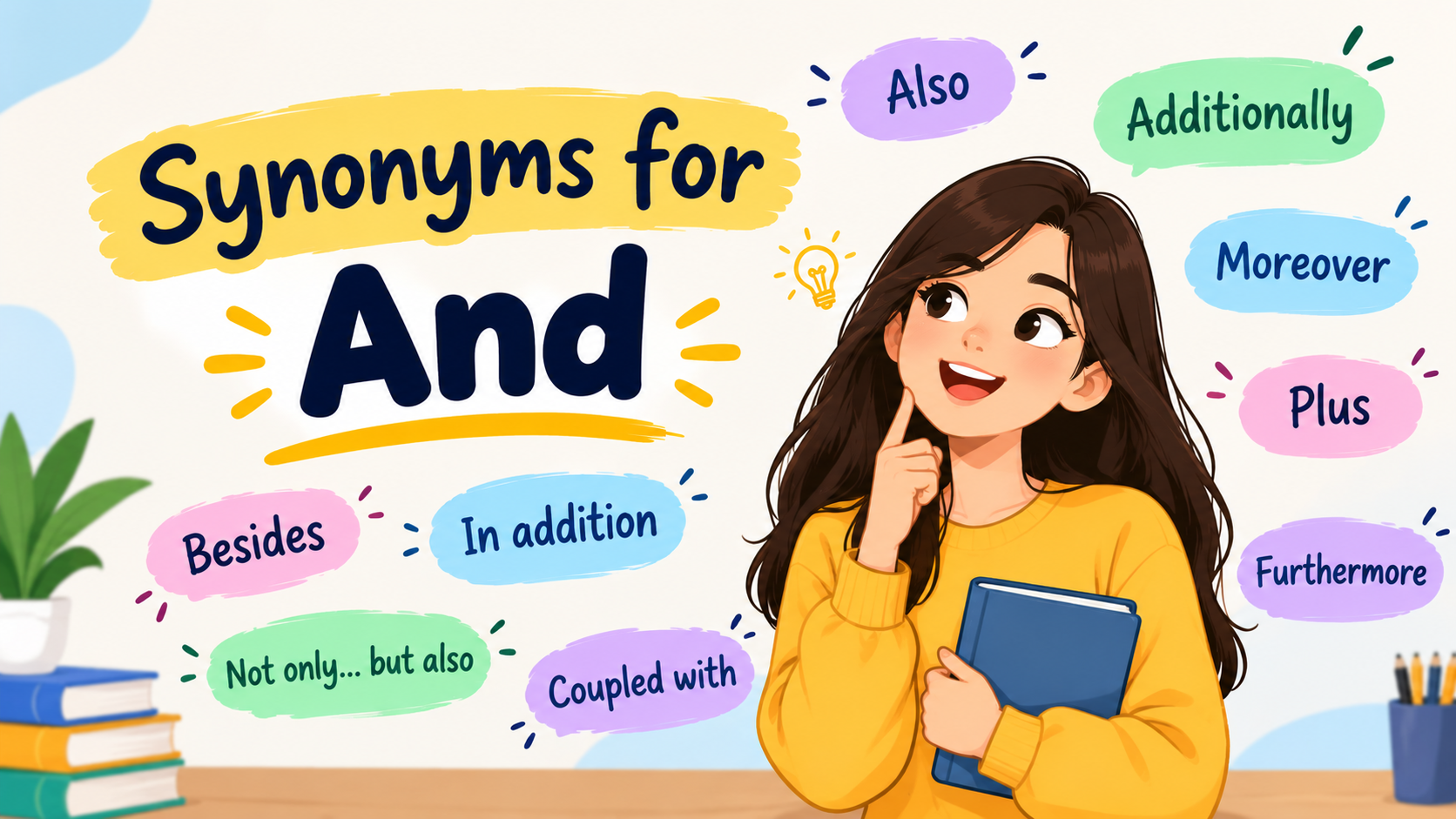
This guide explores 80+ alternatives to “and”, explains what each one means, and shows how to use them naturally.
What Does “And” Mean?
“And” is a coordinating conjunction used to connect words, phrases, or clauses that have a related or additive relationship.
It can indicate:
- Addition
- Combination
- Association
- Continuation
- Sequence in some contexts
- Two simultaneous actions
- Multiple qualities or characteristics
Examples
- “Sarah bought bread and milk.”
- “He is intelligent and hardworking.”
- “She opened the door and walked inside.”
- “The report is detailed and accurate.”
Unlike words such as “however” or “therefore,” and is neutral. It usually tells the reader that another related element is being added without specifying exactly how the two ideas relate.
Quick List of Alternatives to “And”
| Alternative | Main Meaning | Best Use |
|---|---|---|
| Also | In addition | General writing |
| As well | In addition | Everyday writing |
| As well as | In addition to | General/formal |
| Along with | Together with | Professional writing |
| Together with | In combination with | Formal writing |
| In addition to | Additional element | Formal writing |
| Additionally | Further information | Academic/professional |
| Furthermore | Additional supporting point | Academic |
| Moreover | Stronger additional point | Formal/academic |
| Besides | In addition | Conversational |
| Plus | Additional item | Informal |
| Too | Also | Casual writing |
| What’s more | Additional noteworthy point | Conversational |
| On top of that | Additional point | Informal |
| Not only…but also | Emphasis | Formal/general |
| Coupled with | Combined with | Academic/business |
| Combined with | Used together | Formal |
| Alongside | Together with | Professional |
| In conjunction with | Working together | Formal |
| In tandem with | Working together | Business |
| Hand in hand with | Closely connected | General |
| Together | In combination | General |
| Jointly | Done together | Formal |
| Simultaneously | At the same time | Timing |
| Meanwhile | At the same time | Narrative |
| While | During the same period | Timing |
| Then | Next | Sequence |
| Next | Following step | Instructions |
| Subsequently | Afterward | Formal |
| Afterwards | After that | General |
| Following this | After this event | Formal |
| Complemented by | Improved by an addition | Formal |
| Accompanied by | Occurring with | Formal |
| Supplemented by | Added to | Formal |
| Reinforced by | Strengthened by | Academic |
| Paired with | Put together with | General |
| With | Together with | General |
| Including | Containing as part | Lists |
| Both…and | Two connected items | Grammar |
| In combination with | Used together | Formal |
| Side by side with | Together/alongside | General |
| In addition | Further point | Formal |
| What is more | Further noteworthy point | Formal/general |
80+ Synonyms and Alternatives for “And”
1. Also
Also means “in addition” or “too.”
Example:
“She speaks English and also understands French.”
It works well in everyday, academic, and professional writing.
2. As Well
As well means “also” or “in addition.”
Example:
“He applied for the position as well.”
It is especially common at the end of a sentence.
3. As Well As
As well as means “in addition to.”
Example:
“She speaks Spanish as well as English.”
It can be a natural alternative when connecting two nouns or activities.
4. Along With
Along with means “together with” or “in addition to.”
Example:
“The manager, along with her team, attended the meeting.”
5. Together With
Together with emphasizes that two or more people or things are involved collectively.
Example:
“The director, together with the board, approved the proposal.”
6. In Addition To
In addition to introduces another person, thing, or idea.
Example:
“In addition to salary, employees receive health benefits.”
This is particularly useful in professional writing.
7. Additionally
Additionally means “also” or “in addition.”
Example:
“The product is affordable. Additionally, it is easy to use.”
It works especially well at the beginning of a new sentence.
8. Furthermore
Furthermore adds another supporting point, especially in formal or academic writing.
Example:
“The method is inexpensive. Furthermore, it is easy to implement.”
9. Moreover
Moreover introduces an additional point that often carries extra importance.
Example:
“The proposal is expensive. Moreover, it has several practical limitations.”
10. Besides
Besides can mean “in addition to” or “apart from.”
Example:
“Besides being talented, she is extremely hardworking.”
11. Plus
Plus is an informal way to add another point.
Example:
“The apartment is spacious, plus it has a great location.”
It is more conversational than “furthermore” or “additionally.”
12. Too
Too means “also.”
Example:
“I enjoyed the movie too.”
It commonly appears toward the end of a sentence.
13. What’s More
What’s more adds another noteworthy or persuasive point.
Example:
“The service was excellent. What’s more, the price was reasonable.”
14. On Top of That
On top of that introduces an additional circumstance, often one that makes a situation more significant.
Example:
“The flight was delayed. On top of that, our luggage was lost.”
15. Not Only…But Also
Not only…but also emphasizes two related points.
Example:
“She is not only intelligent but also extremely creative.”
This construction is especially useful when you want the second point to receive emphasis.
16. Coupled With
Coupled with means combined with another factor.
Example:
“His experience, coupled with his determination, helped him succeed.”
17. Combined With
Combined with shows that two things work together.
Example:
“Exercise combined with a balanced diet can support a healthy lifestyle.”
18. Alongside
Alongside means together with or next to.
Example:
“The new system operates alongside the existing platform.”
19. In Conjunction With
In conjunction with means working or occurring together with something else.
Example:
“The study was conducted in conjunction with a local university.”
This is common in formal and professional writing.
20. In Tandem With
In tandem with means working together or occurring at the same time.
Example:
“The marketing campaign was developed in tandem with the product launch.”
21. Hand in Hand With
Hand in hand with describes two things that are closely connected.
Example:
“Good communication goes hand in hand with effective leadership.”
22. Together
Together indicates that people or things act or exist as a group.
Example:
“The two teams worked together to complete the project.”
23. Jointly
Jointly means together, especially when people or organizations share responsibility.
Example:
“The report was jointly prepared by the two departments.”
24. Simultaneously
Simultaneously means at the same time.
Example:
“The two announcements were made simultaneously.”
It is not a general replacement for “and,” but it works when the original sentence describes simultaneous events.
25. Meanwhile
Meanwhile indicates that something happens during the same period as another event.
Example:
“She prepared the presentation. Meanwhile, her colleague organized the data.”
26. While
While can indicate that two actions happen during the same period.
Example:
“While she prepared the report, he analyzed the results.”
27. Then
Then shows that one event follows another.
Example:
“Finish the introduction, then write the conclusion.”
28. Next
Next indicates the following step or event.
Example:
“First, gather the information. Next, organize it into categories.”
29. Subsequently
Subsequently means “afterward” or “later.”
Example:
“The proposal was reviewed and subsequently approved.”
It is especially useful in formal writing.
30. Afterwards
Afterwards means after something has happened.
Example:
“She completed the interview and went home afterwards.”
31. Following This
Following this introduces something that happens after a previous event.
Example:
“The agreement was signed. Following this, both companies began the project.”
32. In Addition
In addition introduces another related point.
Example:
“The hotel is affordable. In addition, it is close to the city center.”
33. What Is More
What is more is a slightly more formal version of “what’s more.”
Example:
“The plan is practical. What is more, it can be implemented quickly.”
34. As an Addition
As an addition can introduce something added to an existing item.
Example:
“The company introduced training as an addition to its existing employee program.”
In many cases, in addition to sounds more natural.
35. Accompanied By
Accompanied by means occurring or appearing together with something else.
Example:
“The report was accompanied by several charts.”
36. Complemented By
Complemented by means added in a way that improves or completes something.
Example:
“The meal was complemented by a fresh salad.”
37. Supplemented By
Supplemented by means something additional was provided to support or complete the main thing.
Example:
“The lecture was supplemented by practical exercises.”
38. Reinforced By
Reinforced by means strengthened by something additional.
Example:
“Her argument was reinforced by reliable evidence.”
39. Paired With
Paired with means combined or matched with another thing.
Example:
“The jacket looks excellent paired with dark jeans.”
40. With
With can sometimes replace “and” when showing association or accompaniment.
Example:
“She arrived with her brother.”
However, “with” does not always have exactly the same grammatical function as “and.”
41. Including
Including introduces something that forms part of a larger group.
Example:
“The package includes breakfast, including fresh fruit and coffee.”
42. Both…And
Both…and emphasizes that two elements are included.
Example:
“Both the manager and the assistant attended the meeting.”
43. In Combination With
This phrase means that two or more things are used together.
Example:
“The software works in combination with existing security tools.”
44. Side by Side With
Side by side with means together or alongside something else.
Example:
“The new system operates side by side with the old platform.”
45. In Association With
In association with means together with or connected to another person or organization.
Example:
“The event was organized in association with several local groups.”
46. In Partnership With
In partnership with emphasizes cooperation between people or organizations.
Example:
“The program was developed in partnership with local schools.”
47. In Collaboration With
In collaboration with means working together toward a shared objective.
Example:
“The research was conducted in collaboration with several universities.”
48. In Cooperation With
In cooperation with indicates that people or organizations worked together.
Example:
“The campaign was created in cooperation with community organizations.”
49. Collectively
Collectively means as a group.
Example:
“The researchers collectively analyzed the results.”
50. Concurrently
Concurrently means happening at the same time.
Example:
“The two projects were developed concurrently.”
51. At the Same Time
This phrase can show simultaneous events.
Example:
“She was working while studying at the same time.”
Use it when timing matters rather than simply adding two unrelated items.
52. At Once
At once can sometimes indicate that multiple actions happen immediately or together.
Example:
“The system processes several requests at once.”
53. In Parallel
In parallel describes activities taking place alongside each other.
Example:
“The two teams worked in parallel.”
54. In Concert With
In concert with means together or in agreement with.
Example:
“The agency acted in concert with local authorities.”
55. In Coordination With
In coordination with emphasizes organized cooperation.
Example:
“The event was planned in coordination with city officials.”
56. In Cooperation
In cooperation describes joint action.
Example:
“The organizations worked in cooperation to address the issue.”
57. Along the Same Lines
This expression can connect related ideas that share a similar approach.
Example:
“The second proposal follows along the same lines as the first.”
58. Likewise
Likewise means similarly or in the same way.
Example:
“She supported the project; likewise, her colleagues approved it.”
It is not an exact substitute for “and,” but it can connect related ideas.
59. Similarly
Similarly introduces something comparable.
Example:
“The first study produced positive results. Similarly, the second study found significant improvements.”
60. Equally
Equally can introduce another point that deserves comparable consideration.
Example:
“The design is attractive. Equally important, it is easy to maintain.”
61. Beyond That
Beyond that introduces another point beyond what has already been discussed.
Example:
“The plan is affordable. Beyond that, it is easy to implement.”
62. On Another Note
On another note introduces a different but related topic.
Example:
“The project is nearly finished. On another note, we should discuss next year’s budget.”
63. In the Same Way
In the same way connects an idea with another idea that follows a similar pattern.
Example:
“Exercise improves physical health. In the same way, reading strengthens mental skills.”
64. Not to Mention
Not to mention adds another relevant point, often something that strengthens the preceding statement.
Example:
“The hotel is affordable, not to mention conveniently located.”
65. Let Alone
Let alone adds a stronger or more difficult example.
Example:
“He can barely afford a basic car, let alone a luxury vehicle.”
This is not a direct synonym for “and,” but it can replace an additive structure in specific contexts.
66. As a Bonus
As a bonus introduces an additional benefit.
Example:
“The apartment is affordable, and as a bonus, it has a large balcony.”
67. To Add to This
To add to this introduces another supporting point.
Example:
“The product is inexpensive. To add to this, it is easy to maintain.”
68. Adding to This
Adding to this introduces another related idea.
Example:
“Adding to this, the company offers flexible working hours.”
69. Over and Above
Over and above means in addition to something already mentioned.
Example:
“Over and above the basic salary, employees receive performance bonuses.”
70. Apart From
Apart from can mean “in addition to” or “excluding,” depending on context.
Example:
“Apart from English, she speaks German and French.”
Because it can be ambiguous, use it carefully.
71. Besides That
Besides that adds another point.
Example:
“The job is demanding. Besides that, the commute is quite long.”
72. Along With That
Along with that adds another associated point.
Example:
“The company increased salaries. Along with that, it expanded employee benefits.”
73. In Addition to This
This formal phrase introduces an additional idea.
Example:
“In addition to this, the report recommends further research.”
74. As a Further Point
This phrase introduces another supporting consideration.
Example:
“As a further point, the researchers noted the limitations of the study.”
75. Added To
Added to describes one factor combined with another.
Example:
“High demand, added to limited supply, caused prices to rise.”
76. Together With This
This phrase emphasizes another accompanying factor.
Example:
“Together with this, the company introduced a new training program.”
77. In Conjunction
In conjunction means together or jointly.
Example:
“The system operates in conjunction with existing software.”
78. In Tandem
In tandem means alongside or together.
Example:
“The departments worked in tandem.”
79. Hand in Hand
Hand in hand describes two things that naturally occur or develop together.
Example:
“Growth and innovation often go hand in hand.”
80. In Union With
In union with means together with or in combination with.
Example:
“The organization worked in union with community partners.”
81. As One
As one emphasizes people acting collectively.
Example:
“The team worked as one to complete the project.”
82. Collectively With
This construction emphasizes group participation.
Example:
“The departments collectively worked with the external consultants.”
In most cases, simply using collectively or together with is more natural.
Best Alternatives to “And” by Context
Not every alternative works in every sentence. Choosing the right connector depends on the relationship between your ideas.
| Context | Useful Alternatives |
|---|---|
| Simple addition | Also, as well, too |
| Formal addition | Additionally, furthermore, moreover |
| Academic writing | Furthermore, moreover, additionally |
| Business writing | Along with, in addition to, alongside |
| Informal writing | Plus, besides, what’s more |
| Two equal elements | Both…and |
| Strong emphasis | Not only…but also |
| Combination | Coupled with, combined with |
| Cooperation | In conjunction with, in collaboration with |
| Simultaneous events | While, meanwhile, simultaneously |
| Sequence | Then, next, afterward, subsequently |
| Parallel activities | In parallel, alongside, in tandem |
| Accompaniment | Accompanied by, along with |
| Enhancement | Complemented by, supplemented by |
| Evidence/support | Reinforced by |
| Partnerships | In partnership with, jointly with |
| Lists | Including, along with |
| Formal reports | Additionally, furthermore, in addition |
| Everyday speech | Also, too, plus, as well |
Synonyms for “And” in Formal Writing
If you are writing an essay, report, research paper, or professional document, these alternatives can provide more variety:
- Additionally
- Furthermore
- Moreover
- In addition
- In addition to
- Along with
- Together with
- Alongside
- In conjunction with
- In tandem with
- Coupled with
- Combined with
- Supplemented by
- Accompanied by
- Complemented by
- Jointly with
- In collaboration with
- In partnership with
Example
Basic:
“The study examined costs and analyzed customer behavior.”
Alternative:
“The study examined costs. Additionally, it analyzed customer behavior.”
Or:
“The study examined costs, along with customer behavior.”
The best choice depends on the grammatical structure and the relationship between the ideas.
Synonyms for “And” in Academic Writing
Academic writing often benefits from connectors that clearly show how ideas relate.
Adding information
- Additionally
- Furthermore
- Moreover
- In addition
Emphasizing a second point
- Moreover
- Not only…but also
- What is more
Combining factors
- Coupled with
- Combined with
- In conjunction with
- In combination with
Showing simultaneous activity
- While
- Meanwhile
- Simultaneously
- Concurrently
Example
Instead of repeatedly writing:
“The method is affordable and it is reliable and it is easy to implement.”
You could write:
“The method is affordable. Furthermore, it is reliable and easy to implement.”
Or:
“The method is affordable, reliable, and easy to implement.”
Sometimes the best alternative to “and” is simply restructuring the sentence.
Synonyms for “And” in Professional Writing
In business communication, natural alternatives include:
- Along with
- Together with
- In addition to
- Additionally
- Alongside
- In conjunction with
- In partnership with
- In collaboration with
- Jointly
- Coupled with
Example
Instead of:
“The proposal includes a budget and a timeline and supporting documents.”
You could write:
“The proposal includes a budget, timeline, and supporting documents.”
Or:
“The proposal includes a budget along with a detailed timeline and supporting documents.”
Synonyms for “And” in Everyday Conversation
In casual conversation, you do not need complicated connectors.
Natural choices include:
- Also
- Too
- As well
- Plus
- Besides
- What’s more
- On top of that
Examples
“The restaurant is affordable, plus the food is great.”
“I invited Sarah too.”
“He is funny as well.”
“The hotel was comfortable. On top of that, it was close to the beach.”
“And” vs. “Also”
Both words add information, but they are used differently.
And normally connects elements directly:
“She bought bread and milk.”
Also can add information within a sentence:
“She also bought milk.”
Use “and” when two elements naturally belong together. Use “also” when you want to introduce an additional point.
“And” vs. “As Well As”
And usually treats connected elements equally.
“She speaks English and French.”
As well as can give slightly greater emphasis to the first element:
“She speaks English as well as French.”
However, these structures are not always interchangeable because they can affect sentence grammar and emphasis.
“And” vs. “Furthermore”
And is a simple connector.
Furthermore is a formal transition used to add another supporting point.
Compare:
“The product is affordable and reliable.”
with:
“The product is affordable. Furthermore, it is highly reliable.”
The second version separates the ideas and gives the additional point more rhetorical emphasis.
“And” vs. “Moreover”
Moreover is more formal and often introduces an additional point that strengthens the argument.
“The plan is expensive. Moreover, it has not been adequately tested.”
It is usually better suited to formal writing than everyday conversation.
“And” vs. “Plus”
Plus is casual.
“The room is large, plus it has a great view.”
In formal writing, in addition, additionally, or furthermore may be more appropriate.
“And” vs. “Then”
These words should not normally be treated as interchangeable.
And adds or connects:
“She opened the door and walked inside.”
Then emphasizes sequence:
“She opened the door, then walked inside.”
The second version makes the order of events clearer.
“And” vs. “While”
While can show that two actions happen at the same time.
“She prepared the report while he analyzed the data.”
“And” does not necessarily make simultaneity explicit.
Therefore, if timing is important, while, meanwhile, or simultaneously may be more precise.
“And” vs. “But”
“And” adds information.
“But” introduces contrast.
“She is young and experienced.”
“She is young but experienced.”
The meaning changes significantly, so “but” should not be used simply as a synonym for “and.”
Can “And” Be Replaced With a Comma?
Sometimes the best way to avoid repeating “and” is to change the sentence structure rather than substitute another connector.
For example:
“The course is affordable and practical and flexible.”
can become:
“The course is affordable, practical, and flexible.”
This is often cleaner than replacing every “and” with a more complicated phrase.
How to Avoid Repeating “And”
If your writing contains too many “ands,” try these strategies.
1. Combine items into a list
Instead of:
“The course is affordable and practical and flexible.”
Write:
“The course is affordable, practical, and flexible.”
2. Separate major ideas
Instead of:
“The product is inexpensive and reliable and easy to use.”
Write:
“The product is inexpensive. It is also reliable and easy to use.”
3. Use a precise transition
Instead of:
“The method is affordable and it is easy to implement.”
Write:
“The method is affordable. Furthermore, it is easy to implement.”
4. Show the actual relationship
If two events happen simultaneously, use while.
If one follows another, use then or subsequently.
If one strengthens another, use coupled with or reinforced by.
If one contrasts with another, use but, however, or although.
This approach makes writing clearer rather than simply replacing words for variety.
Common Mistakes When Replacing “And”
Mistake 1: Treating every connector as an exact synonym
Words such as “moreover,” “then,” and “while” do different jobs.
Do not replace “and” automatically. First identify the relationship between the ideas.
Mistake 2: Using “plus” in formal writing
“Plus” is natural in conversation but can sound too informal in an academic paper or official report.
Use in addition, additionally, or furthermore instead.
Mistake 3: Overusing “furthermore”
If every sentence starts with “furthermore,” the writing can become repetitive again.
Good writing uses a mixture of sentence structures and transitions.
Mistake 4: Using “moreover” for simple lists
You would not normally write:
“I bought apples. Moreover, I bought oranges.”
Simply write:
“I bought apples and oranges.”
“Moreover” is better suited to adding a significant supporting point.
Mistake 5: Replacing “and” when no replacement is needed
“And” is not a bad word.
If it is the clearest connector, keep it.
The goal is precision, not avoiding a common English word.
Antonyms and Contrasting Connectors for “And”
Technically, “and” does not have a single grammatical antonym. However, English has conjunctions and transitions that express relationships opposite to simple addition.
| Connector | Function | Example |
|---|---|---|
| But | Contrast | He tried, but he failed. |
| However | Contrast | The plan is good; however, it is expensive. |
| Yet | Unexpected contrast | She was tired, yet she continued. |
| Although | Concession | Although it was difficult, they continued. |
| Whereas | Direct comparison/contrast | He prefers tea, whereas she prefers coffee. |
| Instead | Alternative | She didn’t call; instead, she emailed. |
| Rather than | Preference/replacement | He walked rather than drove. |
| Otherwise | Alternative consequence | Hurry, otherwise you’ll miss the train. |
| Conversely | Opposite relationship | Sales increased; conversely, profits declined. |
| On the contrary | Direct opposition | The evidence does not weaken the argument. On the contrary, it supports it. |
Common Expressions With “And”
Not Only…But Also
“She is not only talented but also hardworking.”
Both…And
“Both the manager and the assistant attended.”
Safe and Sound
“They arrived safe and sound.”
More and More
“The technology is becoming more and more popular.”
Again and Again
“He made the same mistake again and again.”
Pros and Cons
“Let’s discuss the pros and cons.”
Back and Forth
“They went back and forth during the discussion.”
These expressions show why “and” remains important even when alternatives are available.
FAQs
What is another word for “and”?
Common alternatives include also, as well, as well as, along with, in addition to, additionally, furthermore, moreover, besides, plus, together with, alongside, and coupled with.
However, these words are not interchangeable in every sentence.
What is the best formal synonym for “and”?
For adding information in formal writing, additionally, furthermore, moreover, and in addition are common choices. For connecting nouns or entities, along with, together with, and in conjunction with may work better.
What is a good synonym for “and” in academic writing?
Useful academic alternatives include furthermore, moreover, additionally, in addition, coupled with, combined with, and in conjunction with.
What can I use instead of “and” in an essay?
It depends on what you want to express. Try furthermore or additionally for another supporting point, while for simultaneous actions, then for sequence, and not only…but also for emphasis.
What is a casual alternative to “and”?
Plus, too, also, as well, and what’s more can work in casual writing and conversation.
Can I replace “and” with “also”?
Sometimes. “Also” means “in addition,” but its grammatical position differs from “and.”
For example:
“She bought bread and milk.”
can become:
“She bought bread. She also bought milk.”
But you cannot replace “and” with “also” mechanically in every sentence.
Can “and” be replaced with “plus”?
In informal contexts, yes.
“The hotel is cheap, plus it has a great location.”
For formal writing, in addition, additionally, or furthermore is usually more appropriate.
Is “moreover” a synonym for “and”?
It can serve a similar additive function, but “moreover” is more formal and usually introduces an additional point that strengthens an argument.
Is “and” a conjunction?
Yes. And is a coordinating conjunction. It connects words, phrases, or independent clauses that have a related grammatical relationship.
Can I start a sentence with “and”?
Yes. Starting a sentence with “and” is accepted in modern English. The issue is usually style rather than grammar. Repeatedly beginning sentences with “and” can make prose feel repetitive, so varying sentence structure may improve readability.
What is the difference between “and” and “as well as”?
“And” generally presents connected elements more neutrally, while “as well as” often adds something to an already established element.
Compare:
“She speaks English and Spanish.”
“She speaks English as well as Spanish.”
Both are grammatical, but the emphasis and structure can differ.
Final Thoughts
The best alternative to “and” is not necessarily a more complicated word. The right choice depends on what relationship you want to show between your ideas.
Use also, as well, or in addition for straightforward addition. Choose furthermore or moreover for formal supporting points. Use along with, alongside, or together with when describing things that occur or belong together.
If you need to show timing, consider while, meanwhile, simultaneously, then, or subsequently. For stronger emphasis, not only…but also can be effective. For combination, coupled with, combined with, or in conjunction with may be more precise.
Most importantly, do not feel that you must eliminate “and” from your writing. It is a fundamental and perfectly useful English conjunction. The goal is to use it when it communicates your meaning clearly and choose another connector only when that connector expresses the relationship more precisely.
With a better understanding of these alternatives, you can make your essays, reports, professional documents, blog posts, and everyday writing more varied, natural, and precise.