
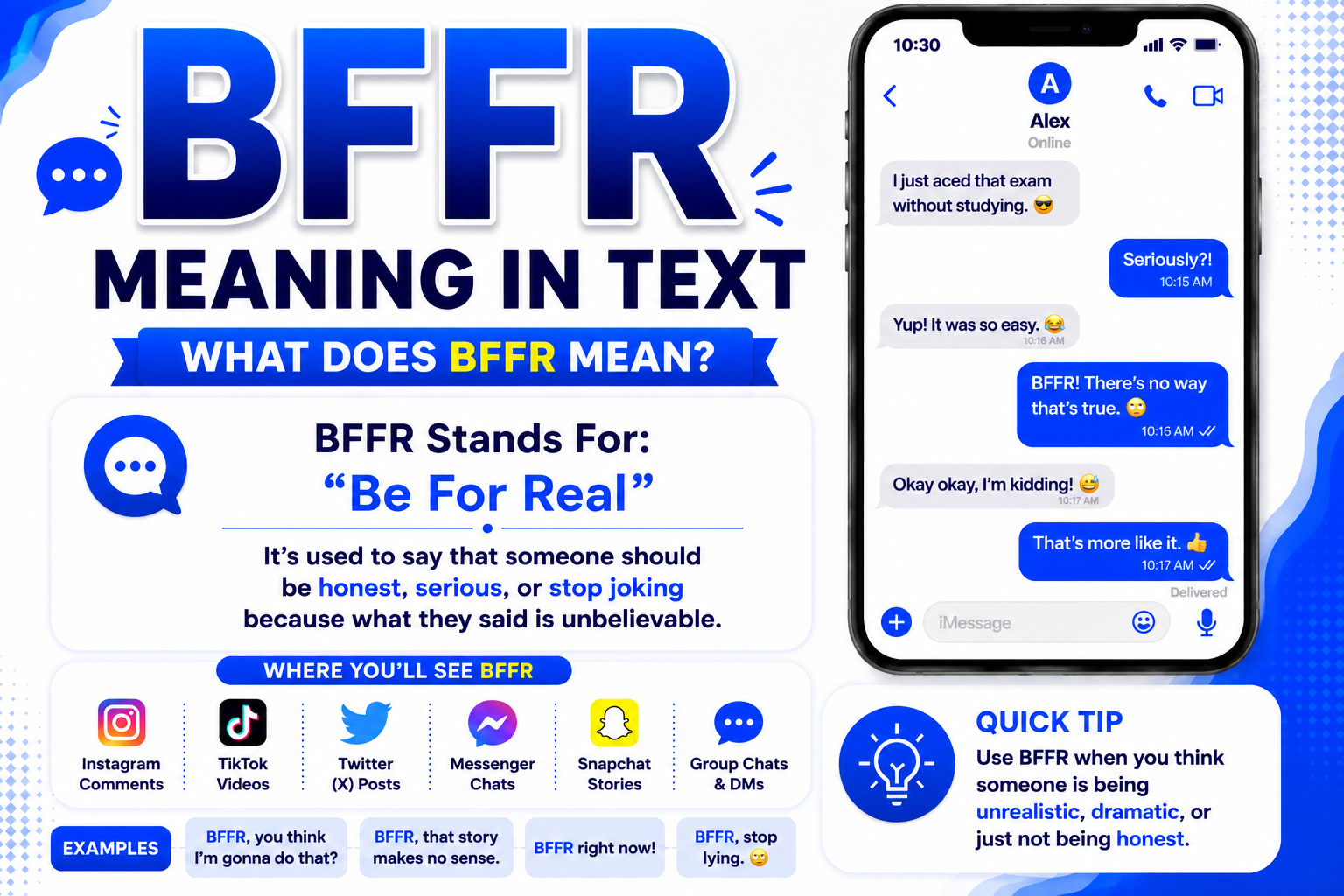
BFFR is a verbal slap with plausible deniability. Short for “be f***ing for real,” it lands somewhere between a joke and a confrontation — the exact spot depends on who says it and how delusional the take was. If someone drops a BFFR on your message, they’re not asking a question. They’re telling you to come back to reality.
The abbreviation exploded on TikTok, where the phrase “be so for real” was already doing laps as a reaction to unhinged opinions. BFFR is its louder sibling: same message, less patience.
What Does BFFR Mean in Text?
Quick answer: BFFR stands for “be f***ing for real.” It’s a blunt way to call out something that sounds delusional, exaggerated, or just plain wrong — playful among friends, confrontational everywhere else.
| Term | BFFR |
| Stands for | “Be F***ing For Real” |
| Tone | Blunt and confrontational — sometimes playful |
| Where you’ll see it | TikTok comments, group chats, X/Twitter, Snapchat |
| Safe for work or school? | Absolutely not (contains profanity) |
Where Did BFFR Come From?
“Be for real” is old — people have said “be serious” forever. The internet compressed it to “be fr,” and TikTok’s sincerity culture gave us “be so for real” as both genuine agreement and sarcastic disbelief. BFFR is the profanity-laced upgrade: when “be so for real” doesn’t carry enough force, you add the intensifier.
It mirrors how “fr” traveled through hip-hop lyrics and stan Twitter before going fully mainstream. Each generation of the phrase gets shorter and hits harder — BFFR is simply the current final form.
How People Actually Use BFFR
1. Calling out a wild claim. “I could totally go pro if I wanted to.” / “BFFR” — you could not, and everyone knows it.
2. Reacting to a bad take. “Pineapple belongs on pizza and I’ll die on this hill.” / “BFFR.” Disagreement, served cold.
3. Playful roasting. “I’m literally the funniest person in this group.” / “BFFR you’re not even top 3.” Roasting with love.
4. Self-deprecating. “Me thinking I can finish this assignment in an hour. BFFR.” Aimed at yourself — always a joke.
5. Shutting down excuses. “I didn’t text back because my phone died.” / “BFFR, your phone was fine.” Caught.
6. Collective disbelief. “New rule: everyone chips in $50 for the trip.” / “BFFR???” The whole chat pushing back at once.
7. Surgical precision. “I totally read the whole book.” / “BFFR you read the back cover.” Specific, devastating, funny.
The BFFR Intensity Scale
Not all “for reals” are equal. Here’s the escalation ladder:
- “fr” — neutral agreement. “fr, that movie was good.”
- “be for real” — mild challenge. “Be for real, that never happened.”
- “be so for real” — TikTok’s favorite. Can be sincere or sarcastic depending on delivery.
- “BFFR” — maximum force. The profanity is doing heavy lifting; this one is never neutral.
BFFR in the Wild: Where You’ll See It Most
- TikTok comments — the number-one habitat. Wild claims, staged pranks, and “POV” videos that are obviously fake all attract BFFRs within minutes.
- X/Twitter quote-tweets — the dunking arena. A bad take quote-tweeted with “BFFR” is the platform’s favorite blood sport.
- Group chats — roasting friends in real time. The safest place for it.
- Meme captions — “Me: I’ll start my diet Monday. Also me: BFFR.” Self-awareness as comedy.
- Twitch chat — reacting to a streamer’s delusional play or excuse at light speed.
Reading the Tone: Playful or Confrontational?
- Playful: laughing or crying emojis, between close friends, about trivial things. “BFFR you did NOT eat all of it”
- Confrontational: no emoji, from a stranger, dropped into a heated thread.
- Self-directed: “me: … BFFR” memes are always jokes — nobody roasts themselves for real.
- The emoji rule: laughing/crying emoji means roasting with love. No emoji in a debate means actual hostility.
BFFR and the Era of the Callout
BFFR didn’t rise alone. It belongs to a whole vocabulary built for puncturing pretense: “delulu,” “solulu,” “be so fr,” “it’s giving delusion.” Where older slang softened disagreement (“no offense, but…”), Gen Z slang performs it. BFFR is the bluntest instrument in that toolkit, which is exactly why it thrives in comment sections — low effort, high clarity, instantly legible to everyone fluent in the dialect. Understanding BFFR means understanding a generation that would rather call something out than let it slide.
When BFFR Stings
- Serious confessions. “I’ve been struggling lately.” / “BFFR.” Devastating — never do this.
- Insecurities. Dropping BFFR on someone’s appearance or achievement post reads as cruelty.
- From strangers. A stranger’s BFFR is never playful — it’s a pile-on.
- Mixed company. In a group chat with acquaintances, your friend’s joke can land as someone else’s insult.
What to Say Instead of BFFR
| Instead of | Try | When |
| BFFR | “Be so for real” | Keep the energy, drop the profanity |
| BFFR | “No way” | Playful disbelief with friends |
| BFFR | “I don’t think that’s right” | Disagreeing without the edge |
| BFFR | “Source??” | Demanding proof, internet-style |
| BFFR | “Let’s be honest here” | Serious conversations |
BFFR FAQs
Is BFFR rude?
It can be. It contains an abbreviated profanity, so it always carries an edge. Among close friends it’s usually teasing; from strangers it’s an insult.
What does BFFR mean on TikTok?
The same thing: “be f***ing for real,” usually in comments reacting to wild claims, bad takes, or obviously staged videos.
Can I use BFFR jokingly?
With close friends, absolutely — that’s its natural habitat. Read the room first; the joke only works when everyone knows it’s a joke.
What’s the difference between BFFR and “be so for real”?
BFFR is stronger and cruder. “Be so for real” can be sincere; BFFR almost never is.
Who uses BFFR the most?
Gen Z, heaviest on TikTok and X. Millennials tend to say “be real” without the intensifier; Gen Alpha has its own callouts.
Is BFFR ever sincere?
Almost never. If someone types BFFR, they’re pushing back on something. For sincere agreement, people use “fr” or “real.”
Is BFFR appropriate at work or school?
No. Use “Could you clarify?” or “That doesn’t sound right” instead.
The Bottom Line
BFFR is a reality check in four letters. It works because everyone instantly understands the assignment: stop capping, be serious. Just remember the profanity hiding inside it — deploy it on friends, not on your manager.