
FML is the internet’s melodrama button. Short for “f*** my life,” it’s what you type when your day goes sideways in a way that’s too funny to just call bad luck. Spilled coffee on your shirt before a meeting? FML. Phone died at 1%? FML. It’s not a cry for help — it’s a punchline with yourself as the setup.
The magic of FML is the exaggeration contract: everyone knows your life is fine, and that’s what makes it funny. Typing those three letters turns a minor disaster into a tiny comedy routine. But like all melodrama, it has a line — and crossing it turns the joke into something heavier.
In this guide: what FML really means, the website that launched it, why the melodrama is funny, how to read its tone, and where the joke ends.
What Does FML Mean in Text?
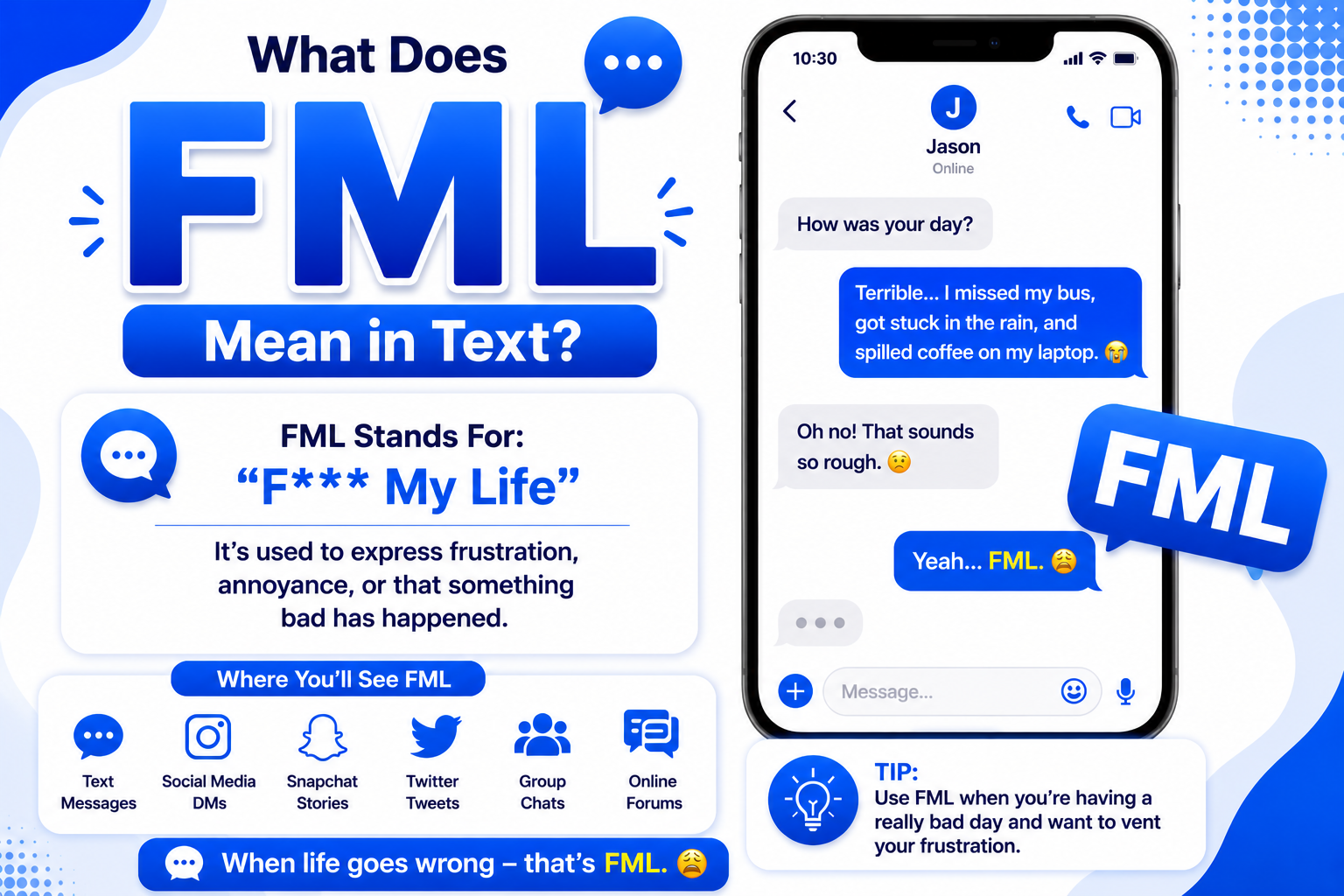
Quick answer: FML stands for “f*** my life.” People use it — usually jokingly — to react to bad luck, frustration, or embarrassing moments. It’s melodrama as comedy: the situation is rarely as bad as the abbreviation suggests.
| Term | FML |
| Stands for | “F*** My Life” |
| Tone | Dramatic — usually humorous |
| Where you’ll see it | Texts, TikTok, X/Twitter, group chats, memes |
| Safe for work or school? | No (contains profanity) |
From a Website to a Reflex
FML didn’t start as slang — it started as a website. FMyLife.com launched in 2009 with a simple format: users posted short anecdotes beginning with “Today” and ending with “FML.” (“Today, I waved back at someone who wasn’t waving at me. FML.”) The site became a genuine cultural phenomenon, spawned books and apps, and embedded the abbreviation in internet vocabulary. The website eventually faded; the reflex stayed. Now “FML” is the punchline people reach for without ever having visited the site that invented it.
FML: A Cultural Timeline
- 2009: FMyLife.com launches. The “Today, … FML” format becomes a meme template overnight.
- Early 2010s: the abbreviation escapes the site into texts, tweets, and Facebook statuses.
- Mid 2010s: peak saturation — FML merch, the phrase in TV dialogue, your mom knows it.
- Late 2010s–2020s: settles into permanent vocabulary. New slang cycles faster now, but FML endures because bad luck is eternal.
Each era kept the format; only the platform changed.
Why FML Is Funny
The humor runs on a shared contract: everyone knows your life isn’t actually ruined. That gap between the catastrophic phrase and the trivial event is the joke. It’s also bonding — posting your small disasters invites everyone else’s. There’s a little schadenfreude in it, but with permission: you’re laughing at yourself first, which makes it safe for everyone else to laugh too. FML turns bad luck into social currency.
The format itself is a joke structure: “Today, [minor disaster]. FML.” Setup, punchline. The site trained a generation to narrate their mishaps as micro-comedies, and the habit stuck. Even now, people frame bad-luck stories as FML anecdotes without realizing they’re following a template from 2009.
How People Actually Use FML
1. Classic bad luck. “Locked my keys in the car. FML.” The everyday use.
2. Tech fails. “Phone died during the concert. FML.” Modern problems, ancient abbreviation.
3. Self-owns. “Studied the wrong chapter. FML.” Your fault, your punchline.
4. Social disasters. “Waved at someone who wasn’t waving at me. FML.” The original genre.
5. Commiserating. Friend: “Missed my train.” You: “FML, that’s the worst.” Borrowing their melodrama.
6. The pile-on. “First the coffee, then the traffic, now this. FML.” When the universe is clearly targeting you.
The FML Scale: Annoyed to Devastated
- Level 1 — Mild: stubbed toe, spilled drink. Pure comedy.
- Level 2 — Annoying: missed train, dead phone. Relatable content.
- Level 3 — Rough: failed exam, bad news about a relationship. Still joking, but the smile is thinner.
- Level 4 — Actually bad: real loss, real pain. The joke stops working here.
The rule: FML is funny in inverse proportion to how bad things actually are. Levels 1–2 are the sweet spot; Level 4 needs real words.
Reading the Tone
- Joking: laughing emojis, trivial events. “FML” is the default setting.
- Venting: no emoji, a real complaint. “Fml, this week has been awful.” Sympathy warranted.
- Theater: all-caps “FML!!!” — drama, not tragedy.
- The emoji rule: laughing or skull emoji means comedy. No emoji plus a serious topic means check on them.
When FML Isn’t a Joke
Sometimes “FML” lands after genuinely bad news — a diagnosis, a death, a disaster. The abbreviation doesn’t magically make it light. If someone drops FML on something serious, don’t reply with laughing emojis; reply like a person: “That’s awful, I’m here.” And if you’re the one typing it about something real, consider skipping the slang — plain words get plain sympathy, which is what you actually need.
FML vs. Its Cousins
| Reaction | What it signals | Difference from FML |
| FML | Melodramatic bad luck | The baseline — the joke is the exaggeration |
| SMH | Disappointed disbelief | Calmer and drier than FML |
| “Kill me” | Exaggerated despair | Darker humor, same melodrama family |
| “I can’t” | Overwhelmed | More about being done than unlucky |
| “RIP me” | Playful doom | The Gen Z cousin of FML |
What to Say Instead of FML
| Instead of | Try | When |
| FML | “That’s the worst” | Commiserating cleanly |
| FML | “My luck today…” | Telling the story |
| FML | “Of course this happened” | Sarcastic bad luck |
| FML | “I’m having a day” | Venting without profanity |
| FML | “That sucks, I’m sorry” | Responding to someone else |
FML FAQs
What does FML stand for?
“F*** my life.”
Is FML rude?
It contains profanity. Among friends it’s normal; in formal settings, no.
Where did FML come from?
The website FMyLife.com (2009), where users posted unlucky anecdotes ending in “FML.”
Why is FML so popular?
It does three jobs at once: vents frustration, invites sympathy, and makes people laugh. Few abbreviations multitask that well.
What’s the difference between FML and “my life is a joke”?
Same energy, different era. “My life is a joke” is the Gen Z rephrase; FML is the millennial original. Both mean: minor disaster, played for laughs.
Is FML still popular?
Yes — it’s one of the most durable internet abbreviations, still going strong more than 15 years later.
Can I use FML at work?
No. Use “That’s frustrating” or “What bad luck” instead.
The Bottom Line
FML is melodrama as a coping mechanism: three letters that turn bad luck into a bit. Keep it at the mild end, aim it at yourself, and remember that when things are actually bad, plain words beat punchlines.