
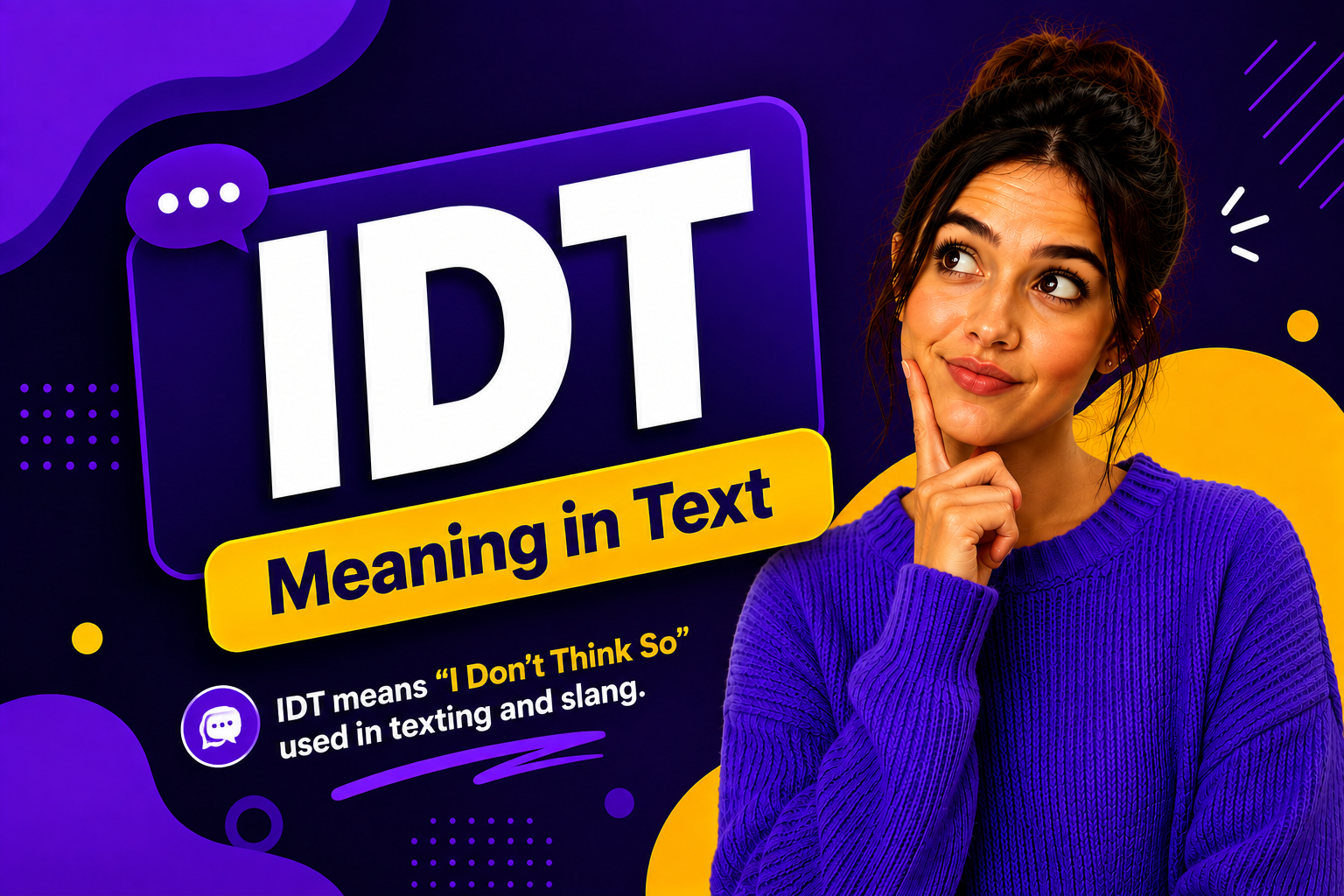
If you have received a text containing “IDT”, you may be wondering what it means. Texting abbreviations are designed to make conversations faster, but not every abbreviation is immediately obvious. IDT is a common casual texting abbreviation that usually means “I Don’t Think.”
For example:
“IDT that’s a good idea.”
means:
“I don’t think that’s a good idea.”
People commonly use IDT in text messages, Snapchat, Instagram DMs, group chats, and other informal online conversations. It can express doubt, disagreement, uncertainty, or a personal opinion without writing the full phrase.
However, as with many abbreviations, IDT can have different meanings in specialized contexts. The surrounding conversation is therefore important when interpreting it.
In this guide, you’ll learn everything about IDT meaning in text, including its meaning in everyday texting, Snapchat, Instagram, relationships, professional communication, examples, alternative phrases, tone, replies, and frequently asked questions.
What Does “IDT” Mean in Text?
Quick Answer
IDT usually means “I Don’t Think” in texting and online conversations.
It is generally placed before a statement that expresses an opinion, uncertainty, doubt, or disagreement.
For example:
“IDT he’s coming.”
means:
“I don’t think he’s coming.”
What Does IDT Stand For?
- I = I
- D = Don’t
- T = Think
The abbreviation is especially popular because it saves time while preserving the basic meaning of the sentence.
Quick-Reference Table
| Meaning | Platform | Context | Example |
|---|---|---|---|
| I Don’t Think | Texting | Opinion | “IDT that’s right.” |
| I Don’t Think | Snapchat | Casual conversation | “IDT she’ll come.” |
| I Don’t Think | DMs/comments | “IDT so.” | |
| I Don’t Think | Group chats | Uncertainty | “IDT we have time.” |
| I Don’t Think | Relationships | Personal opinion | “IDT you’re upset.” |
| I Don’t Think | Work chat | Informal discussion | “IDT that’s possible.” |
| Context-specific meaning | Specialized contexts | Technical | Depends on the field |
IDT Meaning in Everyday Texting
In everyday texting, IDT is primarily used as a shorter way to say “I don’t think.”
It is useful when someone wants to express an opinion without sounding overly formal.
Example 1: Expressing Doubt
“IDT it will rain today.”
Meaning:
“I don’t think it will rain today.”
Example 2: Disagreeing Politely
“IDT that’s the best option.”
Meaning:
“I don’t think that’s the best option.”
Example 3: Predicting Something
“IDT he’ll be there.”
Meaning:
“I don’t think he’ll be there.”
Example 4: Answering a Question
Friend:
“Do you think she’s coming?”
You:
“IDT.”
Meaning:
“I don’t think so.”
Example 5: Making Plans
“IDT we have enough time.”
This means:
“I don’t think we have enough time.”
Example 6: Expressing Uncertainty
“IDT I remember his name.”
The sender isn’t completely certain.
Example 7: Reacting to an Opinion
“IDT that’s true.”
The sender disagrees or isn’t convinced.
Example 8: Casual Prediction
“IDT they’ll win tonight.”
The sender doesn’t believe the team will win.
Example 9: Correcting Someone
“IDT that’s what she meant.”
The sender is expressing a different interpretation.
Example 10: Short Response
“IDT tbh.”
This can mean:
“I don’t think so, to be honest.”
IDT Meaning on Snapchat
Snapchat is one of the platforms where short abbreviations such as IDT are commonly used.
Users may use IDT in:
- Chats
- Snap replies
- Group chats
- Story replies
- Casual conversations
Snapchat Example
Friend:
“Do you think he’ll text back?”
You:
“IDT 😭.”
This means:
“I don’t think so.”
The crying emoji can add a humorous, disappointed, or dramatic tone.
Another Example
“IDT I can come tonight.”
Meaning:
“I don’t think I can come tonight.”
Snapchat Story Reply
Someone posts:
“Think I’ll pass this exam?”
You reply:
“IDT 😂.”
This means:
“I don’t think so 😂.”
Whether this is playful or insulting depends on your relationship with the person.
IDT With Emojis
| Message | Likely Tone |
|---|---|
| “IDT 😂” | Playful doubt |
| “IDT 😭” | Disappointed or humorous |
| “IDT ❤️” | Gentle disagreement |
| “IDT tbh” | Honest opinion |
| “IDT.” | Direct/neutral |
| “IDT!!!” | Strong disagreement or certainty |
IDT Meaning on Instagram & Twitter/X
IDT can also appear in Instagram DMs, comments, captions, and Twitter/X conversations.
Instagram DM Example
Person A:
“Do you think this outfit works?”
Person B:
“IDT, try the black one.”
Here, IDT means:
“I don’t think so.”
Instagram Comment
“IDT this is the original version.”
The person is expressing doubt about the claim.
Twitter/X Example
“IDT we’re ready for another season yet.”
This means:
“I don’t think we’re ready for another season yet.”
Social Media Tone
On social media, IDT can be used to make disagreement sound relatively casual.
Compare:
“That’s wrong.”
with:
“IDT that’s right.”
The second version can sound less direct and more conversational.
IDT Meaning in Relationships
IDT is common in relationship conversations because people frequently use it to express opinions, doubts, or uncertainty.
Example 1: Checking Feelings
Person A:
“Do you think she’s still upset?”
Person B:
“IDT.”
Meaning:
“I don’t think so.”
Example 2: Romantic Conversation
“IDT you understand how much I care about you.”
This means:
“I don’t think you understand how much I care about you.”
The abbreviation can make an emotionally serious statement feel more conversational.
Example 3: Relationship Plans
“IDT we should rush into this.”
The sender is expressing a cautious opinion.
Example 4: Reassurance
Partner:
“Do you think I’m annoying you?”
You:
“IDT ❤️.”
Meaning:
“I don’t think so.”
Example 5: Relationship Doubt
“IDT this relationship is working anymore.”
Here, IDT introduces a serious opinion.
Does IDT Mean Someone Is Upset?
Not by itself.
IDT simply means “I don’t think.” The emotional meaning comes from the rest of the sentence.
For example:
“IDT that’s a good idea 😂”
sounds casual.
But:
“IDT I can do this anymore.”
can communicate serious emotional difficulty.
IDT Meaning in Professional Communication
IDT is primarily an informal abbreviation, so it should be used carefully in professional communication.
In a casual workplace chat, someone might write:
“IDT that’s going to work.”
But in a formal email, it would be better to write:
“I don’t think that approach will work.”
Professional Example
Instead of:
“IDT we can finish today.”
write:
“I don’t think we can complete this today.”
This is clearer and more professional.
When IDT May Be Acceptable
IDT may be acceptable in very informal internal messages between coworkers who regularly use texting abbreviations.
For example:
“IDT we need another meeting.”
Still, complete wording is usually safer when communicating with:
- Clients
- Managers
- Customers
- Professors
- Job recruiters
- Business partners
Professional Alternatives
| Informal | Professional |
|---|---|
| “IDT that’s possible.” | “I don’t think that’s possible.” |
| “IDT we have time.” | “I don’t think we have enough time.” |
| “IDT that’s correct.” | “I don’t believe that’s correct.” |
| “IDT so.” | “I don’t believe so.” |
| “IDT we should do that.” | “I don’t think we should proceed with that.” |
Other Possible Meanings of IDT
Although “I Don’t Think” is the most common texting interpretation, IDT can represent other terms in specialized contexts.
| Meaning | Context | Notes |
|---|---|---|
| I Don’t Think | Texting/slang | Most common casual meaning |
| I Don’t Think So | Casual replies | Often shortened to IDT |
| International Data Transfer | Technology | Context-specific |
| Integrated Device Technology | Technology/business | Specialized usage |
| Information and Data Technology | Technical | Organization/industry-dependent |
| Industry-specific abbreviation | Professional | Depends on context |
| Organization name/initialism | Business | Must be determined from context |
IDT in Technical Contexts
If you encounter IDT in technical documentation, don’t automatically interpret it as “I don’t think.”
For example:
“The IDT process requires additional verification.”
This could be a specialized acronym.
In ordinary texting, however, “I Don’t Think” is the most likely interpretation.
How to Interpret IDT Based on Context
When you see IDT, consider three main factors.
Who Is Sending It?
The sender’s communication style can provide a clue.
A friend might write:
“IDT he’ll come.”
A coworker may use it casually in a group chat.
A technical professional might use IDT as an industry acronym.
Which Platform?
The platform also matters.
Text Messages
Usually means “I don’t think.”
Snapchat
Usually casual and conversational.
Often used in DMs or comments to express doubt.
Twitter/X
Can be used to disagree with or question an opinion.
Professional Documents
May have a specialized meaning.
What Is the Conversation About?
The subject often provides the strongest clue.
Example: Plans
“IDT I’ll be able to come.”
Clearly means:
“I don’t think I’ll be able to come.”
Example: Opinion
“IDT that’s true.”
Means:
“I don’t think that’s true.”
Example: Technology
“The IDT protocol…”
This may be a technical acronym instead.
Tone Guide
| Tone | Meaning | Interpretation |
|---|---|---|
| Casual | I don’t think | Everyday uncertainty |
| Polite | I don’t think | Soft disagreement |
| Doubtful | I don’t think | Lack of confidence |
| Honest | I don’t think | Personal opinion |
| Playful | I don’t think | Light disagreement |
| Serious | I don’t think | Strong concern |
| Professional | I don’t think | Better written in full |
| Argumentative | I don’t think | Direct disagreement |
How to Reply to IDT
The best response depends on the sentence containing IDT.
Friendly Replies
If someone says:
“IDT he’ll come.”
You could respond:
“Yeah, probably not.”
Or:
“Same, I don’t think so either.”
Casual Replies
Try:
- “Why not?”
- “Really?”
- “I think he will.”
- “Same.”
- “We’ll see.”
- “Hopefully!”
Professional Replies
If someone writes:
“I don’t think we can finish this today.”
A professional response could be:
“What timeline would work better?”
Or:
“Let’s review what remains and adjust the deadline if necessary.”
Relationship Replies
If your partner says:
“IDT you’re listening to me.”
You could reply:
“I am listening. Tell me what you’re feeling.”
If they say:
“IDT I can make it tonight.”
you could respond:
“That’s okay. We can meet another day.”
When Not to Use IDT
IDT is useful in casual conversations, but there are times when writing the full phrase is better.
1. Formal Emails
Use “I don’t think” instead.
2. Academic Writing
Avoid texting abbreviations.
3. Business Documents
Use complete and precise language.
4. Customer Service
Customers should not have to decode abbreviations.
5. Important Discussions
Clear wording reduces misunderstandings.
6. When Speaking to Someone Unfamiliar With Texting Slang
The recipient may not recognize IDT.
7. Legal or Official Communication
Avoid ambiguous abbreviations unless they’re formally defined.
Why Understanding IDT Matters
Understanding IDT meaning in text is useful because it helps you recognize when someone is expressing doubt or disagreement.
Consider:
“IDT that’s going to happen.”
The sender isn’t necessarily angry. They’re simply saying:
“I don’t think that’s going to happen.”
This distinction is important because texting doesn’t include voice tone or facial expressions.
IDT can make a disagreement sound softer than a direct statement.
Compare:
“You’re wrong.”
with:
“IDT that’s right.”
The second statement expresses disagreement without directly attacking the other person’s opinion.
Understanding abbreviations such as IDT can therefore help you:
- interpret messages accurately
- recognize tone
- avoid unnecessary misunderstandings
- respond appropriately
- communicate more naturally online
Alternatives to IDT
If you want to express the same idea without using an abbreviation, there are several options.
| Instead of IDT | Use This |
|---|---|
| IDT | I don’t think |
| IDT so | I don’t think so |
| IDT that’s right | I don’t think that’s right |
| IDT it’ll happen | I don’t think it’ll happen |
| IDT we can | I don’t think we can |
| IDT that’s a good idea | I don’t think that’s a good idea |
| IDT you’re wrong | I don’t think you’re right |
| IDT he knows | I don’t think he knows |
| IDT she’ll come | I don’t think she’ll come |
| IDT it matters | I don’t think it matters |
5 Real-Life Scenarios
Scenario 1: Making Plans
Original message:
“Are you coming tonight?”
Reply:
“IDT I can make it.”
Interpretation:
“I don’t think I can make it.”
The sender is uncertain or believes they won’t be able to attend.
Suggested reply:
“No worries. We can meet another day.”
Scenario 2: Predicting an Outcome
Original message:
“Do you think he’ll win?”
Reply:
“IDT.”
Interpretation:
“I don’t think so.”
Suggested reply:
“Yeah, it might be a close one.”
Scenario 3: Disagreeing With a Friend
Original message:
“I think this is the best restaurant in town.”
Reply:
“IDT 😂.”
Interpretation:
“I don’t think so,” probably in a playful or friendly way.
Suggested reply:
“Okay, then which one is better? 😂”
Scenario 4: Relationship Conversation
Original message:
“Do you think she’s still mad?”
Reply:
“IDT.”
Interpretation:
“I don’t think she’s still mad.”
Suggested reply:
“Hopefully you’re right.”
Scenario 5: Serious Conversation
Original message:
“Do you think we should keep doing this?”
Reply:
“IDT this is working anymore.”
Interpretation:
“I don’t think this is working anymore.”
Here, IDT introduces a serious personal opinion.
Suggested reply:
“Let’s talk about what’s not working.”
Quick Reference Cheat Sheet
| Platform/Context | IDT Meaning | Example |
|---|---|---|
| Texting | I Don’t Think | “IDT that’s right.” |
| Snapchat | I Don’t Think | “IDT 😂” |
| I Don’t Think | “IDT so.” | |
| Twitter/X | I Don’t Think | “IDT that’s true.” |
| Group chats | I Don’t Think | “IDT we have time.” |
| Relationships | I Don’t Think | “IDT you’re upset.” |
| Professional chat | I Don’t Think | “IDT that’s possible.” |
| Technical context | May vary | Check the subject |
| Formal writing | Avoid abbreviation | Write it out |
FAQs
1. What does IDT mean in text?
IDT usually means “I Don’t Think.” It is used to express doubt, uncertainty, disagreement, or an opinion.
2. What does IDT stand for in texting?
IDT stands for “I Don’t Think.”
3. What does “IDT so” mean?
“IDT so” means “I don’t think so.” It is commonly used as a short answer when someone disagrees or isn’t convinced.
4. What does IDT mean on Snapchat?
On Snapchat, IDT generally means “I don’t think.” It is commonly used in casual conversations.
5. What does IDT mean on Instagram?
IDT on Instagram usually means “I don’t think,” especially in DMs, comments, or casual conversations.
6. What does IDT mean from a girl?
The abbreviation has the same basic meaning regardless of gender. A girl saying “IDT” is usually expressing “I don’t think” or “I don’t think so.”
7. What does IDT mean from a guy?
It usually means “I don’t think” or “I don’t think so.” The rest of the message determines the exact interpretation.
8. Is IDT a negative abbreviation?
Not necessarily. It often simply expresses uncertainty or disagreement.
For example:
“IDT it’ll rain.”
is neutral rather than negative.
9. Is IDT rude?
Generally, no. IDT is a casual abbreviation and isn’t inherently rude. However, the sentence around it can make the message sound dismissive or harsh.
10. Is IDT the same as IDTS?
They are similar. IDT generally means “I don’t think,” while IDTS can mean “I don’t think so.”
11. What does “IDT 😂” mean?
It generally means “I don’t think so 😂” in a playful or humorous way.
12. What does “IDT tbh” mean?
It means:
“I don’t think so, to be honest.”
Here, TBH means “to be honest.”
13. What does IDT mean in relationships?
In relationship conversations, IDT still usually means “I don’t think.” The rest of the sentence determines whether the sender is expressing doubt, concern, reassurance, or disagreement.
14. Should I use IDT at work?
It can be acceptable in very casual internal chats, but writing “I don’t think” is clearer and more professional.
15. Can IDT have other meanings?
Yes. IDT can represent different terms in technical, business, or specialized contexts.
16. How do I know what IDT means?
Look at the words around it and the topic of the conversation. In ordinary texting, “I Don’t Think” is the most likely interpretation.
17. What does “IDT you’re coming” mean?
It means:
“I don’t think you’re coming.”
The sender believes you probably won’t attend.
18. What does “IDT that’s true” mean?
It means:
“I don’t think that’s true.”
The sender is expressing doubt or disagreement.
19. What does “IDT I can” mean?
It means:
“I don’t think I can.”
The sender is expressing uncertainty or indicating that they probably cannot do something.
20. Is IDT a common texting abbreviation?
Yes. IDT is a recognizable casual abbreviation, although it is less common than extremely popular shortcuts such as LOL, BTW, IDK, or OMG.
Conclusion
The IDT meaning in text is most commonly “I Don’t Think.” It is a simple abbreviation used to express uncertainty, doubt, disagreement, or a personal opinion.
For example:
“IDT that’s a good idea.”
means:
“I don’t think that’s a good idea.”
You may see IDT in text messages, Snapchat chats, Instagram DMs, Twitter/X posts, group conversations, and other informal online communication.
The abbreviation can also make disagreements sound less direct. Compare:
“That’s wrong.”
with:
“IDT that’s right.”
The second version is often softer and more conversational.
However, IDT can have specialized meanings in technical or professional contexts, so don’t automatically assume that it means “I don’t think” when you’re reading a document or discussion outside casual texting.
To understand IDT correctly, consider the sender, platform, topic, and surrounding words. In everyday texting, though, “I Don’t Think” is by far the most useful meaning to remember.
When clarity matters especially in professional, academic, or formal communication it’s better to write “I don’t think” in full.