
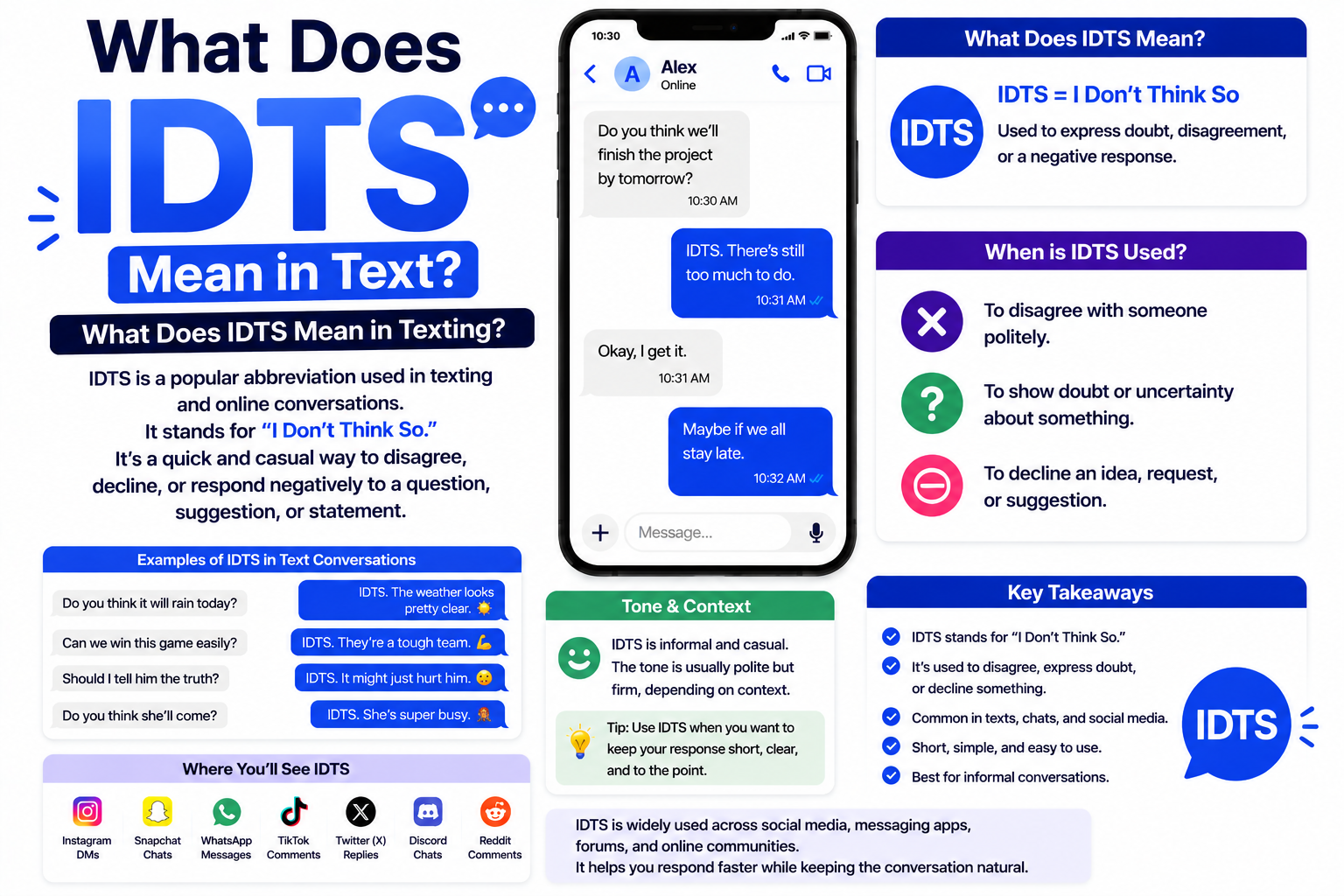
If you’ve seen IDTS in a text message, Snapchat chat, TikTok comment, Instagram DM, or online conversation, you may be wondering what it means. IDTS is a popular texting abbreviation used when someone wants to express doubt, disagreement, or uncertainty.
Because texting slang often shortens common phrases, IDTS allows people to communicate their opinions quickly without typing a full sentence.
What Does IDTS Mean in Text?
The most common meaning of IDTS is:
I Don’t Think So
People use IDTS when they disagree with something, doubt that something will happen, or aren’t convinced about a statement.
Quick Reference Table
| Meaning | Platform | Context | Example |
|---|---|---|---|
| I Don’t Think So | Text Messages | Disagreement | “Will it rain today?” “IDTS.” |
| I Don’t Think So | Snapchat | Casual response | “Are they coming?” “IDTS.” |
| I Don’t Think So | Comment reply | “IDTS that’s true.” | |
| I Don’t Think So | TikTok | Expressing doubt | “IDTS this will happen.” |
Featured Snippet Answer
IDTS stands for “I Don’t Think So.” It’s commonly used in texting and social media to express doubt, disagreement, skepticism, or uncertainty about a statement or question.
IDTS Meaning in Everyday Texting
In everyday texting, IDTS is often used as a quick response when someone doesn’t believe something is true or likely to happen.
Common Texting Examples
- “Will they win?” “IDTS.”
- “Do you think he’s serious?” “IDTS.”
- “Are we getting snow tomorrow?” “IDTS.”
- “Will she be late?” “IDTS.”
- “Do they know?” “IDTS.”
- “Is that real?” “IDTS.”
- “Will he call?” “IDTS.”
- “Are prices going down?” “IDTS.”
- “Do you think it matters?” “IDTS.”
- “Will they notice?” “IDTS.”
Why People Use IDTS
- Saves typing time
- Expresses doubt quickly
- Common in casual conversations
- Easy to understand in context
IDTS Meaning on Snapchat
On Snapchat, IDTS is frequently used in direct messages and group chats.
Common Snapchat Situations
- Discussing plans
- Talking about friends
- Responding to questions
- Sharing opinions
Snapchat Examples
Example 1
Message:
“Do you think they’re coming?”
Reply:
“IDTS.”
Meaning:
The person doesn’t believe they’re coming.
Example 2
Message:
“Will the teacher notice?”
Reply:
“IDTS.”
Meaning:
The person doubts it.
IDTS Meaning on Instagram & Twitter/X
IDTS is commonly used in comments, replies, and direct messages.
Instagram Example
“IDTS that’s the best option.”
Meaning:
The user disagrees.
Twitter/X Example
“IDTS this rumor is true.”
Meaning:
The user is skeptical.
IDTS Meaning on TikTok
TikTok users often use IDTS when reacting to videos or trends.
TikTok Examples
“IDTS that’s real.”
Meaning:
The commenter doubts the claim.
“IDTS this trend will last.”
Meaning:
The commenter doesn’t expect the trend to continue.
Why It’s Popular
- Quick expression of opinion
- Easy to type
- Useful in discussions and debates
IDTS Meaning in Relationships
In relationships, IDTS is often used to express uncertainty or disagreement.
Relationship Examples
Example 1
“Do you think they’re interested in me?”
Reply:
“IDTS.”
Meaning:
The person doesn’t think so.
Example 2
“Will we be late?”
Reply:
“IDTS.”
Meaning:
The person doubts it.
Relationship Tone
IDTS can sound:
- Honest
- Casual
- Skeptical
- Thoughtful
IDTS Meaning in Professional Communication
IDTS is generally too informal for professional communication.
Better Professional Alternatives
Instead of IDTS, use:
- I don’t believe so.
- I don’t think that’s likely.
- Probably not.
- That seems unlikely.
- I have my doubts.
Example
Instead of:
“IDTS that will work.”
Use:
“I don’t believe that approach will be effective.”
Other Possible Meanings of IDTS
While I Don’t Think So is the most common meaning, there are a few less common interpretations.
| Meaning | Context | Notes |
|---|---|---|
| I Don’t Think So | Texting & social media | Most common |
| Internal Data Tracking System | Business/technology | Rare |
| Information Decision Tracking System | Technical contexts | Uncommon |
| Custom acronym | Organization-specific | Context-dependent |
How to Interpret IDTS Based on Context
Who Is Sending It?
| Sender | Likely Meaning |
|---|---|
| Friend | I Don’t Think So |
| Partner | Doubt or disagreement |
| Social media user | Skepticism |
| Colleague | Usually context-specific |
Which Platform?
| Platform | Most Likely Meaning |
|---|---|
| Text Messages | I Don’t Think So |
| Snapchat | I Don’t Think So |
| I Don’t Think So | |
| TikTok | I Don’t Think So |
| I Don’t Think So | |
| Discord | I Don’t Think So |
What Is the Conversation About?
If someone says:
“IDTS he’ll show up.”
They mean:
“I don’t think he’ll show up.”
Tone Guide
| Tone | Meaning | Interpretation |
|---|---|---|
| Skeptical | I Don’t Think So | Doubtful |
| Casual | I Don’t Think So | Informal disagreement |
| Honest | I Don’t Think So | Genuine opinion |
| Friendly | I Don’t Think So | Light disagreement |
| Serious | I Don’t Think So | Strong doubt |
How to Reply to IDTS
Friendly Replies
- Maybe you’re right.
- We’ll see.
- Good point.
- That’s possible.
Casual Replies
- Fair enough.
- True.
- You could be right.
- Let’s find out.
Professional Replies
- Thank you for your perspective.
- That’s worth considering.
- Let’s review the evidence.
Relationship Replies
- Maybe 😊
- We’ll see what happens.
- You might be right ❤️
- That’s fair.
When Not to Use IDTS
Avoid using IDTS when:
- Writing business emails
- Preparing reports
- Academic writing
- Client communications
- Legal documents
- Formal presentations
Why Understanding IDTS Matters
Understanding IDTS helps you:
- Interpret online conversations correctly
- Recognize expressions of doubt
- Respond appropriately
- Avoid misunderstandings
- Improve digital communication skills
Because IDTS often signals skepticism, understanding the tone is important.
Alternatives to IDTS
| Instead of IDTS | Use This |
|---|---|
| IDTS | I don’t think so |
| IDTS | Probably not |
| IDTS | Unlikely |
| IDTS | I doubt it |
| IDTS | I don’t believe so |
| IDTS | Doesn’t seem likely |
| IDTS | Not really |
| IDTS | I’m skeptical |
| IDTS | I have doubts |
| IDTS | We’ll see |
5 Real-Life Scenarios
Scenario 1
Original Message
“Do you think it’ll rain?”
Reply
“IDTS.”
Interpretation
The person doesn’t think it will rain.
Suggested Reply
“Hopefully you’re right.”
Scenario 2
Original Message
“Will they arrive on time?”
Reply
“IDTS.”
Interpretation
The person doubts they’ll be on time.
Suggested Reply
“We should have a backup plan.”
Scenario 3
Original Message
“Is that rumor true?”
Reply
“IDTS.”
Interpretation
The person doesn’t believe the rumor.
Suggested Reply
“Yeah, it sounds questionable.”
Scenario 4
Original Message
“Will the team win?”
Reply
“IDTS.”
Interpretation
The person doubts the team will win.
Suggested Reply
“We’ll find out soon.”
Scenario 5
Original Message
“Do you think they noticed?”
Reply
“IDTS.”
Interpretation
The person doesn’t think they noticed.
Suggested Reply
“That’s good then.”
Quick Reference Cheat Sheet
| Platform | Meaning |
|---|---|
| Text Messages | I Don’t Think So |
| Snapchat | I Don’t Think So |
| I Don’t Think So | |
| TikTok | I Don’t Think So |
| Twitter/X | I Don’t Think So |
| I Don’t Think So | |
| Discord | I Don’t Think So |
| Group Chats | I Don’t Think So |
FAQs
What does IDTS mean in text?
IDTS means “I Don’t Think So.”
What does IDTS mean on Snapchat?
It usually means “I Don’t Think So.”
What does IDTS mean on TikTok?
It’s commonly used to express doubt or skepticism.
Is IDTS slang?
Yes, it’s a texting abbreviation and internet slang term.
What does IDTS mean from a girl?
Usually the same meaning: “I Don’t Think So.”
Is IDTS rude?
Not necessarily. It’s generally a polite way to disagree or express doubt.
Can IDTS be used professionally?
It’s best to avoid it in formal communication.
Why do people use IDTS?
To quickly express doubt, disagreement, or uncertainty.
Is IDTS common on social media?
Yes, especially in texting, Snapchat, TikTok, and Instagram.
How should I respond to IDTS?
Acknowledge their opinion, discuss the topic further, or provide additional information.
Conclusion
The IDTS meaning in text is “I Don’t Think So.” It’s a popular texting abbreviation used to express doubt, skepticism, disagreement, or uncertainty in conversations.
To understand IDTS correctly, consider:
- The platform
- The sender
- The conversation topic
- The overall tone
In most texting and social media conversations, IDTS simply means “I Don’t Think So” and serves as a quick, casual way to share an opinion or express doubt about something.