
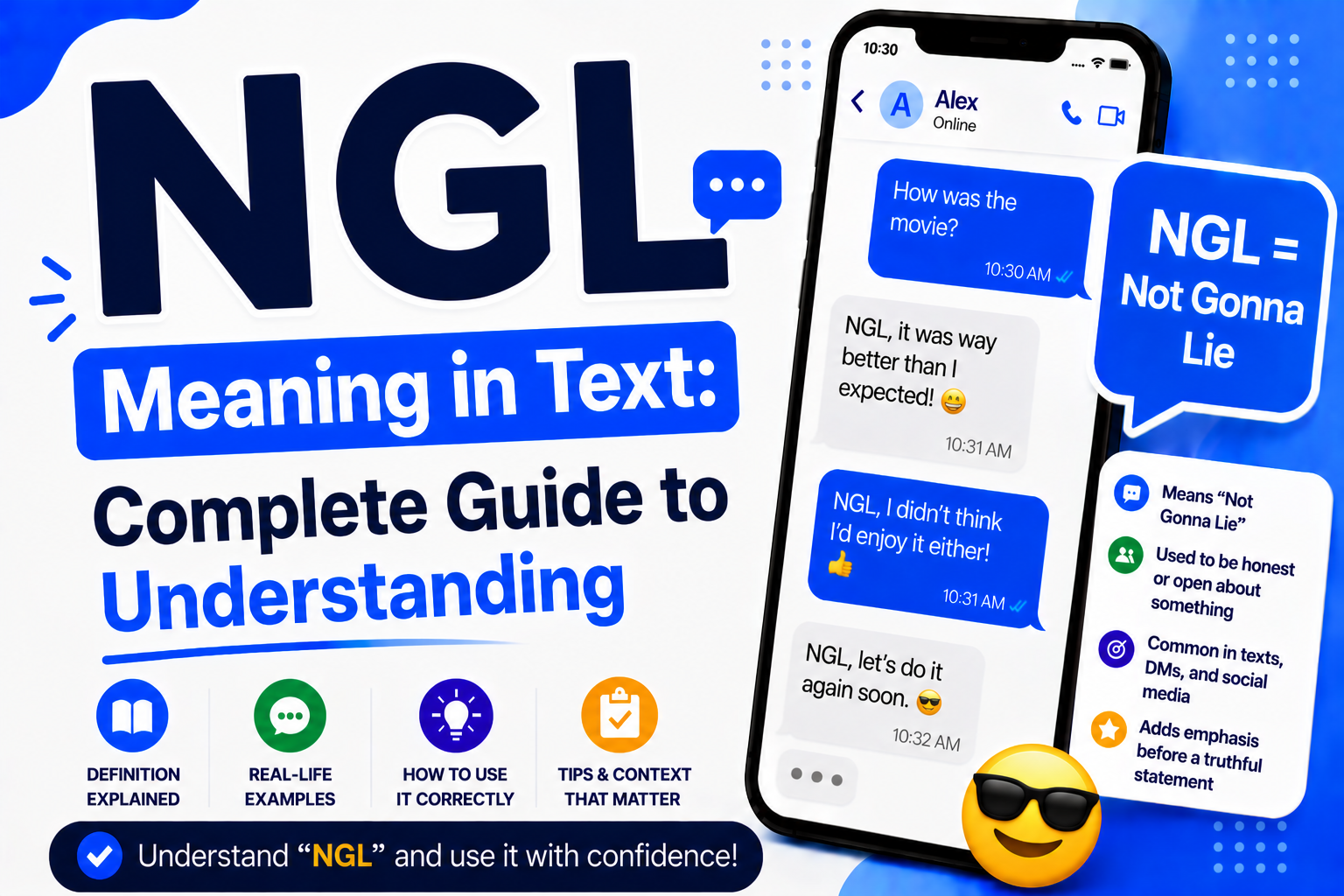
NGL is the internet’s honesty badge. Short for “not gonna lie,” those three letters do something remarkable: they make whatever comes next sound more believable. Preface an opinion with “ngl” and it lands like a confession; say the same thing without it and it’s just another take. Nobody appointed NGL the arbiter of sincerity — it earned the job one group chat at a time.
The trick is that “not gonna lie” implies everything else might be a lie. It’s a small verbal contract: I’m dropping the filter, here’s the real thing. Whether people are actually more honest after typing it is debatable. That everyone believes they are is what matters.
In this guide: what NGL really signals, the psychology of the “honesty hedge,” how it differs from TBH, the anonymous app sharing its name, and when the badge backfires.
What Does NGL Mean in Text?
Quick answer: NGL stands for “not gonna lie.” People type it before an honest opinion, confession, or unfiltered thought — it signals “I’m being real with you right now.”
| Term | NGL |
| Stands for | “Not Gonna Lie” |
| Tone | Casual, confessional, sincere |
| Where you’ll see it | Texts, TikTok, X/Twitter, group chats, dating apps |
| Safe for work or school? | Casual settings only |
The Honesty Hedge: Why “NGL” Works
Linguists call words like this “discourse markers” — little flags that tell you how to read what follows. “NGL” is a hedge and a booster at once: it hedges (“this is just my honest take”) while boosting credibility (“I’m being straight with you”). That’s why it softens criticism: “ngl, that didn’t work” stings less than “that didn’t work,” because the preface frames it as reluctant truth-telling rather than an attack.
There’s a paradox baked in: flagging your honesty can make everything else you say sound less honest by comparison. Use it deliberately, not by default — the badge only works if you don’t hand it out to every sentence.
The Anatomy of an NGL Sentence
NGL is flexible — it works at the front, middle, or end of a sentence, and each position feels different:
- Front: “Ngl, that was amazing.” The classic setup — a drumroll for honesty.
- Middle: “That was, ngl, amazing.” A mid-sentence aside; more conversational.
- End: “That was amazing, ngl.” The honesty lands as an afterthought — casual, almost throwaway.
Front-loaded NGL dominates in writing; spoken conversation favors the middle and end positions, where it sounds like thinking out loud.
NGL vs. TBH: The Sibling Rivalry
TBH (“to be honest”) is NGL’s older sibling, and they’re often interchangeable — but they feel different. TBH is slightly more formal, the one millennials reach for; NGL is looser, more confessional, more Gen Z. “Tbh, I agree” reads as measured. “Ngl, I agree” reads as a whisper. TBH introduces opinions; NGL introduces secrets. In practice, most people pick one and never switch — your choice says which internet generation raised you.
| NGL | TBH | |
| Stands for | Not gonna lie | To be honest |
| Vibe | Confessional, Gen Z | Measured, millennial |
| Best for | Secrets, hype, softening blows | Opinions, assessments |
How People Actually Use NGL
1. Softening an opinion. “Ngl, I didn’t love the movie.” Honesty with a cushion.
2. Hyping something. “NGL this is the best thing I’ve ever eaten.” Enthusiasm, certified genuine.
3. Confessing. “Ngl, I was nervous the whole time.” Vulnerability, unlocked.
4. Breaking news gently. “Ngl, we need to talk.” The preface does heavy lifting — this one makes stomachs drop.
5. Agreeing hard. “Ngl, you’re so right.” Agreement with feeling.
6. Low-stakes honesty. “Ngl, I have no idea what we’re talking about.” Disarming and funny.
NGL in the Wild
- TikTok captions: “ngl this made my day” — sincerity as content strategy.
- X hot takes: “ngl, unpopular opinion but…” — the classic take-announcement format.
- Group chats: confessions, reviews, and 2 a.m. honesty.
- Dating apps: “ngl, your profile made me laugh” — flirting with a credibility boost.
- Comment sections: “ngl, this deserves more views” — the sincerity upvote.
Reading the Tone
- Confessional: “ngl, I’ve been struggling” — treat it as trust.
- Hype: “NGL THIS IS INSANE” — all-caps enthusiasm, no nuance needed.
- Softening: “ngl, not my favorite” — criticism wearing a seatbelt.
- Ominous: “ngl, we need to talk” — brace yourself.
- The comma rule: “ngl,” with a comma usually introduces something real; “NGL” in all caps usually introduces something loud.
When NGL Backfires
- The honesty paradox: if you “ngl” everything, nothing sounds honest. Save it for actual honesty.
- Serious news: “ngl, he didn’t make it” — some moments need plain words, not slang.
- Apologies: “ngl, I’m sorry” accidentally implies you might not be.
- Professional settings: it reads as unserious even when you mean it sincerely.
- Overuse: like “literally,” it fades into noise if every sentence starts with it.
The Other NGL: The Anonymous App
NGL also names a popular anonymous Q&A app (ngl.link) where users post a link on Instagram and receive anonymous questions and messages. If someone says “send me an NGL,” they might mean the app, not the abbreviation. Context tells you: “answer my NGLs” means the app; “ngl, that’s wild” means the slang. The app’s name is itself a play on the abbreviation — anonymous honesty as a product.
What to Say Instead of NGL
| Instead of | Try | When |
| NGL | “Honestly,” | Any honest opinion |
| NGL | “To be real,” | Casual sincerity |
| NGL | “Full disclosure:” | Confessions with humor |
| NGL | “Real talk?” | Setting up a serious point |
| NGL | (nothing) | When the opinion is strong enough alone |
NGL FAQs
What does NGL stand for?
“Not gonna lie.”
Is NGL rude?
No — it’s one of the friendliest abbreviations. It signals sincerity, not attitude.
Is NGL passive-aggressive?
Rarely. Unlike some hedges, NGL usually signals genuine warmth. “Ngl, great job” is a compliment, not a dig.
What’s the difference between NGL and TBH?
Mostly generational flavor. NGL is more casual and confessional; TBH is slightly more measured. They overlap heavily.
Do older people use NGL?
Increasingly, yes — it’s crossed into mainstream texting. But heavy NGL users still skew young; your dad’s “ngl” is usually ironic.
What is the NGL app?
An anonymous Q&A app (ngl.link) popular on Instagram for receiving anonymous questions from followers.
Can I use NGL at work?
In casual team chat, sparingly. In emails or formal writing, use “honestly” or “to be candid” instead.
The Bottom Line
NGL is a tiny credibility machine: three letters that make honesty sound honest. Use it when you mean it, retire it when you don’t — and remember that the most believable thing you can type is the truth without a preface.