

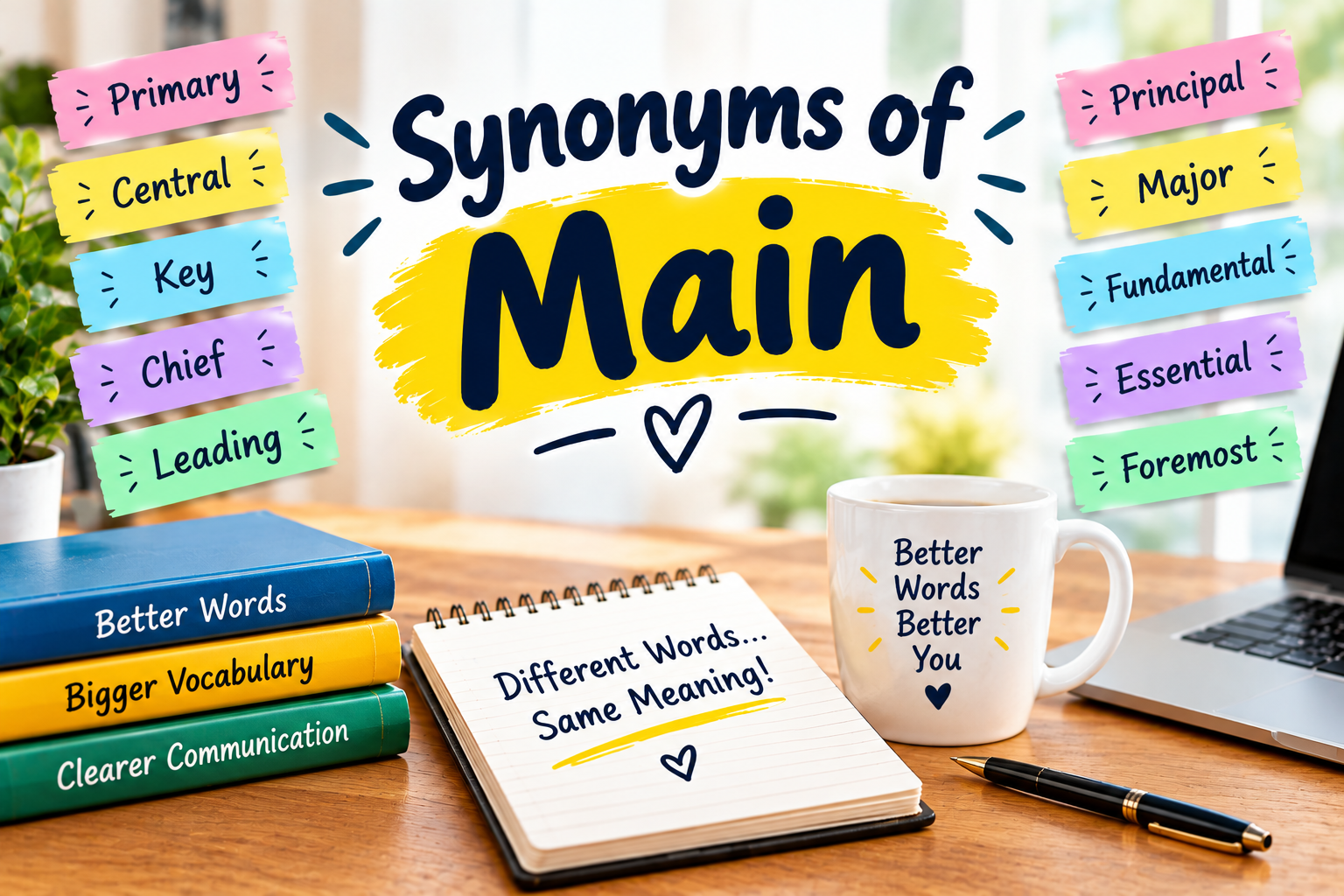
The word “main” is one of the most useful words in English. We use it to describe something that is most important, central, primary, or prominent. You can talk about the main reason, main idea, main character, main goal, main problem, or main source.
However, repeating “main” too often can make your writing sound repetitive. Fortunately, English has many alternatives, and each one can emphasize a slightly different idea.
For example, primary suggests first or highest importance, central emphasizes something at the center of an idea, chief highlights importance or leadership, while key suggests something essential to understanding or achieving a result.
This guide covers 70+ synonyms for main, including formal, academic, professional, conversational, and context-specific alternatives. You will also find examples for essays, resumes, business writing, IELTS, everyday English, and common phrases such as “main reason” and “main source.”
What Does “Main” Mean?
Main generally means the most important, primary, central, or significant part of something.
For example:
- Main reason = the most important reason
- Main idea = the central idea
- Main goal = the primary objective
- Main character = the central character
- Main problem = the most important problem
- Main source = the primary source
- Main road = the principal or major road
The exact synonym depends on what “main” describes.
Quick Reference: Synonyms for Main
| Synonym | Meaning | Example |
|---|---|---|
| Primary | First or most important | The primary goal is quality. |
| Principal | Most important or influential | The principal reason was cost. |
| Chief | Highest in importance | Safety is our chief concern. |
| Central | At the center of importance | Trust is central to the relationship. |
| Key | Crucial or essential | Communication is a key factor. |
| Major | Significant or important | This is a major issue. |
| Leading | Most prominent or influential | She is a leading researcher. |
| Core | Essential central part | Trust is the core value. |
| Fundamental | Basic and essential | Education is fundamental to development. |
| Foremost | Most important or prominent | Safety is the foremost priority. |
| Paramount | More important than anything else | Security is paramount. |
| Dominant | Most powerful or influential | The dominant theme is freedom. |
| Pivotal | Extremely important to an outcome | His decision was pivotal. |
| Predominant | Most common or influential | The predominant view has changed. |
| Essential | Absolutely necessary | Sleep is essential for health. |
70+ Synonyms for “Main”
Here are useful alternatives, with their meanings and example sentences.
| # | Synonym | Meaning | Example |
|---|---|---|---|
| 1 | Primary | First or most important | The primary objective is customer satisfaction. |
| 2 | Principal | Most important or influential | The principal cause was poor planning. |
| 3 | Chief | Most important or highest-ranking | Her chief concern was safety. |
| 4 | Central | Most important or at the center | This is a central issue in the debate. |
| 5 | Key | Crucial or essential | Communication is a key factor. |
| 6 | Major | Significant in importance or size | Cost is a major consideration. |
| 7 | Leading | Most prominent or influential | He is a leading expert in the field. |
| 8 | Core | Essential central part | Trust is the core of the relationship. |
| 9 | Fundamental | Basic and essential | Freedom is a fundamental principle. |
| 10 | Foremost | Most important or prominent | Safety is the foremost priority. |
| 11 | Paramount | Of the highest importance | Public safety is paramount. |
| 12 | Dominant | Most powerful or influential | The dominant theme is equality. |
| 13 | Pivotal | Critically important | Her decision was pivotal. |
| 14 | Predominant | Most common or influential | The predominant opinion was positive. |
| 15 | Essential | Absolutely necessary | Preparation is essential for success. |
| 16 | Vital | Extremely important or necessary | Clean water is vital. |
| 17 | Significant | Important or meaningful | This is a significant development. |
| 18 | Salient | Particularly noticeable or important | The salient point is affordability. |
| 19 | Prime | Of first importance | Our prime objective is growth. |
| 20 | Overriding | More important than competing concerns | Cost was the overriding issue. |
| 21 | Crucial | Extremely important | Timing is crucial to the project. |
| 22 | Critical | Necessary for success or stability | Security is a critical concern. |
| 23 | Notable | Worthy of attention | The project achieved notable results. |
| 24 | Prominent | Important and noticeable | The building occupies a prominent position. |
| 25 | Foremost | Highest in importance | Her foremost priority was her family. |
| 26 | Supreme | Highest in rank or importance | The court has supreme authority. |
| 27 | Preeminent | More important or distinguished than others | He is a preeminent scholar. |
| 28 | Predominant | Most widespread or influential | The predominant factor was price. |
| 29 | Underlying | Existing beneath or supporting something | The underlying cause was poor communication. |
| 30 | Foundational | Forming a basic foundation | Trust is foundational to teamwork. |
| 31 | Cornerstone | Fundamental supporting element | Education is a cornerstone of development. |
| 32 | Backbone | Main support or structure | Small businesses are the backbone of the economy. |
| 33 | Heart | Most important or central part | This is the heart of the problem. |
| 34 | Essence | Most basic or central quality | Simplicity is the essence of the design. |
| 35 | Nucleus | Central or essential part | The research team became the nucleus of the project. |
| 36 | Crux | Most important point | The crux of the matter is timing. |
| 37 | Focus | Central point of attention | The main focus is now sustainability. |
| 38 | Emphasis | Something given special importance | The emphasis is on quality. |
| 39 | Priority | Something treated as more important | Customer safety is the top priority. |
| 40 | Top | Highest in importance | This is a top concern. |
| 41 | Primary | First in order or importance | The primary source provided the evidence. |
| 42 | Major | Important or large-scale | It became a major challenge. |
| 43 | Principal | Chief or leading | The principal objective is efficiency. |
| 44 | Central | Closely connected to the central idea | Equality is central to the discussion. |
| 45 | Leading | At the forefront | The company is a leading provider. |
| 46 | Foremost | Most prominent | He is one of the foremost experts. |
| 47 | Paramount | Highest priority | Accuracy is paramount. |
| 48 | Pivotal | Decisive or crucial | The discovery played a pivotal role. |
| 49 | Dominant | Controlling or strongest | The dominant market trend is digitalization. |
| 50 | Integral | Necessary to make something complete | Teamwork is integral to success. |
| 51 | Indispensable | Absolutely necessary | Her experience was indispensable. |
| 52 | Fundamental | Basic and necessary | These are fundamental principles. |
| 53 | Decisive | Producing a definite result | His vote was decisive. |
| 54 | Influential | Having strong influence | She was an influential figure. |
| 55 | Substantial | Large or important | The company made substantial investments. |
| 56 | Considerable | Significant in size or importance | Considerable attention was given to the issue. |
| 57 | Weighty | Important or serious | The committee discussed several weighty matters. |
| 58 | Material | Relevant and significant | The report identified material changes. |
| 59 | Relevant | Directly connected to the subject | Focus on the most relevant evidence. |
| 60 | Strategic | Important to a larger plan | This is a strategic priority. |
| 61 | Driving | Providing the main force behind something | Innovation is a driving factor. |
| 62 | Guiding | Providing direction | These are the guiding principles. |
| 63 | Defining | Characterizing something strongly | It became a defining moment. |
| 64 | Primary-level | Relating to the first or main level | The primary-level objective is clear. |
| 65 | Principal-level | Relating to the highest or main level | The principal concern remains cost. |
| 66 | Head | Chief or leading | He is the head researcher. |
| 67 | Flagship | Most important or representative | This is the company’s flagship product. |
| 68 | Signature | Most characteristic or representative | It is the restaurant’s signature dish. |
| 69 | Landmark | Especially important or significant | The ruling was a landmark decision. |
| 70 | Central-most | At the very center | The central-most idea concerns equality. |
What Is Another Word for Main?
Some of the most natural alternatives to main are:
- Primary
- Principal
- Chief
- Central
- Key
- Major
- Leading
- Core
- Fundamental
- Foremost
- Important
- Crucial
- Essential
- Pivotal
The right option depends on the sentence.
For example:
Main goal → Primary goal
Main reason → Principal reason
Main character → Central character
Main concern → Chief concern
Main factor → Key factor
This is more effective than treating every synonym as interchangeable.
Synonyms for Main in an Essay
Academic writing often benefits from replacing repeated uses of “main” with more precise words.
| Common Phrase | Academic Alternative |
|---|---|
| Main idea | Central idea |
| Main argument | Principal argument |
| Main reason | Primary reason |
| Main point | Key point |
| Main objective | Primary objective |
| Main cause | Principal cause |
| Main factor | Key factor |
| Main issue | Central issue |
| Main purpose | Primary purpose |
| Main finding | Principal finding |
| Main concern | Primary concern |
| Main difference | Key difference |
Example
Instead of:
The main reason for this change is technology.
You could write:
The primary reason for this change is technological development.
Or:
The principal factor behind this change is technological development.
Main Synonyms for IELTS Writing
For IELTS and other academic writing, useful alternatives include:
- Primary
- Principal
- Central
- Fundamental
- Key
- Major
- Significant
- Predominant
- Crucial
- Essential
- Pivotal
- Leading
Example
Basic:
The main cause of pollution is industrial activity.
More formal:
The primary cause of pollution is industrial activity.
Another option:
Industrial activity is a major contributor to pollution.
Using precise vocabulary is generally more useful than simply choosing the most complicated word.
Synonyms for Main Reason
“Main reason” is one of the most common phrases in English.
Possible alternatives include:
- Primary reason
- Principal reason
- Chief reason
- Key reason
- Major reason
- Leading reason
- Main cause
- Primary cause
- Principal cause
- Underlying reason
- Fundamental reason
- Driving factor
Examples
The primary reason for the delay was bad weather.
Cost was the principal reason for the decision.
Lack of preparation was the underlying cause of the problem.
Customer demand was the driving factor behind the change.
Synonyms for Main Idea
The phrase main idea can be replaced with:
- Central idea
- Core idea
- Key idea
- Principal idea
- Central concept
- Core concept
- Main concept
- Central theme
- Primary message
- Key message
- Essence
Example
The central idea of the article is that consistency matters more than speed.
In academic writing, central idea, key argument, and core concept are particularly useful.
Synonyms for Main Point
Common alternatives include:
- Key point
- Central point
- Principal point
- Core point
- Essential point
- Crucial point
- Salient point
- Central argument
- Key argument
- Main takeaway
Example
The key point is that the policy affects different groups differently.
Synonyms for Main Goal
You can replace “main goal” with:
- Primary goal
- Principal goal
- Main objective
- Primary objective
- Core objective
- Central objective
- Key objective
- Primary aim
- Principal aim
- Ultimate goal
- Chief objective
Example
Our primary objective is to improve customer satisfaction.
For professional writing, primary objective and key objective are especially natural.
Synonyms for Main Objective
The most useful alternatives are:
- Primary objective
- Principal objective
- Central objective
- Key objective
- Core objective
- Chief objective
- Primary aim
- Main purpose
- Central purpose
Example:
The primary objective of the study is to examine consumer behavior.
Synonyms for Main Character
In literature and storytelling, “main character” has several alternatives:
- Central character
- Principal character
- Lead character
- Leading character
- Protagonist
- Hero
- Heroine
- Central figure
- Main protagonist
Example
The protagonist struggles to understand her past.
Protagonist is particularly useful when discussing fiction, although it does not always mean the same thing as “main character” in every context.
Synonyms for Main Source
Depending on the meaning, you can use:
- Primary source
- Principal source
- Chief source
- Leading source
- Primary origin
- Main provider
- Principal provider
- Major source
- Key source
Examples
The report relies on primary sources.
Solar power is becoming a major source of renewable energy.
The company is the region’s leading supplier.
Synonyms for Main Problem
Useful alternatives include:
- Primary problem
- Principal problem
- Central problem
- Key problem
- Major problem
- Core problem
- Fundamental problem
- Critical issue
- Central issue
- Primary concern
- Main challenge
- Major challenge
Example
The central problem is a lack of reliable information.
Or:
The underlying issue is poor communication.
Synonyms for Main Concern
You can use:
- Primary concern
- Chief concern
- Principal concern
- Central concern
- Key concern
- Major concern
- Core concern
- Main priority
- Leading concern
- Overriding concern
Example:
Safety remains the primary concern.
For a formal report, primary concern usually sounds natural and professional.
Synonyms for Main Focus
Good alternatives include:
- Central focus
- Primary focus
- Main emphasis
- Key focus
- Core focus
- Principal focus
- Central priority
- Primary area of focus
Example:
The central focus of the study is consumer behavior.
Synonyms for Main Feature
Depending on context, use:
- Key feature
- Principal feature
- Primary feature
- Central feature
- Defining feature
- Distinguishing feature
- Notable feature
- Signature feature
- Highlight
- Major feature
Example:
The camera is one of the phone’s key features.
Synonyms for Main Topic
Possible alternatives include:
- Central topic
- Primary topic
- Key topic
- Principal topic
- Core topic
- Main subject
- Central subject
- Primary subject
- Focus
- Area of focus
Example:
Climate change is the central topic of the discussion.
Synonyms for Main Event
Depending on context, alternatives include:
- Central event
- Principal event
- Major event
- Key event
- Primary event
- Featured event
- Highlight event
- Headline event
- Main attraction
Example:
The awards ceremony was the featured event of the evening.
Synonyms for Main Road
When “main” describes a road, it can mean a major or principal route rather than simply “important.”
Useful alternatives include:
- Main route
- Principal road
- Major road
- Primary road
- Main street
- Central road
- Major thoroughfare
- Principal route
- Arterial road
Example:
The principal road connects the town to the highway.
For everyday speech, main road remains more natural than many of these alternatives.
Synonyms for Main Character in a Story
| Term | Typical Meaning |
|---|---|
| Protagonist | Central character driving the story |
| Lead character | Primary character |
| Central character | Character at the center of the narrative |
| Principal character | Major character |
| Hero | Central heroic character |
| Heroine | Female central heroic character |
| Central figure | Important figure in the story |
Not all of these are exact equivalents. For example, a protagonist does not necessarily have to be heroic.
Formal Synonyms for Main
If you need a more formal alternative, consider:
- Principal
- Primary
- Paramount
- Foremost
- Predominant
- Fundamental
- Pivotal
- Significant
- Central
- Chief
- Crucial
- Essential
- Preeminent
Example
Informal:
The main objective is to reduce costs.
Formal:
The primary objective is to reduce costs.
More formal:
The principal objective is to reduce costs.
Professional Synonyms for Main
Professional writing often uses:
- Primary
- Key
- Principal
- Central
- Major
- Strategic
- Core
- Critical
- Essential
- Leading
- Fundamental
Examples:
Our key priority is customer retention.
The primary objective is operational efficiency.
This is a strategic priority for the company.
Communication is a core component of the process.
Synonyms for Main in Business
Business writing frequently uses words such as:
- Primary
- Principal
- Key
- Core
- Major
- Strategic
- Leading
- Dominant
- Central
- Critical
- Driving
Examples
Customer retention is a key priority.
Innovation is a core component of our strategy.
Cost reduction is a strategic objective.
The company is a leading provider in the industry.
Synonyms for Main in a Resume
On a resume, precise wording is generally more effective than repeatedly using “main.”
Instead of:
Main responsibility: managing the marketing team.
Use:
Primary responsibility: managing the marketing team.
Instead of:
Main achievement was increasing sales.
Use:
Key achievement: increased sales by 25%.
Useful resume alternatives include:
- Primary
- Key
- Core
- Principal
- Leading
- Major
- Strategic
- Critical
- Central
Synonyms for Main in Everyday English
In casual conversation, natural choices include:
- Key
- Major
- Important
- Primary
- Central
- Top
- Biggest
- Chief
- Core
Examples:
“What’s the main problem?”
“What’s the biggest problem?”
“What’s the key issue?”
“What’s the central issue?”
All can work, but they create slightly different tones.
Main vs. Primary
Main and primary are close in meaning, but primary often sounds more formal and can emphasize first position or priority.
The main objective is efficiency.
The primary objective is efficiency.
Both are natural.
Primary is especially common in academic, professional, and technical writing.
Main vs. Principal
Principal often means the highest-ranking, most important, or chief element.
The main reason was cost.
The principal reason was cost.
Both work, but principal is generally more formal.
Be careful not to confuse principal with principle. A principle is a rule, belief, or fundamental idea.
Main vs. Central
Central emphasizes being at the center of an idea, situation, system, or discussion.
Trust is the main issue.
Trust is central to the issue.
The second emphasizes that trust is deeply connected to the subject.
Main vs. Key
Key means crucial or essential to a result.
Communication is the main factor.
Communication is a key factor.
“Key” is extremely common in business and everyday professional writing.
Main vs. Chief
Chief means highest in importance or rank.
Her main concern was safety.
Her chief concern was safety.
“Chief” can sound more formal or authoritative.
Main vs. Major
Major means important, significant, or large in scale.
This is the main problem.
This is a major problem.
The meanings overlap, but major emphasizes significance or scale, while main emphasizes being the primary or central element.
Main vs. Important
“Main” and “important” are related but are not exact synonyms.
Main identifies something as primary within a group or situation.
Important means something has significant value, influence, or consequence.
For example:
The main character is important to the story.
A character can be important without necessarily being the main character.
Main vs. Core
Core emphasizes the essential center or foundation of something.
Trust is the main value.
Trust is a core value.
“Core” is especially common in business, education, technology, and organizational language.
Antonyms of Main
The opposite of “main” generally describes something that is less important, secondary, peripheral, or insignificant.
| Antonym | Meaning | Example |
|---|---|---|
| Minor | Less important | It was a minor issue. |
| Secondary | Less important than the primary element | Secondary factors also mattered. |
| Peripheral | Outside the central focus | The issue was peripheral to the discussion. |
| Subordinate | Lower in importance or rank | The subordinate task came later. |
| Lesser | Lower in importance or degree | He played a lesser role. |
| Trivial | Of little importance | It was a trivial detail. |
| Insignificant | Not important or meaningful | The difference was insignificant. |
| Marginal | Small or limited in importance | The change had a marginal effect. |
| Incidental | Occurring as a minor consequence | These were incidental costs. |
| Negligible | So small that it has little effect | The impact was negligible. |
Common Mistakes When Using Synonyms for Main
Using Every Synonym as an Exact Replacement
Words such as primary, chief, central, key, major, and principal overlap with “main,” but they are not identical in every situation.
Using “Major” When You Mean “Primary”
“Major” often emphasizes size, significance, or seriousness.
The main reason
does not always mean:
The major reason.
Both can work in some contexts, but the intended meaning should determine the choice.
Confusing Principal and Principle
Principal can mean main, chief, or most important.
Principle means a rule, belief, or fundamental standard.
For example:
The principal reason was cost.
But:
Honesty is an important principle.
Using Unnecessarily Complicated Words
Words such as paramount and preeminent have their place, but they should not replace “main” simply to make writing sound advanced.
A natural sentence is usually better than an unnecessarily complex one.
Ignoring Context
“Main road,” “main character,” “main reason,” and “main idea” do not necessarily require the same synonym.
The best replacement depends on the noun being described.
Examples of “Main” in Everyday Sentences
Here are some common examples:
- The main reason I called was to ask a question.
- What is the main goal of the project?
- The main character changes throughout the story.
- Safety is our main concern.
- The main road is closed today.
- This is the main point of the discussion.
- Her main priority is completing the project.
- The main problem is a lack of funding.
- The main source of information was the official report.
- The main idea is easy to understand.
Common Phrases With “Main”
Main Idea
Meaning: the central thought or message.
Alternative: central idea
Main Reason
Meaning: the most important reason.
Alternative: primary reason
Main Goal
Meaning: the most important desired result.
Alternative: primary goal
Main Objective
Meaning: the principal aim.
Alternative: primary objective
Main Point
Meaning: the most important point.
Alternative: key point
Main Concern
Meaning: the most important worry or issue.
Alternative: primary concern
Main Source
Meaning: the primary provider or origin.
Alternative: primary source
Main Character
Meaning: the central figure in a story.
Alternative: protagonist or central character
Main Factor
Meaning: the most influential factor.
Alternative: key factor
Main Problem
Meaning: the central difficulty.
Alternative: core problem or central issue
How to Choose the Right Synonym for Main
A simple way to choose the best word is to identify what you want to emphasize.
If you mean first in importance:
Use primary.
If you mean chief or highest-ranking:
Use principal or chief.
If you mean central to the subject:
Use central or core.
If you mean crucial to success:
Use key or critical.
If you mean significant or large-scale:
Use major or substantial.
If you mean extremely important:
Use paramount, vital, or crucial.
If you mean highly influential:
Use leading or dominant.
If you mean fundamental to something:
Use essential, fundamental, cornerstone, or foundational.
This makes your vocabulary more precise without forcing unnatural synonyms into your writing.
FAQs
What is the best synonym for main?
Common and versatile alternatives include primary, principal, chief, central, key, major, core, and leading. The best choice depends on the context.
What is another word for main in an essay?
For essays, useful alternatives include primary, principal, central, key, fundamental, major, and core.
What is a formal word for main?
Formal alternatives include principal, primary, paramount, foremost, predominant, fundamental, pivotal, and preeminent.
What is a synonym for main reason?
Common alternatives are primary reason, principal reason, chief reason, key reason, major reason, underlying reason, and driving factor.
What is a synonym for main idea?
You can use central idea, core idea, key idea, principal idea, central concept, or primary message.
What is a synonym for main point?
Useful alternatives include key point, central point, principal point, core point, salient point, and main takeaway.
What is a synonym for main goal?
Try primary goal, principal goal, key objective, central objective, core objective, primary aim, or ultimate goal.
What is a synonym for main objective?
Good alternatives include primary objective, principal objective, central objective, key objective, core objective, and primary aim.
Is “major” a synonym for “main”?
Yes, major can replace “main” in many contexts. However, “major” tends to emphasize significance or scale, while “main” emphasizes primary or central importance.
Is “primary” a synonym for “main”?
Yes. Primary is one of the closest and most useful alternatives to “main,” particularly in formal and academic writing.
Is “central” a synonym for “main”?
Often, yes. Central emphasizes something that is at the center of an idea, discussion, system, or situation.
Is “important” the same as “main”?
Not exactly. Something can be important without being the main or primary element. “Main” generally identifies the central or most important element within a particular context.
How can I avoid repeating “main”?
Replace it according to the meaning you want to express. Use primary for priority, central for centrality, key for importance, principal for formal contexts, and core for an essential element.
Final Thoughts
The word “main” is simple and useful, but English offers many alternatives that can make your writing more precise.
Use primary when you mean first or highest in importance, principal when you want a formal alternative, central when something is at the heart of an idea, and key when something is crucial to an outcome.
For stronger emphasis, words such as critical, crucial, paramount, pivotal, and essential can be useful. For foundational ideas, core, cornerstone, backbone, and fundamental may communicate the meaning more accurately.
The goal is not to replace “main” every time you use it. Instead, choose the alternative that best matches the exact meaning of your sentence. That approach will make your essays, business writing, articles, emails, resumes, and everyday English clearer and more varied.