
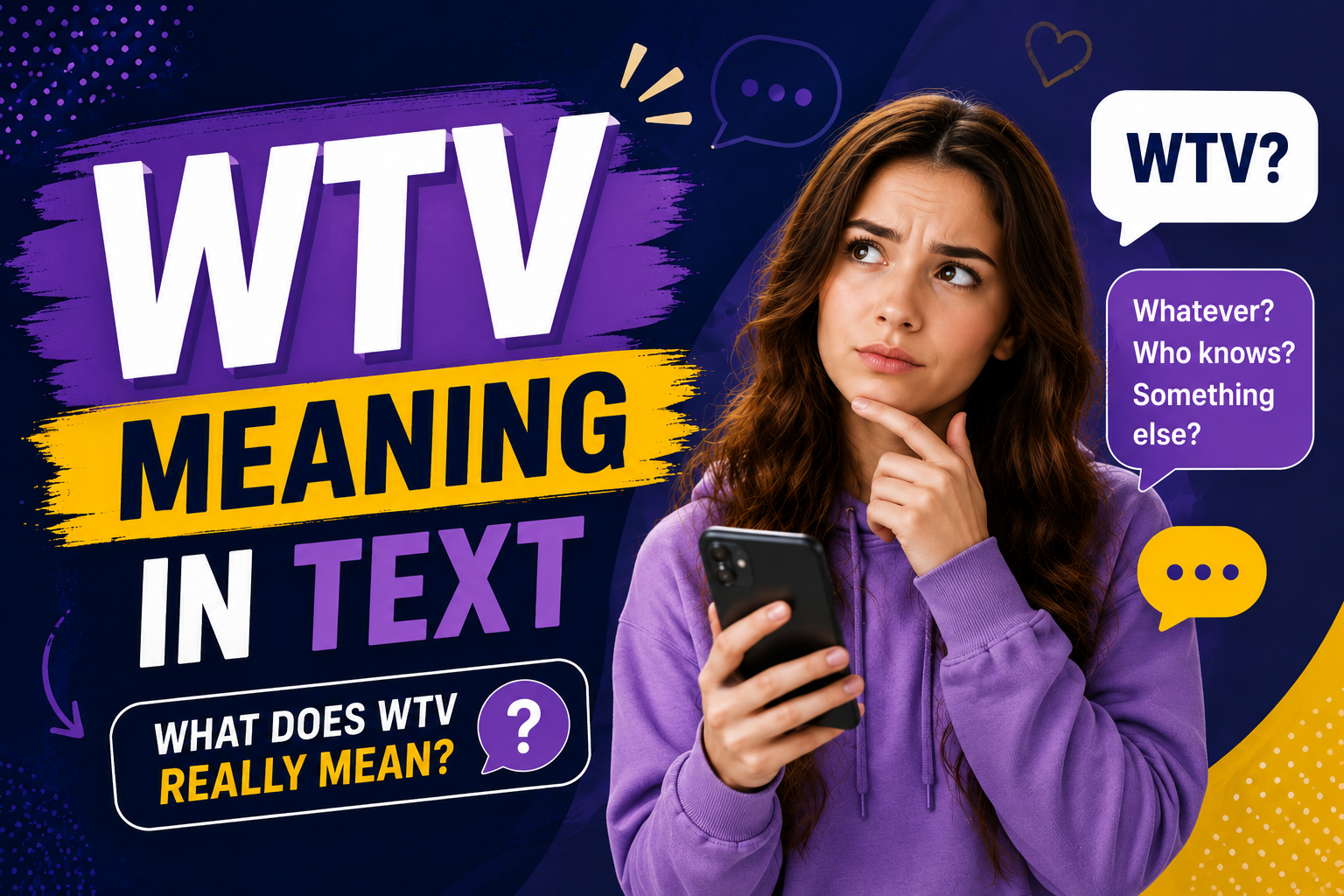
WTV is the text-message equivalent of a shrug. Three letters that stand for “whatever,” it shows up when someone genuinely doesn’t mind, can’t be bothered to choose, or has quietly checked out of the conversation. Which one it is depends entirely on tone — and that is exactly what makes this tiny abbreviation worth understanding.
Unlike older slang that arrived with a fixed dictionary definition, WTV earned its meaning through sheer repetition. It spread through group chats, Twitch streams, and TikTok comments until “whatever” started to feel too formal and “w/e” felt dated. WTV is what “whatever” sounds like when you’re typing with one thumb.
This guide breaks down what WTV means, the second meaning most people miss, how to read its tone in real conversations, and when you’re better off swapping it for something clearer.
What Does WTV Mean in Text?
Quick answer: In texting, WTV most commonly stands for “whatever.” People use it to show they have no preference, to brush something off, or to signal indifference — friendly or annoyed, depending on context.
| Term | WTV |
| Stands for | “Whatever” (most common); “What’s the vibe?” (less common) |
| Tone | Casual and indifferent — sometimes dismissive |
| Where you’ll see it | Group chats, TikTok comments, Twitch chat, Snapchat |
| Safe for work or school? | No |
Where Did WTV Come From?
“Whatever” has been a verbal shrug for decades — it was even voted one of the most annoying words in the English language in old polls. But WTV as a typed abbreviation took off in the late 2010s and early 2020s alongside fast, low-effort chat culture. On Twitch, chatters needed reactions that cost almost no keystrokes; on TikTok, “wtv” fit the short-caption mindset and comment-section speed.
It quietly replaced “w/e” the same way “ngl” replaced “tbh” in many circles — shorter, softer, and less confrontational than the full word. Nobody declared WTV a thing; millions of lazy thumbs just agreed on it at once.
How People Actually Use WTV
The meaning shifts with the sentence around it. Here are the five real ways it shows up:
1. Genuine flexibility. “Pizza or tacos?” / “Wtv, I’m starving either way.” The sender truly has no preference.
2. Handing over a decision. “What should we watch?” / “Wtv you want.” The choice is yours now.
3. Brushing something off. “Sorry I’m late, traffic was insane.” / “Wtv, you’re here now.” Translation: it’s fine, let it go.
4. Checked-out indifference. “Did you hear they changed the whole plan?” / “Wtv.” Note the period — this one ends the conversation.
5. Playful exaggeration. “Wtv, I’m literally a genius.” Ironic and self-aware, common in meme captions.
WTV vs. “Whatever”: Is There a Difference?
Technically they mean the same thing, but they feel different. “Whatever” spelled out carries more weight — it can sound like the opening line of an argument. Lowercase “wtv” reads lazier and lighter, more like a shrug than a door slam. That is why friends fire off WTV to each other all day but would almost never type it to a parent or a boss: the informality is the whole point.
The Second Meaning: “What’s the Vibe?”
Less common but real: in some group chats and TikTok circles, WTV stands for “what’s the vibe?” — as in, what’s the plan or the mood. Example: “Wtv for tonight?” means “What’s happening tonight?” Context makes it obvious. If the message is a question about plans, it’s “what’s the vibe”; if it’s a reaction to something, it’s “whatever.”
Reading the Tone: Chill or Annoyed?
Since WTV carries no tone of voice, look for these signals:
- Chill: lowercase “wtv,” paired with “haha” or an emoji, followed by more conversation.
- Annoyed: a standalone “Wtv.” with a period, or short replies after it.
- Done talking: sent mid-disagreement with nothing after it.
- Speed matters: an instant “wtv” is usually genuine; a “wtv” after ten minutes of silence is a different message entirely.
The period test is the fastest read: “wtv” keeps the chat going, “Wtv.” shuts it down.
WTV in Different Kinds of Chats
Where you type it changes what it means:
- Close friends: the default setting. “Wtv” flies constantly and nobody thinks twice.
- Family group chat: riskier. Parents often read indifference as attitude — “wtv mom” has started real arguments.
- Gaming and Discord: pure efficiency. “Wtv” between rounds means “I don’t care, queue us up.”
- Dating: dangerous. To someone you’re getting to know, “wtv” reads as low interest even when you’re just being easygoing.
- Work Slack: don’t. Even in casual startups it looks checked-out.
WTV Combos Worth Knowing
WTV rarely travels alone. These pairings change its flavor:
- “wtv lol” — softens it. “I failed the quiz wtv lol” means “it is what it is,” said with a laugh.
- “wtv bro” / “wtv dude” — bro-code for “drop it.” Usually friendly, occasionally a warning.
- “wtv wtv” — doubled for emphasis. Either extra chill or extra done, depending on the day.
- “Eh, wtv” — the verbal shrug in written form. Pure “I can’t be bothered.”
- “WTV” + shrug emoji — makes the meaning unmistakable: no strong feelings here.
When WTV Lands Wrong
- During an apology. Replying “wtv” to “I’m really sorry” can read as “I don’t care about your apology.”
- Planning with an anxious friend. “Wtv you want” dumps the entire decision on them.
- When someone is venting. “Wtv” after a long vent message feels like you didn’t read it.
- Serious topics. Around grief, health, or money, indifference reads as cold.
- Upward in age or rank. To parents, teachers, or managers it scans as disrespectful even when you don’t mean it that way.
What to Say Instead of WTV
| Instead of | Try | When |
| WTV | “Either works for me” | You genuinely don’t mind |
| WTV | “You pick — I trust your taste” | Handing over a decision warmly |
| Wtv. | “It’s fine, don’t worry about it” | Letting something go kindly |
| WTV | “I’m easy” / “Not fussed” | Casual indifference with friends |
| WTV | “Let’s just move on” | Ending a debate that’s looping |
WTV FAQs
Is WTV rude?
It can be. Among friends it’s usually harmless shorthand. With a period, mid-argument, or aimed at an authority figure, it reads as dismissive.
What does WTV mean on TikTok?
Usually “whatever,” often in comments brushing off drama. Occasionally “what’s the vibe?” when someone is asking about plans.
What’s the difference between WTV and IDC?
IDC (“I don’t care”) is blunter and almost always negative. WTV is softer — closer to “I don’t mind.”
Why do people type WTV instead of “whatever”?
Speed and softness. Three keystrokes instead of eight, and it lands lighter — less like picking a fight.
Is WTV Gen Z or Gen Alpha slang?
Firmly Gen Z. It peaked with late-2010s and early-2020s chat culture — Twitch, TikTok, Snapchat. Gen Alpha has its own vocabulary (skibidi, rizz, sigma) and would probably find WTV dated.
Should I use WTV at work or school?
No. Use “either option works for me” or “no strong preference” instead.
The Bottom Line
WTV is a shrug you can type. Used lightly, it keeps conversations moving; used carelessly, it shuts them down. Read the tone, mind the period, and when it actually matters, spell out what you mean.